
Nutra operators and their playbooks
Nutra marketing: how supplement VSL offers are built, sold and scaled
Nutra is direct response for dietary supplements: an ad, a video sales letter, an order page that sells bundles, and a back end that keeps selling. Here is how the model works, the numbers operators watch, where affiliates and networks fit, and the compliance lines that keep an offer alive.
On this page
- What does nutra mean in marketing?
- How a nutra funnel works, step by step
- Why bottle bundles drive the economics
- Who does what: offer owners, affiliates, networks and fulfillment
- Where the traffic comes from
- Creatives: why operators test formats before copy
- The VSL: leads, mechanism and proof
- The numbers nutra operators watch
- Compliance: the rules that keep a nutra offer alive
- Why so many Brazilian operators sell nutra to the US and Europe
- What the operators in this section say
- A launch checklist for your first nutra offer
- Frequently asked questions
Nutra marketing is direct-response selling of dietary supplements, mostly to cold traffic. An ad sends the visitor to a presell or straight to a video sales letter. The VSL ends on an order page that sells one, three or six bottles, and upsells, welcome calls and repeat orders carry the profit. Affiliates paid per sale bring much of the traffic, and compliance decides how long an offer lives.
What does nutra mean in marketing?
"Nutra" is short for nutraceuticals. In direct-response slang it means a supplement sold with a long-form sales message instead of a shelf and a brand campaign. The product is usually a capsule, gummy or powder. The selling is done by a VSL that explains a problem, names a mechanism and makes an offer.
The categories that come up again and again in operators' interviews are weight management, blood sugar support, joint comfort, men's health, memory and hearing. They have three things in common: a large audience that already worries about the problem, a long history of advertising, and a strict line on what the ad may claim.
That line shapes the copy. Under FDA rules, a supplement may make a structure/function statement ("supports healthy joints") if the label carries the FDA disclaimer. A statement that it diagnoses, treats, cures, prevents or mitigates a disease is a disease claim, and a product that makes one can be regulated as a drug (21 CFR 101.93). This is why nutra copy talks about "support" and mechanisms, and why the compliance section below matters as much as the creative. The two kinds of statement side by side:
Structure/function statement vs disease claim
The line FDA rules draw for dietary supplements
Allowed with the disclaimerStructure/function statement
"Supports healthy joints", if the label carries the FDA disclaimer.
- FDA must be notified within 30 days of first marketing a product that bears one.
Can make it a drugDisease claim
A statement that the product diagnoses, treats, cures, prevents or mitigates a disease.
- A product that makes one can be regulated as a drug.
- Implied disease claims count too, so swapping a disease's name for a euphemism doesn't fix a disease claim.
How a nutra funnel works, step by step
Every nutra funnel is a version of the same chain. The video sales funnel guide covers the general pattern; this is how it looks for supplements.
The nutra funnel, stage by stage
Each stage, its job and the numbers to watch
1Ad (Meta, YouTube, search)
What happens: The ad stops the right person with one promise. The numbers to watch: hook rate, CTR, cost per click.
Why it matters: The first seconds decide whether anyone hears the message at all.
What goes wrong:
- Copying a competitor's ad frame for frame is plagiarism, and networks can move commissions to the original owner when they catch it.
2Presell or advertorial (optional)
What happens: A story or an article warms colder traffic. The number to watch: click-through to the VSL.
What goes wrong:
- An article-style page that is not honestly labeled as advertising. The label is a legal requirement, not a style choice.
Read more: Presell Page: What It Is, Formats and How to Write One
3VSL
What happens: The video runs the lead, story, mechanism, proof and offer. The numbers to watch: play rate, retention to the pitch, CTA clicks.
Why it matters: The first minute or two (the lead) decides whether the viewer stays for the mechanism and the offer.
What goes wrong:
- A claim backed by evidence that would satisfy a viewer but not a regulator.
4Order page
What happens: The page offers one, three or six bottles and the guarantee. The numbers to watch: conversion rate, average order value.
Why it matters: Bundles raise the order value, and that is what lets the offer pay for cold traffic.
What goes wrong:
- An invented "retail price" is a deceptive reference price: anchor prices only against prices you really charge.
- The bundle that sells best isn't always the most profitable once refunds arrive, so track refunds by bundle.
Read more: VSL Offer: How to Build and Present the Offer Stack
5Upsells
What happens: The buyer is offered more units, a related product or a guide. The numbers to watch: take rate, order value added.
Why it matters: Bundles and upsells move the average order value more than conversion rate does.
What goes wrong:
- Judging an upsell by its take rate alone instead of the order value it adds.
Read more: Upsell Funnel: Order Bumps, Upsells and Downsells
6Back end
What happens: A welcome call, follow-up and repeat orders keep selling after the first order. The numbers to watch: repeat rate, refund rate, lifetime value.
Why it matters: A physical product ships, so the buyer can be called, upsold and asked to reorder. Several operators in this section describe businesses where the back end decides the profit.
What goes wrong:
- Refunds and chargebacks hide behind a good front-end ROAS for weeks.
The presell is optional. Some offers send ad traffic straight to the VSL; others put a presell page or an advertorial in front when the audience needs warming up first. The VSL itself follows the classic structure covered in the VSL script guide, and the order page follows the logic of a VSL offer stack.
What makes nutra different from most info products is what happens after the sale. A physical product ships, so the buyer can be called, upsold and asked to reorder. Several operators in this section describe businesses where the back end decides the profit and the front end only has to break even, or close to it.
Why bottle bundles drive the economics
The order page almost always sells bundles: one bottle, three bottles, six bottles, with the price per bottle falling as the bundle grows. The reason is order value. With the illustrative prices used below, the price per bottle drops like this:
The price per bottle falls as the bundle grows
Illustrative prices from the worked example below
A worked example, with illustrative prices: one bottle at $69, three at $177 ($59 each) and six at $294 ($49 each). Out of 100 orders, 30 take one bottle, 40 take three and 30 take six.
- Revenue: 30 × $69 + 40 × $177 + 30 × $294 = $2,070 + $7,080 + $8,820 = $17,970
- Average order value: $17,970 / 100 = $179.70
If everyone bought a single bottle, the average order would be $69. The bundle mix lifts it about 2.6 times, and that is what lets the offer pay for cold traffic. Now add one upsell, say a $97 companion product taken by 30% of buyers. That adds $29.10 per order, so the average order becomes $208.80.
Next, find the most you can pay for a customer. Keep the same illustrative order: $40 of product and shipping per order, 10% payment and platform fees ($20.88), and an 8% reserve for refunds ($16.70). That leaves about $131.20 before advertising. If you want $40 of margin per order on the front end, your cost per acquisition (CPA) ceiling is about $91.
Two cautions. First, anchor prices only against prices you really charge; an invented "retail price" is a deceptive reference price (see VSL compliance). Second, the bundle that sells best isn't always the most profitable once refunds arrive. Track refunds by bundle, not just in total.
Who does what: offer owners, affiliates, networks and fulfillment
A nutra offer usually involves four parties.
- The offer owner (Brazilians call them the producer) owns the product, the VSL, the funnel, customer service and compliance.
- Affiliates buy traffic and send it to the offer through tracked links, and they are paid per sale. Large offers can have hundreds or thousands of them.
- Networks and marketplaces such as ClickBank, Digistore24 and BuyGoods track the sales, pay the affiliates and review the offers. Operators describe network reviewers asking for wording changes before an offer can run.
- Fulfillment companies supply ready-made or custom formulas and ship the orders. ShipOffers, for example, lists more than 50 on-demand health and beauty products, custom formulation, and pick, pack and ship from hubs in Colorado, Tennessee and the EU (ShipOffers services). Its events page shows how hard it courts sellers in Brazil: São Paulo events with Digistore24 in May 2024 and with BuyGoods in November 2024, plus the Afiliados Brasil conference every year (ShipOffers events).
CPA or revenue share?
Affiliates are paid one of two ways, and the choice decides who carries the risk.
Revenue share vs CPA
How each affiliate deal pays, and who carries the risk
Revenue share
- How it pays: a percentage of each sale, sometimes including upsells and rebills
- Refunds and chargebacks: shared with the affiliate
- Back-end upside: the affiliate gets a share
- Who prefers it: owners with thin margins, newer affiliates
CPA (cost per acquisition)
- How it pays: a fixed amount per new customer
- Refunds and chargebacks: carried by the offer owner
- Back-end upside: the offer owner keeps it
- Who prefers it: affiliates with volume, owners with a strong back end
Guilherme Bifi, who made his first real progress as an affiliate, explained in an interview why he pushed for CPA: the payout stops shrinking with refunds and chargebacks, and he frames the deal as selling a lead to the owner. An owner can afford a high fixed payout when the back end is worth more than the first order. An owner who can't predict the back end shouldn't offer CPA. An owner who can often finds it is the fastest way to recruit the affiliates with real volume.
Where the traffic comes from
Meta (Facebook and Instagram) is the largest source for most offers. With broad targeting the creative does the targeting, so the work is mostly creative testing. Most buyers test new ads with ad set budgets (ABO) and scale winners under Meta's Advantage campaign budget (CBO), which moves spend between ad sets in real time (Meta for Developers). The trade-offs are in CBO vs ABO, and the tracking setup is in Facebook ads for a VSL.
YouTube and Google carry in-stream video ads, and many affiliates run search ads on product names, catching people who have already seen the offer and gone looking for it. Read each offer's terms before you bid on its name: owners and networks set their own rules on brand bidding.
Native ads and advertorials put an article-style page between the ad and the VSL. They work when they are honestly labeled as advertising, which is a legal requirement, not a style choice (the advertorial guide covers it).
Email plays two roles. It is a traffic source in its own right, and some operators use rented lists to validate a new offer cheaply before they spend on paid social.
Creatives: why operators test formats before copy
The creative is where nutra offers win or lose, and the operators in this section agree on one thing: format beats wording. A proven message in a fresh format (a reaction video, a podcast-style clip, motion text, a casual phone recording) often beats a better-written ad in a tired one, because the first seconds decide whether anyone hears the message at all.
A practical way to work:
Testing creatives, one change at a time
- Keep the messageKeep the message that has already sold: the promise, the pain, the mechanism, the proof.
- Change one thingChange one thing at a time: the hook, the format or the person on camera.
- Judge in orderJudge the first seconds by hook rate and the click by CTR, then judge the winner by sales.
- Iterate on your winnersIterate on your own winners. Copying a competitor's ad frame for frame is plagiarism, and networks can move commissions to the original owner when they catch it.
The honest guardrails matter more here than in almost any other vertical. No actors presented as doctors or customers without disclosure, no fake news layouts, no invented testimonials. The FTC has pursued these patterns in supplement marketing for years, including fake news sites that promoted acai berry weight-loss products (FTC, 2011), and its 2024 rule bans fake or AI-generated reviews and testimonials outright (FTC, 2024).
The VSL: leads, mechanism and proof
The lead is the most tested part. The first minute or two of a nutra VSL (the lead) decides whether the viewer stays for the mechanism and the offer. Operators write many leads for one VSL body, some as many as a dozen, and they test them against each other while the rest of the video stays fixed. The VSL hook examples show the common opening patterns.
The mechanism is the reason to believe. A named mechanism explains why this product works when others failed (see unique mechanism). Paulo Sanches, who writes VSLs for health offers, separates the VSL's structure (big idea, mechanism, story) from its argument, and puts emotion first and logic second.
Proof belongs to every claim. Filipe Santana describes a simple ratio: one claim, two proofs, three benefits. Whatever ratio you use, every claim needs evidence that would satisfy a regulator, not just a viewer.
Vertical video for phone traffic. Most nutra traffic arrives on phones, and Guilherme Bifi says vertical VSLs beat horizontal ones in his tests. On the Growth plan and up, RevvyScales lets you attach a 9:16 companion cut to a VSL: phones and tablets get the vertical version, desktops get the landscape one, from the same URL and with the same analytics (portrait video).
The numbers nutra operators watch
| Metric | What it is | Why it matters |
|---|---|---|
| EPC | Revenue per click on the offer link | Lets affiliates compare offers and owners compare traffic sources |
| CPA | Ad spend per new customer | The ceiling comes from your order value and margin |
| AOV | Revenue per order | Bundles and upsells move it more than conversion rate does |
| Upsell take rate | Share of buyers who accept each upsell | Judge it by order value added, not the rate alone |
| Refund and chargeback rate | Share of orders reversed | Hides behind a good front-end ROAS for weeks |
| Repeat rate | Share of customers who reorder | The back end that pays for an aggressive front end |
Gabriel Medeiros, who led media buying at V Shred, adds one that finance teams like: net loss per trial, the most the company is willing to lose to acquire a customer, agreed in advance with whoever owns the money. It forces media buying to price the back end in rather than chase a front-end ROAS target.
A worked example of the front-end loss model, with illustrative numbers: you pay $120 to acquire a customer whose first order leaves $100 of contribution, so you are $20 down per customer. If 25% of those customers reorder within 90 days and each reorder leaves $150 of contribution, that adds $37.50 per original customer, and you end up $17.50 ahead. The model works only if the reorder rate is real, the cash lasts until it arrives, and refunds don't eat the difference. Measure it by monthly cohort before you scale on it. The same customer, step by step:
The front-end loss model, per customer
Illustrative numbers from the worked example
In RevvyScales the analytics show EPC (earnings per CTA click) and revenue per visitor for each VSL and each variant, so you can compare leads and offers on money rather than clicks (analytics).
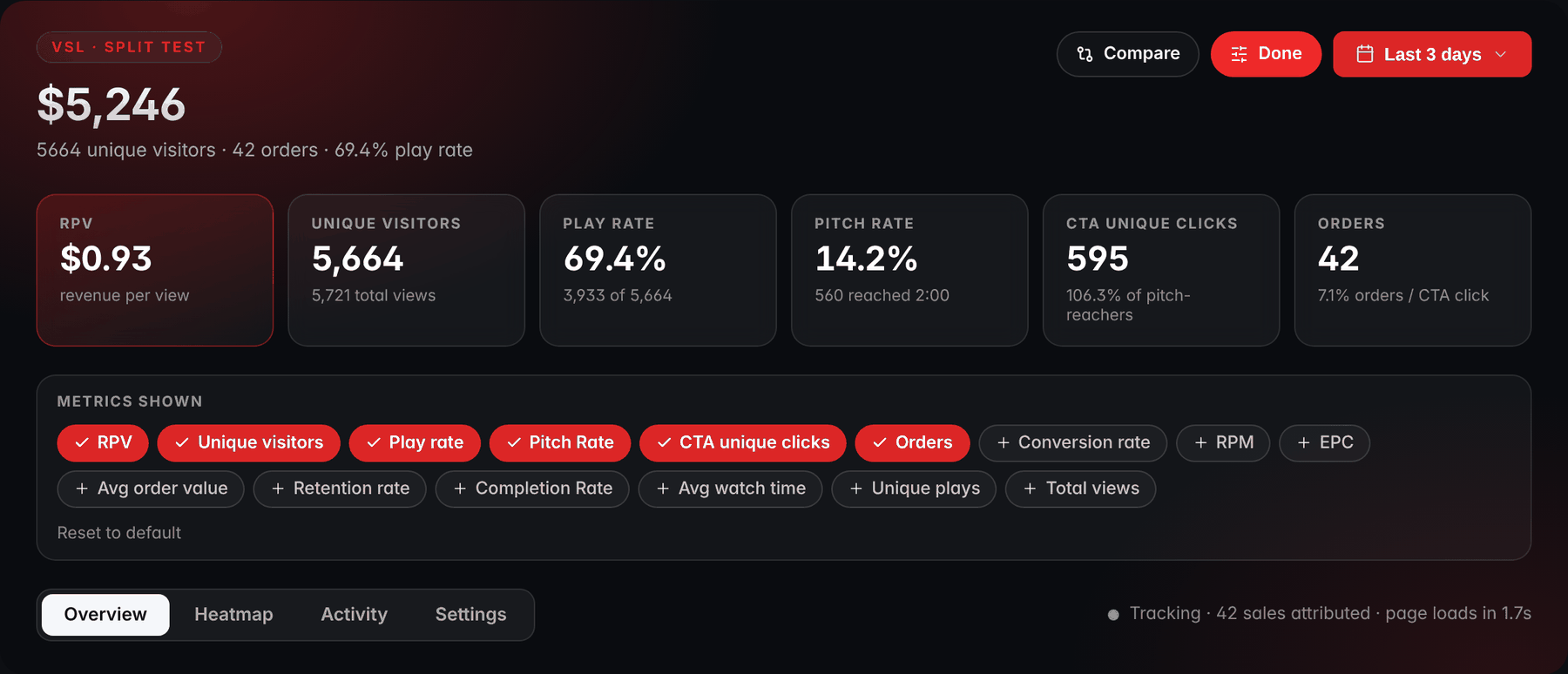
- RPVRPV (revenue per visitor) is the first tile in the band.
- EPCEPC (earnings per CTA click) can be added to the band from this list.
Compliance: the rules that keep a nutra offer alive
This isn't legal advice; it's the checklist to take to someone who gives it.
- Health claims need evidence. The FTC expects health claims to be backed by competent and reliable scientific evidence, and its Health Products Compliance Guidance explains what that means for ads.
- Structure/function, not disease. Structure/function statements need the disclaimer "This statement has not been evaluated by the Food and Drug Administration" and "This product is not intended to diagnose, treat, cure, or prevent any disease." FDA must be notified within 30 days of first marketing a product that bears one (21 CFR 101.93). Implied disease claims count too, so swapping a disease's name for a euphemism doesn't fix a disease claim.
- Real testimonials, disclosed actors. The Endorsement Guides require real experiences and disclosure of material connections, and the 2024 rule bans fake reviews and testimonials.
- Clear subscription terms. If the offer rebills, the terms, the consent and the cancellation have to be clear. The VSL compliance guide covers ROSCA and the state laws that apply.
- Platform and network rules. Networks review offers, and Meta has its own Health and Wellness ad standards. Read them before you launch, not after a rejection.
Compliance is also economics. An offer built on claims it can't support collects refunds, chargebacks and rejected ads, and every one of those costs more than the softer claim would have.
Why so many Brazilian operators sell nutra to the US and Europe
A striking share of the operators in this section are Brazilian, and their interviews give the reasons. They earn in dollars or euros while running teams in Brazil. Average tickets abroad are higher: Filipe Santana estimated that both the cost of validating an offer and the average order run about three times higher in the US than in Brazil. And at home, Brazil's health regulator draws hard lines between supplements, herbal medicines and drugs.
The industry has noticed. The networks and suppliers now meet Brazilian sellers in São Paulo, and ShipOffers lists a 2026 São Paulo event built around scaling nutraceuticals (ShipOffers events). Europe is the next market several of them mention. The who's who of Brazilian nutra operators maps the names.
What the operators in this section say
- Guilherme Bifi: affiliate turned offer owner. He argues for CPA deals, validates offers on email lists before paid traffic, and treats format as more important than copy.
- Gabriel Medeiros: led media buying at V Shred. Cold traffic is the engine, retargeting a modest add-on, and he moves Meta spend toward strong days with lifetime budgets.
- Rubens Araujo: went from translated PLR offers in Brazil to Latin America and then the US. He ran ABO at volume and says offers die faster than most owners plan for.
- Paulo Sanches: VSL copywriter for health offers. He works from named mechanisms, emotion first and logic second, and the right authority figure.
- Filipe Santana: builds offers from research into ingredients and mechanisms, designing the solution first, and has compared the economics of Brazil and the US.
- Pedro Andrade: direct-response traffic manager. He tests CBO and ABO per offer, isolates one creative per campaign and finds a campaign's budget ceiling before calling it dead.
A launch checklist for your first nutra offer
Tick these off as you build the offer; the ticks stay in this browser:
A launch checklist for your first nutra offer
0 of 10 done
Frequently asked questions
What does nutra mean in affiliate marketing?
Nutra is short for nutraceuticals. In affiliate and direct-response marketing it means dietary supplements sold with a sales message such as a VSL or an advertorial, usually to cold traffic. Affiliates promote the offers through networks like ClickBank, Digistore24 and BuyGoods and are paid per sale, either a fixed CPA or a share of revenue.
Is nutra marketing legal?
Selling supplements with VSLs is legal; many of the claims made in them are not. Health claims need competent and reliable scientific evidence, supplements can't claim to diagnose, treat, cure or prevent a disease, testimonials must be real and connections disclosed, and subscriptions need clear terms and easy cancellation. This isn't legal advice, so have a lawyer review your claims.
What is a good EPC for a nutra offer?
There is no universal benchmark, because EPC only means something next to your cost per click. If your clicks cost $1.50 and the offer earns $2.10 per click, you have room to scale; at $2.50 per click you don't. One operator profiled here looks for an EPC above $3 when he tests offers on email lists before paying for traffic.
Should a nutra affiliate take CPA or revenue share?
CPA pays a fixed amount per customer and leaves refunds and chargebacks with the offer owner, which suits affiliates with volume. Revenue share pays a percentage of each sale, often including upsells and rebills, but the affiliate shares the refunds. Compare offers on the payout you actually keep per click, not the headline percentage.
Why are VSLs used to sell supplements?
A supplement needs explaining: the problem, why other approaches failed, the mechanism behind the product and the proof. A VSL tells that story in a fixed order, keeps the viewer on one message and reveals the offer at the moment the case is made. It also lets operators test leads, offers and prices while the rest of the video stays the same.
Can a supplement VSL mention a disease?
It can't claim the product diagnoses, treats, cures, mitigates or prevents a disease; that is a disease claim and can make the product a drug under FDA rules. Implied claims count, including product names and imagery. Statements about supporting normal structure or function are allowed with the required FDA disclaimer and a notification to FDA within 30 days.
Sources
- Health Products Compliance Guidance — FTC
- 21 CFR 101.93: Certain types of statements for dietary supplements — eCFR
- FTC announces final rule banning fake reviews and testimonials (August 2024) — FTC
- FTC seeks to halt 10 operators of fake news sites making deceptive claims about acai berry weight loss (2011) — FTC
- Advantage Campaign Budget — Meta for Developers
- Events — ShipOffers
- Our services — ShipOffers