
Funnels, traffic and compliance
Facebook ads for a VSL: tracking, campaign structure, creative and scaling on Meta
How to run Facebook (Meta) ads to a video sales letter: the tracking to finish before you spend, which conversion event to optimize for, a campaign structure for testing and scaling, creative that sets up the VSL, and how to check Meta’s numbers against real sales.
On this page
- What to set up before you run Facebook ads to a VSL
- What is the best campaign objective for a VSL on Facebook?
- How to structure Facebook campaigns for a VSL: testing vs scaling
- Creative strategy: Facebook ads that set up the VSL
- Landing page experience and Meta's ad policies
- How to read results: Meta-reported purchases vs real sales
- A launch checklist for Facebook ads to a VSL
- Frequently asked questions
Running Facebook ads to a VSL works when three things are in place: tracking that reports real purchases back to Meta (the Pixel plus the Conversions API, deduplicated), a campaign optimized for the deepest event you can feed with volume, usually Purchase, and a steady supply of new creatives tested against one proven VSL. Judge all of it by revenue and profit, not by Meta's dashboard alone.
What to set up before you run Facebook ads to a VSL
The ad is the first step of a video sales funnel, and Meta's delivery system learns from the events you send it about everything after the click. If a purchase never reaches Meta, the system optimizes toward the wrong people and every report you read is wrong. So the first job is plumbing, not ads.
Six things to set up before the first ad
1Meta Pixel on every page you control
What happens: The presell, the VSL page and, if your cart allows it, the thank-you page. The Pixel sends browser events such as ViewContent, InitiateCheckout and Purchase, which are among Meta's standard events.
2The Conversions API alongside the Pixel
What happens: The Conversions API sends the same events from a server instead of the visitor's browser.
Why it matters: Meta's best-practice guidance is a redundant setup: share the same events through both, because the Pixel can miss events the server catches.
3Deduplication
What happens: When the browser and the server both report a purchase, Meta keeps one copy only if the event name and the event ID match, and it deduplicates within 48 hours of the first event.
What goes wrong:
- Mismatched IDs mean double-counted sales and a ROAS that looks better than your bank account.
4Customer information for matching
What happens: Adding customer information parameters to server events, such as an email collected with consent, can improve Event Match Quality.
Why it matters: Meta can only use matched events for attribution and delivery optimization.
5Domain verification
What happens: Verifying your domain claims ownership of it in Business Manager, through a DNS TXT record or an HTML file. Verify the domain your VSL lives on.
6Sales reported from the checkout
What happens: VSL pages rarely host the checkout. The sale happens on Shopify, Whop, CartPanda or another cart, so something has to carry the click across and report the purchase back. Our guide to VSL tracking walks through the full chain.
In RevvyScales, each CTA click gets a click_id, the checkout's thank-you page or a store webhook reports the sale back, and the Conversions API integration (Growth plan and up) is deduplicated so each sale reaches Meta once (set up the Conversions API). Add the rvs parameter to your ad URLs, and visits and sales are attributed to the campaign, ad set and ad (how the rvs parameter works).
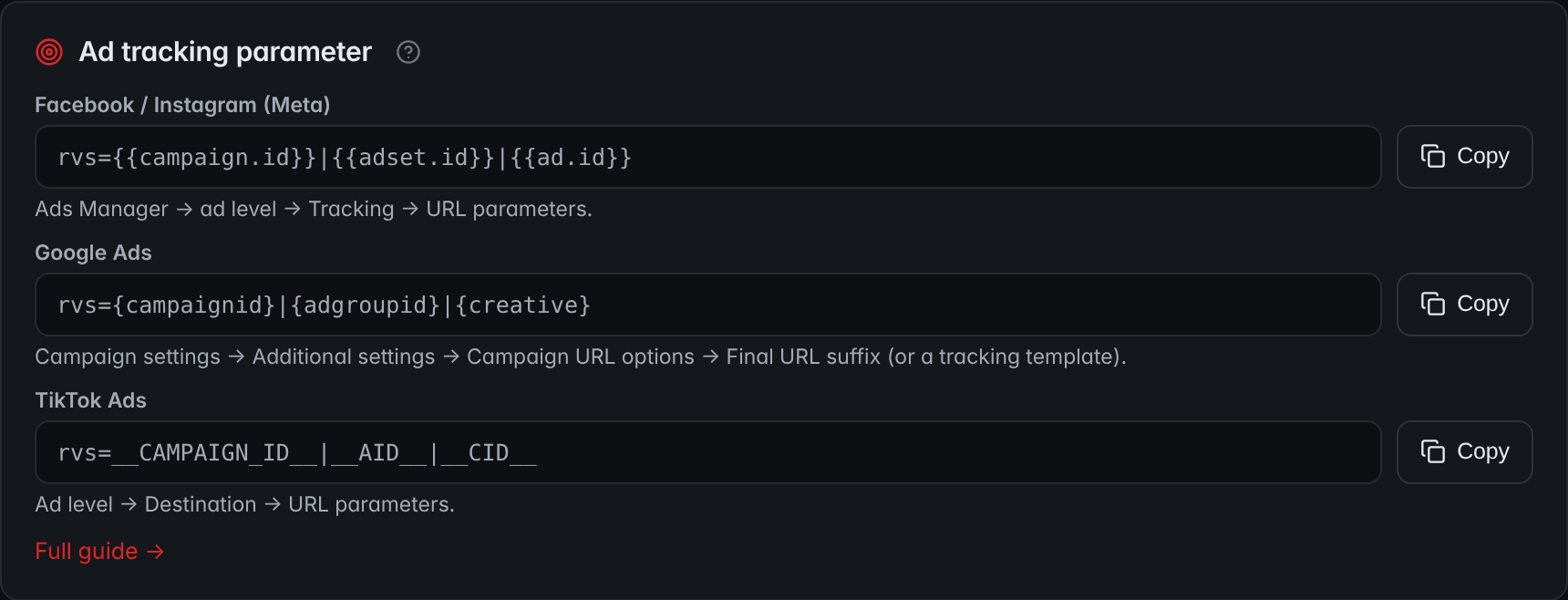
- The Meta lineThe line for Facebook and Instagram ads carries the campaign, ad set and ad IDs.
- Where it goesIt goes in Ads Manager at the ad level, under Tracking, in the URL parameters.
- Other platformsGoogle Ads and TikTok Ads get the same parameter with their own macros.
A VSL funnel typically uses five events. Here's what each one is good for:
| Event | Fires when | Best use |
|---|---|---|
| ViewContent | The VSL page loads | Audiences of visitors; landing diagnostics |
| Custom event (pitch reached, CTA click) | Your page or player reports a milestone | Retargeting audiences of engaged viewers |
| Lead | An email is captured | Optimization only if the lead is the goal |
| InitiateCheckout | The checkout opens | Fallback optimization event when purchases are scarce |
| Purchase | The order is confirmed | Primary optimization event and ROAS |
Use milestones like "pitch reached" to build retargeting audiences (Meta's documentation describes custom events as a way to define custom audiences), and keep Purchase as the event you optimize for.
What is the best campaign objective for a VSL on Facebook?
For a VSL that sells directly, use the Sales objective and optimize for the Purchase event. Meta's system looks for people likely to take the action you choose. Choose a cheap action and you get people who take cheap actions: clickers, not buyers. A VSL needs people who will watch for twenty minutes and then pull out a card, and only the Purchase event describes them exactly.
The catch is volume. An optimization event teaches the system something only if it happens often enough, so do the arithmetic before you choose.
Which event should the campaign optimize for?
What should the campaign find?
Does your budget buy several sales per ad set per week?
Best fit
Purchase
Buyers on the checkout after the VSL, and a budget that buys several sales per ad set per week. Signal volume: lowest. Buyer quality: highest. Only the Purchase event describes the people a VSL needs exactly.
Best fit
InitiateCheckout, for a few weeks
Buyers on the checkout after the VSL, but purchases are still rare: a new account or a high price. Signal volume: medium. Buyer quality: medium. Either concentrate the budget in one ad set so the sales aren't divided, or optimize for InitiateCheckout for a few weeks while you judge the campaign by its cost per purchase, never by the cheaper event's cost.
Best fit
Lead
The sale happens later, by email, call or webinar. Signal volume: high. Buyer quality: varies.
Best fit
Link clicks: almost never for a VSL
Cheap clicks to the page bring the highest signal volume and the weakest buyer quality: you buy clickers who don't watch.
A worked example: your target cost per acquisition (CPA) is $60 and you plan to spend $300 a day. That's about five purchases a day, 35 a week, plenty of signal for one or two ad sets. Now say you sell a $497 program with a target CPA of $250 on $150 a day. That's fewer than one purchase a day, split across however many ad sets you run. Either concentrate the budget in one ad set so the sales aren't divided, or optimize for InitiateCheckout for a few weeks while you judge the campaign by its cost per purchase, never by the cheaper event's cost.
Once purchases flow steadily and order values vary (bundles of one, three or six units, upsells), a minimum ROAS bid strategy becomes worth testing. Meta supports it alongside lowest cost, cost cap and bid cap (Advantage+ campaigns documentation). Start with lowest cost, and add a cap or a ROAS floor only when you know your numbers.
How to structure Facebook campaigns for a VSL: testing vs scaling
An ad account has two jobs: finding ads that sell and buying more of the ones that do. They need different structures. Dropping five untested ads into a campaign that's already spending well is a reliable way to turn a promising test into noise.
Three ways to spend the budget
Ad set budgets (often called ABO)
How budget is spent: You set each ad set's budget
- Good for: Clean creative tests; guaranteed spend on new concepts
Trade-off: More manual work; keeps spending on losers until you act
Advantage+ campaign budget (what many buyers still call CBO)
How budget is spent: Meta moves one campaign budget across ad sets toward the best opportunities
- Good for: Scaling proven ads with less babysitting
Trade-off: New ads can get almost no spend, so tests are unclear
Advantage+ sales campaign
How budget is spent: Budget, audience and placements are automated
- Good for: Accounts with steady purchase data and many creatives
Trade-off: Least control and least insight into why it works
Under Advantage+ campaign budget you can still cap an ad set's daily or lifetime spend, but minimum spend targets are only a best effort (Meta's documentation). In Meta's current setup, a sales campaign runs as an Advantage+ sales campaign when Advantage+ campaign budget, Advantage+ audience and Advantage+ placements are all on. It replaced the older Advantage+ shopping campaigns.
A two-campaign setup that keeps tests honest
- A testing campaign with ad set budgets. One ad set per creative concept, three to five ads in each, equal budgets, the same broad audience. Every concept gets a fair share of spend.
- Decision rules written before launch. Starting rules to adapt, not Meta guidance: pause an ad that spends twice your target CPA without a purchase; after three times target CPA in spend, keep only ads at or below 1.2 times target; promote ads with five or more purchases at or below target.
- A scaling campaign with a campaign budget. Move winners into a campaign under Advantage+ campaign budget, or into an Advantage+ sales campaign once you have the volume, with broad targeting.
- Leave working campaigns alone. Meta's documentation notes that copying or migrating an older shopping campaign into the Advantage+ format forces it into the learning stage, so don't rebuild a campaign that's working just to change a detail.
Here's how those rules play out with a $60 target CPA. Ad A spends $240 and brings five purchases ($48 CPA): promote it. Ad B spends $180 for two purchases ($90 CPA, 1.5 times target): pause it. Ad C spends $120 with no purchase: pause it. That's $540 to find one ad that works. Budget for testing as the cost of finding winners, because the winners are what pay for it.
$540 of testing, one winner
Example with a $60 target CPA: where the test budget went
- Ad A: five purchases, $48 CPA. Promote it.$24044%
- Ad B: two purchases, $90 CPA (1.5 times target). Pause it.$18033%
- Ad C: no purchase. Pause it.$12022%
Scale in steps, and watch the back end
Raise the scaling campaign's budget in steps and give each step a few days of data before the next one. CPA usually rises as you buy deeper into an audience, so you're looking for the highest budget at which your marginal CPA still clears your target. Grow sideways too: new concepts, new angles from the VSL, new countries. Watch refunds by ad as well: an aggressive ad can hold a pretty CPA while its buyers ask for their money back.
Creative strategy: Facebook ads that set up the VSL
With broad targeting, the creative does most of the targeting. The hook decides who stops scrolling, and the promise decides who clicks. That makes the ad part of the VSL. Whatever the ad promises, the first 30 seconds of the video have to deliver, or viewers leave before your hook lands.
Build creative from the VSL, not from scratch
Your VSL already contains your best angles. List three to five of them (the problem, the mechanism, the story, the proof, the main objection) and turn each into a concept. Give each concept two or three formats, such as a talking head, a demonstration, text on screen, a static image or a cut of the VSL's own opening, and write three hooks for each format. To see which formats and hooks competitors are running, research their ads in Meta's Ad Library.
For a fictional $47 dog-training course, the angles might be "your dog pulls because of what happens in the first ten seconds of the walk" (mechanism), "the walk you dread twice a day" (problem) and "what a shelter trainer does differently" (story). Three angles, two formats and three hooks give you 18 ads from one VSL.
How many ads one VSL gives you
Adsangles × formats per angle × hooks per format
For the fictional $47 dog-training course: 3 angles × 2 formats × 3 hooks = 18 ads from one VSL.
Message match: the ad's promise is the VSL's first line
Each symptom points at a specific handoff:
| Symptom | Likely cause | First fix |
|---|---|---|
| Strong hook rate, weak CTR | The hook grabs attention but the ad promises nothing worth a click | Make the ad's promise specific |
| Good CTR, low unmute rate on the VSL | Message mismatch or a slow page | Open the VSL with the ad's promise; check load time on a phone |
| Good unmute rate, cliff at 30 to 60 seconds | The opening doesn't pay off the ad | Rewrite the first minute |
| Good pitch reach, few CTA clicks | Offer or price | Test the offer |
| Many CTA clicks, few purchases | Checkout friction or broken tracking | Test the checkout and the Purchase event |
Our guide to hook rate covers the ad-side metrics and how they connect to what happens on the VSL.
Honest creative lasts longer
Use real customers, or disclose actors: the FTC's Endorsement Guides call for actual customers when an ad presents people as customers, or a clear disclosure that they aren't. Skip fake news layouts, invented comments and claims you can't prove. Deceptive creative also comes back later as refunds and chargebacks that the front-end CPA never warned you about. The full rules are in our VSL compliance guide.
Landing page experience and Meta's ad policies
The click lands on your VSL page, and the page is part of the ad experience. It has to load fast on a phone, repeat the ad's promise in the headline and show the video at the top of the screen.
Meta's Advertising Standards apply to every ad, and they change. Two of them matter most for typical VSL offers: Privacy Violations and Personal Attributes and, for anything health-related, Health and Wellness. Read the current text before you write copy that refers to a viewer's body, health, finances or other personal traits, and before you use before-and-after images.
A writing habit that reads better and keeps you from telling viewers what they are: describe the situation and the outcome, not the person. If an ad is rejected, read the stated reason, then fix the ad or the page, or request a review if you believe the decision is wrong. And approval by Meta isn't legal clearance: the FTC's rules on claims and testimonials apply to an approved ad exactly as they do to a rejected one.
How to read results: Meta-reported purchases vs real sales
Meta and your checkout count different things. Meta credits a purchase to an ad when it happens within an attribution window, a set number of days after someone clicked or viewed the ad (attribution window options), and it can only count the purchase events it receives. Your checkout counts orders. Expect the two to differ, and give each number its own job.
They drift apart for predictable reasons: view-through credit, purchases that land outside the window, duplicate events when deduplication breaks, missing events when a thank-you page fails to fire, and refunds, which Meta's purchase count doesn't subtract. So reconcile once a week:
One week, from Meta purchases to net orders
Illustrative reconciliation, week 1
A stable ratio is fine: use your net orders for profit decisions and Meta's numbers to compare ads against each other. A ratio that suddenly jumps means tracking broke or attribution changed, so investigate before you touch budgets.
Then judge spend against your economics. Say the front-end price is $47 and order bumps and upsells lift the average order to $72. After fulfillment, payment fees and refunds you keep $58 per order, so your break-even CPA is $58 and your target sits below it. To compare VSL versions or traffic sources fairly, use revenue per visitor. In RevvyScales, profit tracking (Growth plan and up) subtracts ad spend from a connected Meta account, product costs and gateway fees, and shows ROAS and margin by campaign (profit dashboard).
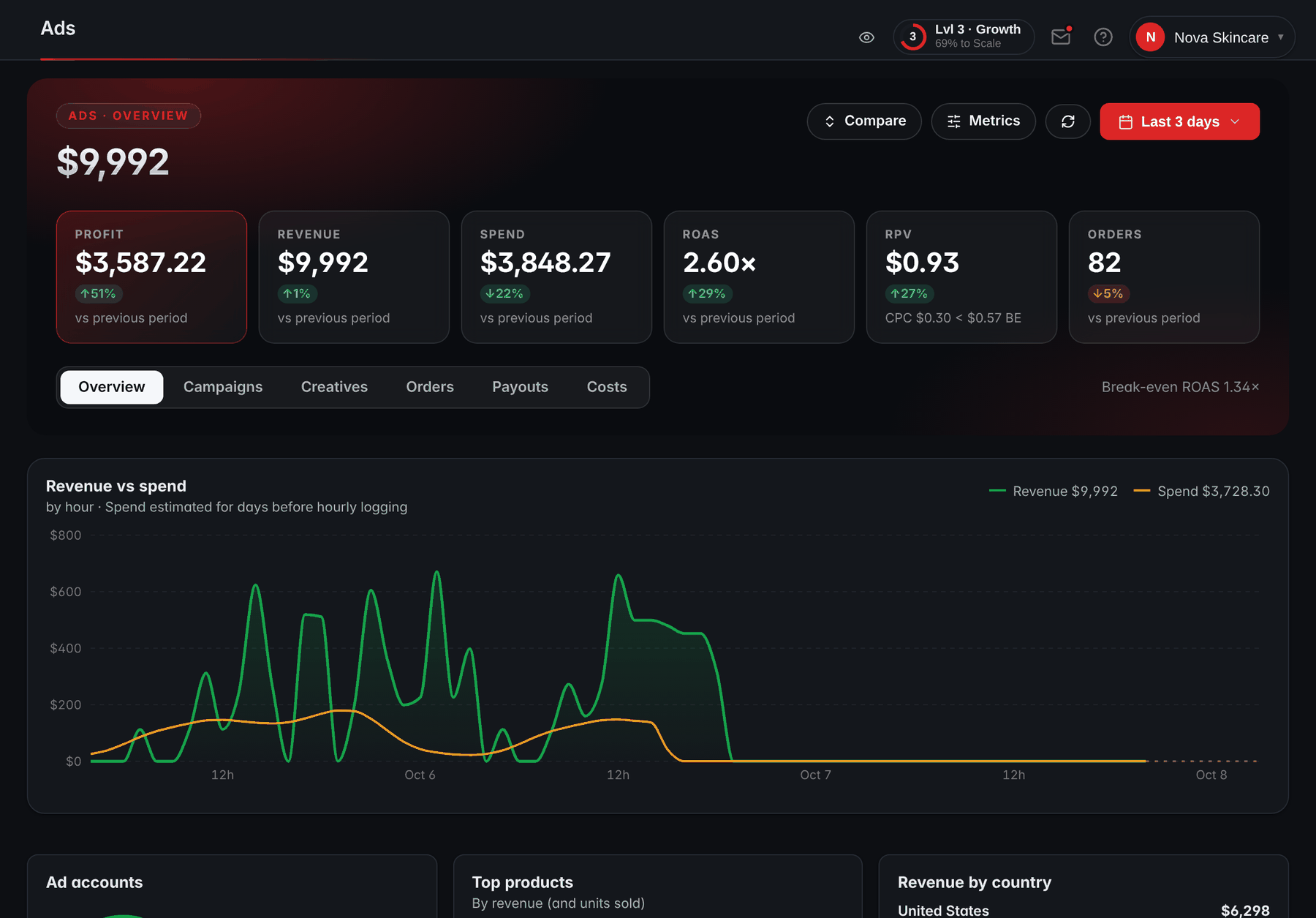
- ProfitProfit is revenue minus ad spend, product costs and gateway fees.
- SpendAd spend comes in from the connected Meta account.
- ROASThe ROAS tile sets revenue against ad spend for the period.
- RPVRevenue per visitor sits in the same row.
- Revenue vs spendRevenue and ad spend are drawn against each other over the range.
- CampaignsThe Campaigns tab breaks ROAS and margin down by campaign.
A launch checklist for Facebook ads to a VSL
Tick these off before you spend; the ticks stay in this browser:
Before the first dollar
0 of 10 done
Frequently asked questions
What is the best campaign objective for a VSL on Facebook?
For a VSL that sells directly, use the Sales objective optimized for the Purchase event, because Meta looks for people likely to take the action you choose. If your budget can’t produce several purchases per ad set each week, concentrate it in fewer ad sets or optimize for InitiateCheckout for a while, and keep judging the campaign by cost per purchase rather than by the cheaper event’s cost.
Do I need the Conversions API if I already have the Meta Pixel?
For a VSL funnel, yes. Meta recommends a redundant setup that sends the same events through the Pixel and the Conversions API, because the Pixel can miss events that a server catches. Give both copies the same event name and event ID so Meta keeps one and discards the other. Mismatched IDs double-count purchases and make your ROAS look better than it is.
How much budget do I need to test a VSL with Facebook ads?
Size the test from your target cost per acquisition, not from a round number. A workable starting rule is to let each creative concept spend two to three times your target CPA before judging it, so three concepts at a $60 target need roughly $360 to $540. Expect most concepts to lose. The test has done its job when it finds one ad that holds your target CPA.
Why doesn’t Facebook’s purchase count match my actual sales?
Meta credits purchases that happen within its attribution windows after a click or a view, and it only counts the purchase events it receives. Broken deduplication inflates its numbers, missing browser events deflate them, and refunds don’t come off its count. Your checkout counts real orders. Reconcile the two weekly, use your net orders for profit decisions and use Meta’s numbers to compare ads with each other.
Should Facebook traffic go straight to the VSL or to a presell first?
Test both, because the answer depends on how much your audience already knows. Cold traffic from a problem-led ad often benefits from a presell that warms it up, while retargeting traffic can go straight to the VSL or even to the offer. Split the same ads between the two paths and judge by revenue per ad click, since the presell loses some people but can raise the value of the rest.
Can I run Facebook ads to a health or supplement VSL?
You can, within Meta’s Health and Wellness and personal attributes policies and within FTC rules that require evidence for health claims before an ad runs. Read the current policy text rather than summaries, avoid copy that tells viewers what condition they have, and keep health conditions out of everything your pixel or server sends to Meta, including URLs, event names and custom conversions.
Sources
- Conversions API best practices — Meta for Developers
- Deduplicate Pixel and Server Events — Meta for Developers
- Meta Pixel reference: standard events — Meta for Developers
- Meta Pixel conversion tracking and custom conversions — Meta for Developers
- Advantage+ campaigns — Meta for Developers
- Advantage Campaign Budget — Meta for Developers
- Domain Verification — Meta for Developers
- Lurking Beneath the Surface: Hidden Impacts of Pixel Tracking — FTC