
Nutra operators and their playbooks
Pedro Andrade: how a direct-response traffic manager tests and scales Facebook ads for VSL offers
Pedro Andrade is a Brazilian direct-response traffic manager who started as an affiliate and now runs Facebook campaigns for VSL offers. Here is the method he has described in public: CBO and ABO tested per offer, creatives isolated, tests sized to the commission, and scaling up to a budget ceiling.
On this page
- Who is Pedro Andrade, the Facebook ads traffic manager?
- CBO or ABO: Pedro Andrade tests both
- One creative per campaign: his test structure
- How much to spend on a test
- Reading the first signals
- Daily optimization: targets, trims and stop rules
- Scaling: vertical, horizontal and the budget ceiling
- When the problem is the VSL, not the ad
- Borrowing formats from other niches
- The mistakes his method protects against
- How to apply his method
- Frequently asked questions
Pedro Andrade is a Brazilian traffic manager who specializes in direct-response offers sold with VSLs on Facebook and Instagram. He started as an affiliate, moved into managing traffic for offer owners, and runs a community for direct-response traffic managers. His method: test CBO and ABO on every offer, isolate one creative per campaign, size tests against the commission, trim before you kill, and find a campaign's budget ceiling before you give up on it.
This profile is based on a long podcast interview published in December 2024. Only a summary of that episode was available, so it keeps to his main points and few numbers. He shouldn't be confused with the Brazilian TV journalist of the same name (Wikipedia).
Who is Pedro Andrade, the Facebook ads traffic manager?
Andrade described starting out as an affiliate, then moving into service work: managing paid traffic for other people's offers, including e-commerce. By his account he has managed tens of millions of reais in ad spend, and he runs a community where direct-response traffic managers share what works. He also talked about working with offer owners on revenue-share deals rather than a flat fee, which ties the traffic manager's pay to results.
His focus is Meta: Facebook and Instagram ads that send cold traffic to a VSL. He described weight loss as a typical example niche and argued that testing in the US market costs less than many Brazilians assume, citing a test he ran on a modest budget. The broader model is covered in the nutra marketing guide.
CBO or ABO: Pedro Andrade tests both
Andrade doesn't pick a side in the CBO vs ABO debate. In ABO (ad set budgets) the budget is split across ad sets as you set it. In CBO, which Meta now calls Advantage campaign budget, Meta allocates one campaign budget across the ad sets. He tests both on each offer, because the same structure doesn't win everywhere.
He was also patient with Meta's automated Advantage+ campaigns: they can trail a manual setup for several days and then overtake it, so he judges them over a longer window than an ordinary test. The mechanics of each structure, with Meta's documentation, are in our CBO vs ABO guide.
One creative per campaign: his test structure
To know which creative works, he isolates it. His structure gives each creative its own CBO campaign, with several ad sets inside running the same creative. Meta then chooses where that creative performs best, and each creative keeps its own budget, so one strong ad can't starve the rest.
Here is what each structure tells you:
What each test structure tells you
His structure1 creative
- Structure: one CBO campaign, several ad sets, same creative
- What you learn: whether the creative can sell
His structure10 creatives
- Structure: ten CBO campaigns, each with several ad sets of one creative
- What you learn: which creatives sell, read side by side
The trap10, all in one campaign
- Structure: one CBO campaign with ten creatives
- What you learn: mostly which creative Meta preferred early
The last option is the trap he avoids: put ten new creatives in one campaign and Meta concentrates spend on one or two of them early, so the others never get a fair test. The cost of his approach is more campaigns to manage, which is why it suits a team that lives in Ads Manager.
How much to spend on a test
His rule of thumb for affiliates is to give each test at least half the expected commission, run over at least three days because results swing between weekdays, and up to the full commission when cash flow allows.
A worked example with illustrative numbers: the offer pays a $120 commission. Each creative gets $60 to $120 over three days, $20 to $40 a day. At a $1.20 cost per click, that buys 50 to 100 clicks per creative, enough to judge the hook and the click, and sometimes a first sale. Ten creatives tested this way need $600 to $1,200, which is why he insisted on keeping enough cash to absorb test losses.
For an offer owner, replace the commission with your CPA ceiling. Either way, the test budget is a function of what a sale is worth, not a round number.
As a formula, with the example's numbers:
Sizing a creative test
His rule of thumb, with the worked example above (illustrative numbers)
Test budget per creativehalf to all of the expected commission; an offer owner uses the CPA ceiling
Daily budgettest budget ÷ the days of the test, three or more
Clicks per creativetest budget ÷ cost per click
$120 commission: $60 to $120 per creative, $20 to $40 a day over three days, 50 to 100 clicks at $1.20 a click. Ten creatives: $600 to $1,200.
Reading the first signals
Before sales arrive, the early metrics tell you where the problem is. He watches hook rate and click-through rate first: a low CTR after two days usually means a weak hook. A practical diagnostic:
Where is the problem?
The first signals in order: the hook, the click, then the sales
Do people watch past the first seconds of the ad?
Is the click-through rate good?
What do the sales look like?
Best fit
Weak hook
Few people watch past the first seconds: the likely cause is a weak hook. What to do: test new openings on the same ad body.
Best fit
The ad doesn't make the click worth it
A good hook rate but a low CTR: the likely cause is that the ad doesn't make the click worth it. What to do: sharpen the promise and the call to action.
Best fit
The VSL or the offer
A good CTR but few sales: the likely cause is the VSL or the offer. What to do: check play rate, retention and the order page.
Read more: Video Retention Graph: How to Read a VSL Drop-Off Curve
Best fit
Too little volume or the wrong structure
Sales, but a CPA above target: the likely cause is too little volume or the wrong structure. What to do: give it time, then trim or restructure.
The hook rate guide explains how to measure the first seconds. Benchmarks vary by niche and market, so compare against your own past winners rather than a number from someone else's account.
Daily optimization: targets, trims and stop rules
Andrade described a daily routine built on a target: a ROAS or CPA number for each offer, checked several times a day. When a campaign falls below target, he cuts its budget gradually, by around 30%, rather than pausing it, because a trimmed campaign often recovers while a paused one loses its momentum. If it still hasn't recovered after a couple of review rounds, he pauses it.
He also reviews campaigns over longer windows (a week, two weeks, three weeks) so that a bad afternoon doesn't decide the fate of a campaign that works over a month. Every significant edit can send an ad set back into Meta's learning phase, and the API reports that status as LEARNING, SUCCESS or FAIL (learning stage reference), so check it before reading a change as a result.
Scaling: vertical, horizontal and the budget ceiling
He uses both scaling moves:
Vertical and horizontal scaling
Vertical
Raise the budget of a winning campaign.
- His own example was aggressive: taking a proven campaign from R$600 to R$6,000 a day in one move.
Jumps that size work only when results are strong and stable, so watch CPA closely after each one.
Horizontal
Duplicate winners into new campaigns at the same budget.
- For example, growing from five campaigns to twenty.
- Keep duplicating to hold the number of active campaigns steady as older ones fatigue.
Before he declares a campaign or an offer dead, he runs a budget ceiling test: push the budget up in steps to find where CPA stops holding. Many campaigns that look like failures were simply never given a budget at which Meta could find their buyers, and many that look like winners only work at small budgets. Daily budgets are averages, and Meta may spend up to 25% more than the daily budget on some days (Meta budgets documentation), so judge each step over days, not hours.
When the problem is the VSL, not the ad
A traffic manager's results depend on the page the ads send people to, and Andrade checks the funnel as well as the campaigns. The points he looks at:
- Connect rate. How many clicks turn into page loads. A big gap between clicks and visits points to a slow page or a tracking problem.
- Play rate. How many visitors start the video.
- Retention in the first minute. Whether the lead holds viewers long enough to reach the mechanism.
- Upsells judged by average ticket. An upsell that converts less but raises the average order more is the better one.
- Headline, lead and autoplay tests. He named these as the page tests worth running.
He also described pre-scaling an offer for about five days and then deciding whether the issue is the creative or the offer, and abandoning an offer after several leads have been tested without success.
In RevvyScales, the analytics show play rate, retention to the pitch and a second-by-second retention graph for each VSL, and the player starts as a muted autoplay teaser that rewinds to the start when the viewer taps for sound (player conversion features).
Here is where those numbers sit for one VSL:
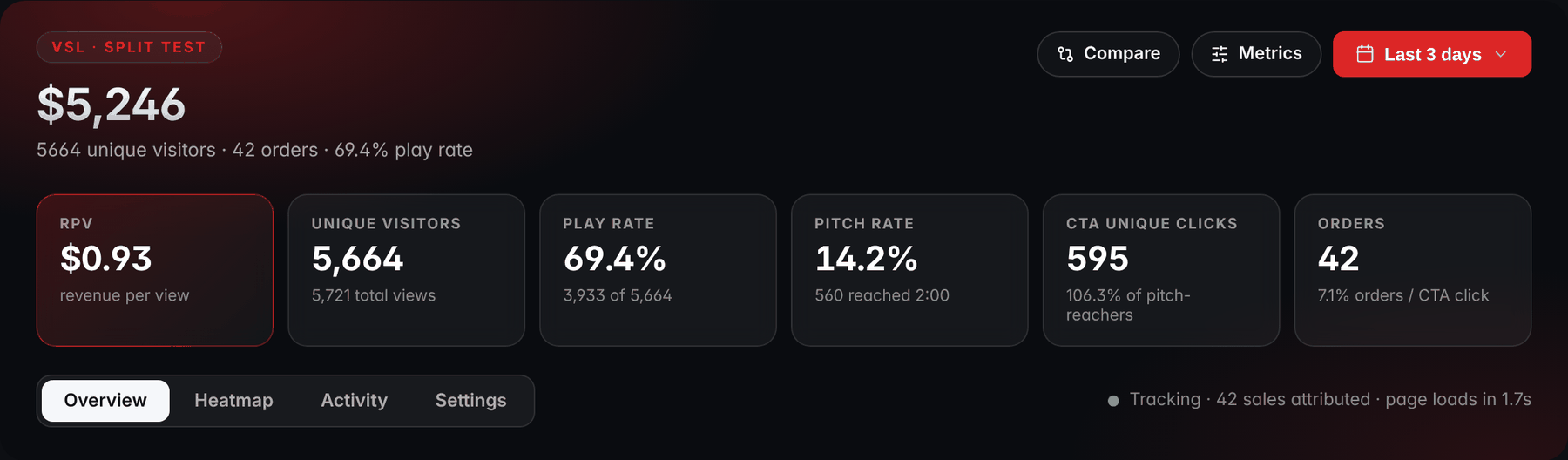
- Play ratePlay rate is the share of unique visitors who started the video.
- Pitch ratePitch rate is the share of viewers who started the video and were still watching at the pitch, set at 2:00 in this test VSL.
Borrowing formats from other niches
To find new creative ideas, he looks outside the niche: successful ads in other categories and formats, such as native content, news-style videos, podcast clips and current TikTok trends, adapted to his offer. Borrow the format, not the deception: a news-style ad must not pretend to be independent journalism. The FTC treats ads disguised as editorial content as deceptive (native advertising guide), and our Facebook ads for a VSL guide covers the platform's own rules.
The mistakes his method protects against
Each habit above answers a common way media buyers lose money:
- Judging an Advantage+ campaign on day two. Automated campaigns often start slowly; give them the window you planned.
- Testing ten creatives in one campaign. Meta picks a favorite early and the rest never get a fair test.
- Pausing on the first bad afternoon. A trim and a second review often save a campaign that a pause would end.
- Declaring a campaign dead before testing its ceiling. Some campaigns only find their buyers at a higher budget.
- Blaming the ad for a page problem. Check connect rate, play rate and first-minute retention before rewriting a creative that clicks well.
- Starting tests without the cash to finish them. A half-finished test costs money and teaches nothing.
How to apply his method
Tick these off as you set up your next offer; the ticks stay in this browser:
Apply his method
0 of 7 done
Frequently asked questions
Who is Pedro Andrade, the traffic manager?
Pedro Andrade is a Brazilian direct-response traffic manager who runs Facebook and Instagram campaigns for VSL offers. He started as an affiliate, moved into managing traffic for offer owners, often on revenue-share deals, and runs a community for direct-response traffic managers. He is not the Brazilian TV journalist of the same name.
Should I use CBO or ABO for a new offer?
Andrade's answer is to test both, because offers respond differently. ABO gives each ad set a fixed budget, which makes tests fair. CBO, now called Advantage campaign budget, lets Meta move one budget to the best ad sets. To read creatives cleanly, he gives each creative its own CBO campaign with several ad sets.
How much should an affiliate spend testing a creative?
His rule of thumb is at least half of the expected commission per creative, spread over at least three days to smooth out weekday swings, and up to the full commission when cash allows. With a $120 commission that means $60 to $120 per creative. The budget follows what a sale is worth, not a round number.
How often should you optimize Facebook campaigns?
Andrade checks his campaigns against a ROAS or CPA target several times a day, trims underperformers by around 30% instead of pausing them, and pauses only after a couple of rounds without recovery. He also reviews results over one, two and three weeks so a single bad day doesn't kill a campaign that works over a month.
What is a budget ceiling test?
It is raising a campaign's budget in steps to find the level where its cost per acquisition stops holding. Andrade runs one before deciding a campaign or offer has failed, because some campaigns only find buyers at higher budgets and others only work small. Judge each step over a few days, since daily spend and results fluctuate.