
Funnels, traffic and compliance
Video sales funnel: how to build a VSL funnel stage by stage, with the math
A video sales funnel takes a cold ad click through an optional presell or quiz, a VSL, checkout, upsells and follow-up. Here is each stage's job, metric and typical failure, the math that sets how much you can pay per sale, and a checklist for building one.
On this page
- What is a video sales funnel?
- The VSL funnel structure: job, metric and failure mode for each stage
- How do the stages hand off? Message match and tracking continuity
- Video sales funnel math: front end, back end and allowable CPA
- Which funnel variant fits your offer?
- Where should you start fixing a VSL funnel?
- How to build a VSL funnel: a step-by-step checklist
- What to do this week
- Frequently asked questions
A video sales funnel is the sequence of pages that turns an ad click into a sale, with a video sales letter (VSL) doing the persuading: the ad, an optional presell or quiz, the VSL page, checkout with an order bump, upsells, a thank-you page and follow-up. Each stage has one job and one number to watch, and you judge the economics across the whole sequence.
What is a video sales funnel?
A video sales funnel is a short, fixed path where each page hands the visitor to the next one and a VSL makes the main argument. A normal website lets people wander. A funnel removes choices on purpose, because every exit before the offer is a visitor you already paid for.
The VSL is the engine. The pages before it prepare the visitor for the video. The pages after it turn one purchase into a full order and then a customer relationship.
The canonical VSL funnel has seven stages:
- Ad. Stops the right person and earns the click.
- Bridge (optional). A presell, advertorial or quiz that warms, filters or segments the visitor.
- VSL page. The video makes the case; the offer appears at the pitch.
- Checkout. Collects payment; an order bump adds a small related item.
- Upsells and downsells. Post-purchase offers, usually one click.
- Thank-you page. Confirms the order, sets expectations and reports the sale.
- Follow-up. Email, SMS (with consent) and retargeting based on what each visitor did.
Not every funnel needs all seven. A low-ticket e-commerce offer might run ad, VSL, checkout and one upsell. A high-ticket coaching offer swaps checkout for an application and a sales call. The structure stays the same: one job per stage, and a clean handoff to the next.
The VSL funnel structure: job, metric and failure mode for each stage
Use these seven stages as the map. Each one is a place where money leaks, and each leak has a number that shows it. Open a stage to see its one job, its main metric and its typical failure:
The seven stages: one job, one metric, one typical failure
Open a stage to see what it does, where a leak shows and what usually goes wrong
1Ad
What happens: Its one job is to earn a click from the right person.
Why it matters: A leak here shows in its main metrics: hook rate, CTR and CPC.
What goes wrong:
- A promise the VSL doesn't keep.
Read more: Facebook Ads for a VSL: Tracking, Testing and Scaling
2Bridge
What happens: Its one job is to warm, filter or segment the visitor.
Why it matters: A leak here shows in its main metric: click-through to the VSL.
What goes wrong:
- Too long: people leave before the video.
Read more: Presell Page: What It Is, Formats and How to Write One
3VSL page
What happens: Its one job is to get viewers to the pitch, then to the button.
Why it matters: A leak here shows in its main metrics: unmute or play rate, pitch retention, and CTA clicks ÷ pitch viewers.
What goes wrong:
- A slow start.
- A weak hook.
- A pitch that comes after most viewers have left.
4Checkout
What happens: Its one job is to turn intent into payment.
Why it matters: A leak here shows in its main metric: orders ÷ CTA clicks.
What goes wrong:
- The offer or price differs from the video.
5Upsells
What happens: Their one job is to raise order value with a relevant offer.
Why it matters: A leak here shows in their main metric: revenue per buyer, net of refunds.
What goes wrong:
- Unrelated offers.
- Confusing decline links.
Read more: Upsell Funnel: Order Bumps, Upsells and Downsells
6Thank-you
What happens: Its one job is to reassure the buyer and record the sale.
Why it matters: A leak here shows in its main metric: tracked orders vs store orders.
What goes wrong:
- Missing or duplicated conversion events.
7Follow-up
What happens: Its one job is to recover non-buyers and onboard buyers.
Why it matters: A leak here shows in its main metrics: revenue per lead and unsubscribe rate.
What goes wrong:
- One message for everyone.
The ad: the promise you will have to keep
The ad's job is not clicks. It is clicks from people the VSL can sell. Every promise in the ad becomes a debt the video has to pay in its first 30 seconds, and a curiosity-bait ad can win on CTR and lose on everything after: fewer plays, a steeper early drop in retention and more refunds.
Decision rule: rank ads by revenue per click or ROAS once each has enough orders to judge, and use CTR and hook rate only to explain why an ad wins or loses. Account setup, optimization events and creative testing on Meta are covered in running Facebook ads to a VSL.
The bridge: presell, advertorial or quiz
A bridge page sits between the ad and the VSL. It earns its place when cold traffic needs context before a long video, when readers in native ad placements expect an article, or when the offer serves distinct segments that should see different videos.
It also costs you a step, and every step loses people. That is why the only fair verdict is a split test against sending the same ad straight to the VSL, judged by revenue per ad click. Each format has its own guide: the presell page, the advertorial, which must be clearly identifiable as an ad (FTC native advertising guide), and the quiz funnel.
The VSL page: from play to pitch to button
The page has two jobs, in order: get viewers to the pitch, then get them to click. The metrics follow that chain: play or unmute rate, retention at 30 seconds and one minute, pitch retention (viewers still watching when the offer appears ÷ viewers who started), then CTA click rate (CTA clicks ÷ viewers who reached the pitch). The VSL metrics guide gives the formula for each and what a drop usually means.
Typical failures are a slow first frame on mobile, a hook that doesn't match the ad, and a buy button that appears before the viewer has heard the argument. Check the retention graph before you set the pitch time: if most viewers are gone by the time the offer appears, either the pitch comes too late or the middle of the video needs cutting.
Checkout and the order bump
Checkout turns intent into payment, and its enemy is surprise. The product, bundle, price and guarantee on the checkout should match what the video just said. A gap between "three for the price of two" in the pitch and a different bundle on the checkout reads as a bait-and-switch, even when it's a typo.
Watch checkout conversion: orders divided by CTA clicks. If CTA click rate holds steady while checkout conversion falls, the problem is on the checkout (load time, payment options, shipping costs revealed late), not in the video. Why buyers leave at that point, and the fix for each cause, is in checkout abandonment.
An order bump is a small, related add-on with a checkbox the buyer ticks themselves. It raises order value, but check that it doesn't lower checkout conversion by more than it adds. A pre-ticked bump is the dishonest version: some buyers won't notice it, and they are the ones who ask for refunds or dispute the charge.
Upsells and downsells
Right after a purchase, the buyer has just said yes and their payment details are on file, so a relevant add-on is one click away. A one-click upsell charges the payment method they just used (a feature of the checkout platform), and a downsell offers a smaller version to people who decline.
Judge them by revenue per buyer net of refunds, not by take rate. The failure to avoid is the upsell that undoes the front end: "the product you just bought won't work without this." It inflates refunds and teaches buyers not to trust your next offer. The full playbook is in the upsell funnel guide.
The thank-you page
The thank-you page confirms the order, tells the buyer exactly what happens next (delivery, login, support), and reports the sale with the right value and IDs. It's also a good place for a short welcome video, because every viewer has just paid and wants reassurance.
Check it like an accountant: orders your tracking recorded versus orders in your store, every day for the first week. A pixel and a server event that both fire without deduplication count one sale twice. A payment method that skips the thank-you page drops sales from your reports entirely.
Follow-up: email, SMS and retargeting by watch depth
If your conversion rate is in the low single digits, more than 90% of visitors leave without buying. Follow-up is how you earn something from them, and watch depth tells you what each person needs to hear:
Follow-up by watch depth
What each group needs to hear next
Left in the first quarter of the video
The hook or the audience missed. Retarget with a different angle, not the same video.
Reached the pitch but didn't click
They heard the offer and hesitated. Answer the objection: the guarantee, an FAQ, real customer stories.
Clicked but didn't buy
Send a checkout reminder and offer help with payment problems.
Bought
Onboarding first, so the product gets used and refunds stay low, then the next offer.
On Growth plans and up, RevvyScales can send these moments as events (watched 25, 50 or 75%, pitch reached, CTA click, lead captured) to Klaviyo, ActiveCampaign, Zapier, Make or your own backend; see webhooks and CRM events. Commercial email has rules too. In the U.S., the CAN-SPAM Act requires, among other things, a clear way to opt out, honoring opt-outs within 10 business days and a valid postal address in each message (FTC compliance guide).
How do the stages hand off? Message match and tracking continuity
Funnels rarely break inside a page. They break at the seams, where one page hands the visitor to the next. Two things have to survive every handoff.
The promise. The headline above the video should echo the ad's promise in similar words. The presell's last line should set up the VSL's first line. The checkout should show the same product, bundle and price as the pitch. When visitors have to wonder whether this is the same thing they clicked on, some of them leave.
The data. The ad's click IDs and campaign parameters have to travel from the ad to the bridge, to the VSL, to the checkout, and back to the ad platform as a purchase. Lose them at any hop and sales still happen, but the platform can't see which ads produced them, so it optimizes toward the wrong people.
In RevvyScales, the rvs URL parameter carries campaign, ad set and ad attribution for Meta, Google and TikTok; presell CTAs link to a VSL or folder and pixels flow from the funnel; each CTA click gets a click_id; and the checkout's thank-you page, or the Shopify, Whop or CartPanda integration, reports the sale back. The setup is in conversion tracking.
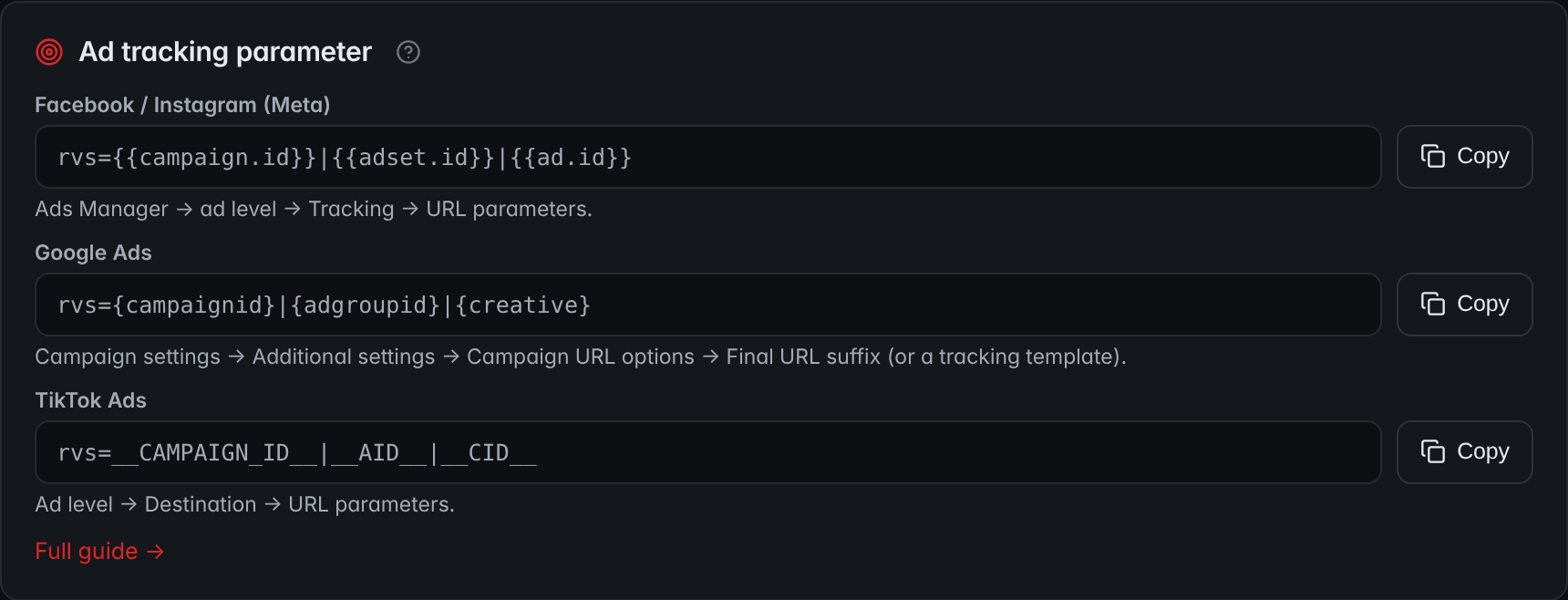
- MetaThe Meta line carries the campaign, ad set and ad IDs; it goes in Ads Manager at ad level, under Tracking → URL parameters.
- Google AdsThe Google Ads line goes in the campaign's Final URL suffix, or in a tracking template.
- TikTok AdsThe TikTok line goes at ad level, under Destination → URL parameters.
A handoff test you can run in 20 minutes; the ticks stay in this browser:
The 20-minute handoff test
0 of 5 done
Video sales funnel math: front end, back end and allowable CPA
Whether a funnel can scale comes down to how much you can afford to pay for a customer. That number comes from the whole funnel, not the front-end price.
Here is a worked example with illustrative numbers. An offer sells a $69 product with a $19 order bump, a $97 one-click upsell, and a $47 downsell for buyers who decline the upsell. Out of 10,000 ad clicks:
From 10,000 ad clicks to 240 buyers
Illustrative worked example
- Ad clicks to the presell10,000
- Clicked through to the VSL40% of the step before4,000
- Reached the pitch40% of the step before1,600
- Clicked the CTA37.5% of the step before600
- Bought40% of the step before240
That's a 2.4% conversion rate per ad click and 6% per VSL visitor. Now the revenue each buyer brings in:
What one buyer brings in
Illustrative offer: revenue per buyer, line by line
The 240 buyers bring in $23,712: $2.37 per ad click, or $5.93 per VSL visitor. Without the upsell and downsell, the same traffic brings in $17,928, or $1.79 per click.
Next, turn revenue into what you can afford. Say refunds, payment fees and fulfillment take 30% of revenue:
- Contribution per buyer, full funnel: $98.80 × 0.70 = $69.16. This is your break-even CPA.
- Contribution per buyer, front end and bump only: $74.70 × 0.70 = $52.29.
- Break-even CPC: contribution per buyer × conversion rate per click. Full funnel: $69.16 × 0.024 = $1.66. Front end only: $52.29 × 0.024 = $1.25.
- Allowable CPA with a profit target: if you want $20 profit per buyer, you can pay up to $49.16 per sale, or about $1.18 per click.
Here is the same math per ad click, starting from this example: 10,000 clicks, 240 orders at $98.80 and the 70% left after those costs. Change the numbers to your own:
Calculator
Revenue per visitor calculator
From one traffic source or one VSL over the same period.
- Conversion rate
- orders ÷ unique visitors
- Revenue
- Break-even cost per visitor
- the most a visitor can cost you
If one ad click brings one visitor, the break-even cost per visitor is also your break-even cost per click.
The back end raised break-even CPA by about 32%, from $52.29 to $69.16. That headroom is what lets one advertiser outbid another for the same audience and still make money. It's also why a weaker upsell can hurt you even though it never touches the front-end conversion rate.
Three rules keep this math honest:
- Use net numbers. Subtract refunds and chargebacks, and recheck once your guarantee window has passed and late refunds have landed.
- Count follow-up revenue only after you've measured it. If email adds a measured amount per buyer within 60 days, you can include it, but you pay for the click today and collect later, so check your cash flow.
- Judge tests by revenue per ad click or per visitor. A presell that raises VSL conversion by sending fewer, warmer people can still lower revenue per ad click. Revenue per visitor explains why it's the better north star.
Which funnel variant fits your offer?
The seven stages combine into a handful of common shapes. Pick by price, by how warm your traffic is, and by how many distinct buyer types you serve.
Which funnel variant fits your offer?
Up to four questions: price, buyer types, how warm the traffic is, where the ads run
Is the offer high ticket, or a low-price impulse purchase?
Do you serve several distinct segments that should see different videos?
How warm is the traffic?
Do the ads run in native placements, with a story-led offer?
Best fit
VSL to call
Fits when: the offer is high ticket, complex or custom. Path: ad, VSL, application, sales call. Watch first: cost per booked call, show rate, close rate.
Best fit
Mini-VSL front end
Fits when: the price is low and the purchase is an impulse buy. Path: ad, short VSL, low-ticket checkout, upsells. Watch first: order value after upsells.
Read more: Mini VSL: How to Script, Time and Test a Short VSL
Best fit
Quiz to VSL
Fits when: you serve several distinct segments. Path: ad, quiz, result VSL, checkout. Watch first: completion rate, revenue per visitor by segment.
Best fit
Direct to VSL
Fits when: the traffic is warm or product-aware and the offer is simple. Path: ad, VSL, checkout. Watch first: unmute rate, pitch retention.
Best fit
Advertorial to VSL
Fits when: the ads run in native placements and the offer is story-led. Path: native ad, labeled advertorial, VSL. Watch first: click-through, revenue per ad click.
Read more: Advertorial: What It Is, Structure and Labeling Rules
Best fit
Presell to VSL
Fits when: cold traffic needs context before the video. Path: ad, presell, VSL, checkout. Watch first: click-through, revenue per ad click.
Read more: Presell Page: What It Is, Formats and How to Write One
Evergreen vs launch funnels
An evergreen funnel runs every day with the same pages, and you scale it by buying more traffic at a stable revenue per click. A launch funnel opens for a fixed window, often with a video series or a live event, and then closes. Launches concentrate sales and give urgency a real reason. Evergreen funnels give you steady data and steady cash.
Urgency is the hard part of an evergreen funnel, because nothing about the offer naturally ends. A countdown that restarts on every visit is fake scarcity, and the FTC's 2022 dark patterns report calls out countdown timers designed to make people believe they only have a limited time to buy (FTC press release). If you use a deadline, make it real: a bonus that actually ends, a price that actually changes, a page that actually comes down.
VSL to call for high ticket
When the price is high or the offer has to be fitted to the buyer, the VSL's job changes from "buy now" to "book a call", and the metrics change with it: cost per booked call, show rate and close rate. The VSL-to-call funnel guide covers application questions, show-up tactics and how to send closed deals back to your ad platforms.
Where should you start fixing a VSL funnel?
Start with tracking, because every other diagnosis depends on it. If the sales in your analytics don't match the orders in your store, fix that first, or you'll spend weeks optimizing noise.
Then find the stage with the biggest drop compared with your own baseline. Published averages mix different prices, traffic sources and definitions, so they can't tell you whether 31% pitch retention is good for your offer. Your last four weeks can.
When two stages look equally weak, fix the upstream one first. A gain at the top multiplies through every stage below it: 10% more viewers reaching the pitch means 10% more CTA clicks if the click rate holds, and the same lift flows into orders and upsells.
| Symptom | Likely stage | First check |
|---|---|---|
| Good CTR, few VSL plays | Bridge or page load | Presell click-through; first-frame time on mobile |
| Plays fine, early retention cliff | Ad-to-video match or hook | Does the first line pay off the ad's promise? |
| Good retention, few CTA clicks | Offer or pitch | Price, bundle and guarantee presentation; button timing |
| Many CTA clicks, few orders | Checkout | Mismatch with the video, load time, payment declines |
| Orders fine, thin profit | Back end or costs | Upsell revenue per buyer, refunds, fulfillment costs |
| Ad platform shows fewer sales than your store | Tracking | Click ID passback, deduplication, payment methods that skip the thank-you page |
Make one change at a time and test it against the current version on split traffic. In RevvyScales, a folder splits new visitors between VSLs by weight and keeps each visitor on the version they first saw (folders and A/B splits).

- RPVRevenue per visitor of each version: the number to judge the test by.
- Traffic %The weight each VSL gets; new visitors are split by it and stay on the version they first saw.
How to build a VSL funnel: a step-by-step checklist
- Do the math before the copy. Write down price, bundles, bump, upsells, a refund assumption and variable costs, then compute break-even CPA. If it's lower than what you expect to pay for a customer, fix the offer before you write a word.
- Pick the variant from the decision tree above, based on price and how warm your traffic is.
- Write the VSL and any bridge copy together, so the bridge's last line hands off to the video's first line.
- Build the VSL page: a headline that echoes the ad, the video at the top on mobile, the pitch time set, an offer block that mirrors the script, the guarantee and a legal footer.
- Build the checkout with the same product names, bundles and prices as the pitch, an unticked order bump, and any recurring charge spelled out next to the button.
- Build the upsells with a clear yes and an equally clear "No thanks" link.
- Write the thank-you page: confirmation, next steps, support contact, and conversion reporting with the order value.
- Wire the tracking: pixels plus server-side events, campaign parameters on every ad, click ID passback from the thank-you page. Then run the handoff test above.
- Set up follow-up by behavior: early leavers, pitch reached, checkout abandoned, buyers.
- Do a compliance pass: substantiated claims, real testimonials used with permission, labeled advertorials, clear subscription terms. The VSL compliance guide has the full checklist. This is not legal advice; check the primary sources and your own counsel.
- Launch on a test budget and record a baseline over at least one full week of steady traffic before you change anything.
- Run one test at a time, judged by revenue per ad click, and check refunds before you call a winner.
What to do this week
- Put your own numbers into the funnel math above and compute break-even CPA and break-even CPC.
- Run the 20-minute handoff test on desktop and on a phone.
- Pull the last four weeks of stage metrics and mark the biggest drop against your own baseline.
- Choose one test for that stage, write down the metric that will decide it, and start it on split traffic.
Frequently asked questions
What is the difference between a sales funnel and a video sales funnel?
A sales funnel is any sequence of steps that leads a prospect to a purchase. A video sales funnel is one where a video sales letter does the main persuading, usually on a dedicated page where the offer appears at the pitch. The surrounding steps (ads, presells, checkout, upsells, follow-up) work the same way, but you also track video metrics such as play rate and pitch retention.
Do I need a presell page before my VSL?
No. A presell is worth adding when cold traffic needs context before a long video, or when your ads run in placements where people expect to read. It also adds a step where visitors can leave. Test it: send the same ad straight to the VSL and through the presell, and keep whichever earns more revenue per ad click after refunds.
What is a good conversion rate for a video sales funnel?
There is no reliable universal number, because published figures use different denominators (ad clicks, page visitors, video viewers), prices and traffic sources. Work backward instead: required conversion rate per click equals your cost per click divided by your allowable cost per sale. At a $1.20 CPC and a $49 allowable CPA, you need about 2.4% of clicks to buy.
How much traffic do I need to test a video sales funnel?
Enough to see orders, not just clicks. Small differences need large samples: telling a 1.8% conversion rate per click from 2.1% at 95% confidence and 80% power takes roughly 33,000 clicks per version. Large differences show up sooner. Use a significance calculator, run full weeks so weekday swings even out, and do not stop a test the first day one version leads.
Can a video sales funnel work for physical products?
Yes. E-commerce funnels often use a shorter, demonstration-led VSL, bundle offers at the pitch (one, three or six units, for example), an order bump such as a related accessory, and a post-purchase upsell. Checkout usually stays on the store platform, so the important part is reporting each sale and its full value back to your analytics and to the ad platform.
What tools does a video sales funnel need?
At minimum: an ad account, a host for the VSL page and any presell, a checkout that supports order bumps and post-purchase offers, an email or SMS tool for follow-up, and tracking that ties each sale to the ad that produced it. RevvyScales covers the VSL and presell pages, split tests, tracking and analytics. Checkout stays on your own platform, such as Shopify, Whop or CartPanda.