
Nutra operators and their playbooks
Gabriel Medeiros: what V Shred's former media buying director learned about scaling cold traffic
Gabriel Medeiros is a Brazilian media buyer who rose to director at V Shred, the US fitness and supplement brand known for its quiz funnel and VSLs, and now leads media buying at Performance Golf. Here is what he has said publicly about cold traffic, budgets, metrics and creative.
On this page
- Who is Gabriel Medeiros?
- Gabriel Medeiros at V Shred: the products and the funnel
- Cold traffic is the engine; retargeting is the add-on
- The old ad that scaled
- The lifetime-budget technique
- Meta is a speedboat, Google is a cruise ship
- Net loss per trial: the metric finance cares about
- Creative: the spokesperson, the first three seconds and AI avatars
- Brand vs performance
- How he makes decisions: break it down, then score it
- How to apply his ideas to a VSL offer
- Frequently asked questions
Gabriel Medeiros is a Brazilian performance marketer who moved to the US in 2015, worked on digital spend at MGM Resorts and Google Shopping at Zappos, and joined V Shred as a Facebook marketing specialist. He became director and grew the media team from 6 to 20 people. He now leads media buying at Performance Golf. His lessons: cold traffic drives everything, metrics should match what finance can afford, and Meta and Google need opposite temperaments.
The material below comes from his own site, askgabe.co, and a long podcast interview published in March 2026. Revenue figures for the companies he worked at are left out.
Who is Gabriel Medeiros?
Medeiros was a marketing manager in Brazil before moving to Las Vegas in 2015. His site lists the steps that followed: managing digital spend across 11 casinos at MGM Resorts, optimizing Google Shopping bids at Zappos (including Black Friday shifts starting at 4am), and then V Shred, where he became director and grew the team from 6 to 20. Today he describes himself as VP of Media Buying at Performance Golf, and he answers questions from marketers and business owners in English and Portuguese (askgabe.co).
In the interview he described the V Shred years in more detail. He joined as a Facebook marketing specialist, was promoted to manager and then director, and stayed about six years. At Performance Golf he was hired to build the media team from scratch.
In order, the path looks like this:
From Brazil to V Shred and Performance Golf
From his site and a podcast interview (March 2026)
- BrazilA marketing manager, before moving to Las Vegas in 2015.
- MGM ResortsManaging digital spend across 11 casinos.
- ZapposOptimizing Google Shopping bids, including Black Friday shifts starting at 4am.
- V ShredHe joined as a Facebook marketing specialist, was promoted to manager and then director, and stayed about six years. He grew the media team from 6 to 20 people.
- Performance GolfHired to build the media team from scratch. Today he describes himself as VP of Media Buying.
Gabriel Medeiros at V Shred: the products and the funnel
V Shred sells workout programs, supplements and coaching, and its homepage invites visitors to take a quiz (vshred.com). Medeiros said the supplements (a fat burner, a testosterone booster and others) and the quiz-based product were the core sellers. His site says V Shred ran one quiz funnel, essentially unchanged, for about seven years.
The ads and VSLs were built around a spokesperson, Vince, the face of the brand, with copywriters briefing what he would say on camera. The team structure Medeiros and the owner aimed for paired one media buyer with one video editor, so every buyer could ship new creative constantly. By his account, they tested more ads than their competitors.
If you are choosing between a quiz and a straight VSL for your own offer, his site lists "quiz vs VSL" among the questions he gets most, and our quiz funnel guide covers when each wins.
Cold traffic is the engine; retargeting is the add-on
One of his first projects at V Shred was a structured retargeting setup: audiences of people who added to cart without buying, people who started checkout, and people grouped by how much of the VSL they had watched. He expected a big gain. By his estimate it added about 20%, which disappointed him.
His conclusion was that retargeting squeezes extra value out of traffic you already bought; it doesn't transform a business. The cold campaigns did the real work. Because heavy cold spend shows the ads to the same people many times, the cold campaigns were already doing much of the remarketing.
Google Shopping played a similar supporting role. It mostly caught people who had seen the VSL and then searched for the product, so it grew when cold traffic grew. The lesson for a VSL offer: put your best people and most of your creative effort on cold acquisition, and treat retargeting and branded search as amplifiers of it.
The old ad that scaled
His breakthrough at V Shred didn't come from a new creative. He took over a cold campaign and, instead of editing new ads, reused an old one that had performed well about a year earlier and had gone dormant. By his account, he scaled it to roughly $100,000 a day in spend within about a month, well beyond where other buyers had been stuck.
The practical habit: keep an archive of past winners with their dates and results, and retest them every few months. Audiences turn over, the auction changes, and an ad that fatigued last year can be fresh to most of today's buyers. It costs one test budget to find out.
The lifetime-budget technique
His site lists "the lifetime budget trick that nobody talks about" among his topics, and in the interview he explained it. A Meta lifetime budget is spent across the schedule until the end date. V Shred's sales were strongest at weekends, so before the weekend he shortened the campaign's remaining schedule, for example from 90 days to 30, which made Meta spend the remaining budget faster on those strong days. On Monday, when results dipped, he extended it back to 90 days. He said it kept performance steadier.
Here is the weekly cycle, stage by stage:
The lifetime-budget technique
How he described it, and the check to run after each change
1Before the weekend: shorten the schedule
What happens: He shortened the campaign's remaining schedule, for example from 90 days to 30.
Why it matters: A lifetime budget is spent across the schedule until the end date. V Shred's sales were strongest at weekends, and the shorter schedule made Meta spend the remaining budget faster on those strong days.
2On Monday: extend it again
What happens: When results dipped, he extended it back to 90 days.
Why it matters: He said it kept performance steadier.
3After each change: check the campaign
What happens: Watch cost per acquisition and the learning status.
Why it matters: The change in daily pacing can be large, so test it on one campaign first.
Read more: CBO vs ABO: Which Meta Budget Setup Fits Your VSL
Meta's documentation confirms the mechanism: a lifetime budget is paced across the whole schedule rather than day by day (Meta budgets documentation). The worked math and the cautions are in our CBO vs ABO guide. Test it on one campaign, and watch cost per acquisition and the learning status after each change.
Meta is a speedboat, Google is a cruise ship
Medeiros described the two platforms with a metaphor. Meta is a speedboat: once a campaign is out of learning and performing, it reacts quickly to budget changes, so you can scale hard. Google is a cruise ship: it changes direction slowly, so changes need planning and patience.
He also said he no longer runs campaigns himself; his job is the system around the buyers. Two practices from that system:
- Attribution he trusts. On Meta he uses a one-day click window and leaves out view-through conversions, which keeps Meta from claiming sales it didn't cause. On Google, he said, he worked with Google's engineers on a last-click setup for his account.
- Platform relationships. Health and fitness ads often wait in review. At his spend level he negotiated faster ad reviews with Google. Smaller advertisers can't get that deal, but they can keep a queue of approved creatives so a slow review never leaves a campaign with nothing to run.
Net loss per trial: the metric finance cares about
When he joined Performance Golf, the team targeted CPA or net ROAS. He asked the CFO which number mattered most. The answer was net loss per trial: the most the company is willing to lose to acquire a customer, given what that customer is worth later. He moved the team to that metric, and said some offers that had been killed under the old targets came back.
A worked example with illustrative numbers. A trial offer brings in $7 at the front end. The ad cost per trial is $45 and the product and shipping cost $10. Net loss per trial is $45 + $10 − $7 = $48. If finance has agreed that a customer is worth losing up to $60 to acquire, this campaign is healthy, even though its front-end ROAS ($7 of revenue on $45 of ads) looks terrible. Judged on ROAS, it would have been switched off.
The same calculation as a formula:
Net loss per trial
The worked example above, with illustrative numbers
Net loss per trialad cost per trial + product and shipping cost − front-end revenue per trial
A healthy campaignnet loss per trial at or below what finance has agreed a customer is worth losing to acquire
$45 + $10 − $7 = $48 per trial. If finance has agreed that a customer is worth losing up to $60 to acquire, the campaign is healthy, even though its front-end ROAS ($7 of revenue on $45 of ads) looks terrible.
He also stressed net ROAS (the return on ad spend counted after all costs, including product and refunds) over gross ROAS, and noted that physical products need different targets from digital ones because the costs differ. The nutra marketing guide shows how to work out the ceiling for a supplement offer. In RevvyScales, profit tracking subtracts ad spend, product costs and gateway fees from revenue by campaign on the Growth plan and up (profit dashboard).
Here is where those numbers sit in the dashboard:
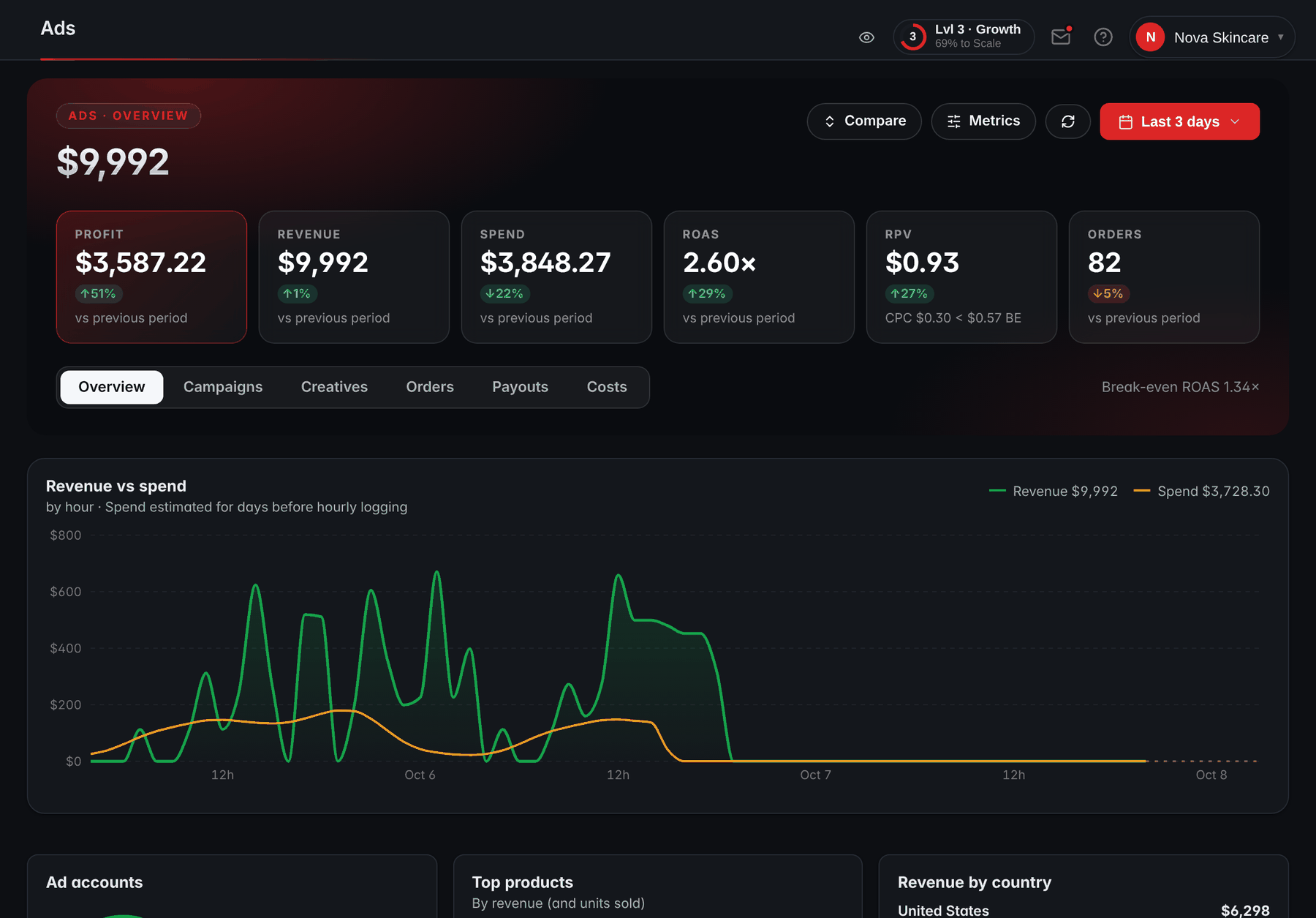
- ProfitProfit is revenue minus ad spend, product costs and gateway fees.
- CampaignsThe Campaigns tab shows ROAS and margin by campaign.
- CostsThe Costs tab is where product costs and payment gateway fees are entered.
Creative: the spokesperson, the first three seconds and AI avatars
Medeiros said Vince's presence on camera drove results: natural delivery, and performance fell when he was taken out of the ads. Adding a credentialed doctor as a second spokesperson, by his account, roughly doubled spend on that launch. Real authority works; borrowed authority (an actor in a lab coat, a "doctor" who isn't one) is deception, and under the FTC's Endorsement Guides an endorser presented as an expert must have the expertise claimed (16 CFR Part 255).
His media buyers obsessed over the first three seconds and over getting the cost per click down. On the page, he recommended testing the VSL's headline and thumbnail, because the first screen changes conversion, but he put ads first, since ads reach far more people than any page tweak.
On AI avatars, he said cheap avatar testing is now easy and admitted nobody knows how it will play out. His guess is that recognizable, trusted people gain value as audiences learn to distrust generic faces. If you test avatars, disclose them where viewers could take them for real customers or experts; the FTC has warned about AI-generated deception in ads (FTC business blog). The VSL presenter guide covers the choice of face.
Brand vs performance
Looking back, Medeiros said V Shred's founders focused almost entirely on performance and let product and brand slide: the site looked like a low-end offer, and reviews suffered because broad targeting brought in buyers the product didn't fit. A clothing line the company invested in heavily also failed.
His argument now is that brand makes paid traffic cheaper to convert and attracts better people, and that direct-response operators will need product quality and brand to last. For a nutra offer, that means reviews you would be happy to show, a product that earns reorders, and a page that doesn't look disposable.
How he makes decisions: break it down, then score it
He says he has no framework, just a way of thinking: break a problem down to the few levers that actually move the result, and ignore the rest. (The host called it first-principles thinking.) To choose between options he described ICE: score each option's impact, confidence and effort, and add the three scores. His own example compared a VSL with handing out flyers by the roadside: the VSL took more effort but won on impact and confidence.
Here is the method applied to three illustrative options, with effort scored so that easier work gets a higher number:
ICE scores for three options
Illustrative scores: impact + confidence + effort, with effort scored so that easier work gets a higher number (10 = easy)
The scores are illustrative. Here the cheap retest wins; in his roadside example the bigger project won. ICE doesn't favor small or large bets; it makes you write down why you expect each one to pay off. He also said bad tests still teach, so the goal is a culture that runs many of them.
How to apply his ideas to a VSL offer
Tick these off as you put his ideas to work; the ticks stay in this browser:
Apply his ideas to a VSL offer
0 of 7 done
Frequently asked questions
Who is Gabriel Medeiros?
Gabriel Medeiros is a Brazilian performance marketer based in the US. After roles at MGM Resorts and Zappos he joined V Shred, the fitness and supplement brand, as a Facebook marketing specialist and became director of its media team, which grew from 6 to 20 people. He now describes himself as VP of Media Buying at Performance Golf.
What is V Shred's funnel?
V Shred sells workout programs, supplements and coaching, and its homepage starts visitors on a quiz. Medeiros says the quiz-based product and the supplements were the core sellers, with ads and VSLs built around the brand's on-camera spokesperson. His site says the company ran one quiz funnel, essentially unchanged, for about seven years.
What is net loss per trial?
It is the most a company is willing to lose to acquire a customer, agreed with finance based on what that customer is worth later. It is calculated as ad cost plus product cost minus front-end revenue per trial. Medeiros moved his Performance Golf team to it from CPA and ROAS targets, which revived offers the old targets had killed.
What is the lifetime budget trick?
A Meta lifetime budget is paced across the campaign's schedule. Medeiros shortened the remaining schedule before strong weekend days so Meta spent the budget faster, then extended it again on Monday when results dropped. The effect is to move spend toward the best days. Test it carefully, because the change in daily pacing can be large.
Is retargeting worth it for VSL offers?
It usually helps, but less than people expect. Medeiros built retargeting audiences for cart abandoners and by VSL watch depth at V Shred and, by his estimate, gained about 20%. Heavy cold traffic already reaches the same people repeatedly. Build retargeting after cold acquisition works, and measure its true lift instead of trusting platform attribution.