
Funnels, traffic and compliance
Advertorial: what it is, how a direct-response advertorial is structured, and how to label it honestly
An advertorial is an ad written in the style of an article. This guide covers where the format comes from, the structure direct-response advertisers use in front of a VSL, how it differs from a presell, how to label it the way the FTC expects, and how to test it.
On this page
- What is an advertorial?
- Advertorial vs presell vs VSL
- The structure of a direct-response advertorial
- How do you label an advertorial?
- Why do fake news layouts, fake bylines and fake doctors backfire?
- How long should an advertorial be?
- How do you test an advertorial?
- An advertorial checklist before you launch
- Frequently asked questions
An advertorial is an advertisement written and designed like an editorial article. In direct response, it's usually a story-led page between a native ad and a VSL: headline, lede, a true story, a discovery, the mechanism, proof and a soft call to action. Because it borrows the look of content, it needs a clear label, such as "Advertisement", so readers know it's an ad.
What is an advertorial?
Merriam-Webster defines an advertorial as "an advertisement that imitates editorial format" and dates the word, a blend of "advertisement" and "editorial", to 1917 (Merriam-Webster). The format is old. What has changed is where it runs and what it leads to.
For most of the 20th century, advertorials were a print format: an ad set in article-style columns and headlines inside a newspaper or magazine. Online, the same idea split into two forms:
- Publisher-hosted sponsored content, written by or with a publisher and run on its site, labeled as sponsored.
- The direct-response advertorial, written by the advertiser, hosted on the advertiser's own domain, and reached from a native ad unit, an in-feed social ad or an email. Its job is to warm a cold reader and send them to a VSL or an offer.
This guide is about the second kind: the native ad advertorial that sits in a video sales funnel between the ad and the video.
Advertorial vs presell vs VSL
All three are steps in the same funnel, but each has a different job. The presell page guide covers the shorter bridge in detail.
Advertorial vs short presell vs VSL
Advertorial
- Format: An article: headline, byline, story, images
- Length to start testing: 800 to 2,000 words
- Job: Make an unaware reader care and believe there's a new answer
- Sells: The idea and the click
- Typical traffic: Native placements, cold social
Disclosure: Needs a clear ad label
Short presell
- Format: A few paragraphs and a button
- Length to start testing: 200 to 500 words
- Job: Nudge a problem-aware reader to watch
- Sells: The click
- Typical traffic: Cold social
Disclosure: Depends on how editorial it looks
VSL
- Format: A video on a sales page
- Length to start testing: Minutes to an hour
- Job: Make the full argument and the offer
- Sells: The product
- Typical traffic: After a bridge, or direct
Disclosure: Plainly a sales page
The disclosure line at the foot of each column follows the FTC's logic: the more an ad looks like editorial content, the more likely it needs a label to avoid misleading people about what it is.
The structure of a direct-response advertorial
Eight parts, written here for a fictional product, an online loose-leash walking course for dog owners. Each part's job is to get the next part read.
The eight parts, in reading order
- The label and the headline"Advertisement" first, then a headline that promises a story worth reading.
- The ledeTwo to four sentences that put the reader inside the problem.
- The storyA true story, told by the real founder or a real customer.
- The discoveryThe moment the narrator learns something that reframes the problem.
- The mechanismWhy the new approach works where the old ones failed, with the full method left to the VSL.
- ProofProof a skeptical reader could check.
- ObjectionsThe two or three doubts that stop readers from clicking, answered honestly.
- The soft CTAIt sells the next step, the VSL, not the product.
1. The label and the headline
The label goes first, above the headline: "Advertisement". The headline then does what an article headline does, promising a story worth reading, without claiming anything the story can't back up.
Example: "Why my dog pulled on the leash for three years, and what finally changed on our walks."
A story headline like this can work on readers who have never heard of you, because it leads with their situation instead of your product.
2. The lede
Two to four sentences that put the reader inside the problem. Concrete details beat adjectives.
Example: "Every walk started the same way. Bailey saw a squirrel, hit the end of the leash, and my shoulder paid for it. I tried two no-pull collars, a stack of training videos and a pocket full of treats."
3. The story
The story is what makes an advertorial readable, and it has to be true. If the narrator is the founder, the byline is the founder's real name and role. If it's a customer, it's a real customer, telling their own experience, with permission. A composite of several people presented as one person's story is a fabrication, however typical it feels.
Keep it moving: short paragraphs, one detail per paragraph, a subhead every few paragraphs so phone readers can find their place.
4. The discovery
The turning point: the moment the narrator learns something that reframes the problem.
Example: "The trainer who finally helped us didn't start with the leash. She started with where Bailey's attention went in the first ten seconds of each walk."
5. The mechanism
Explain, in plain words, why the new approach works where the old ones failed. Give enough to be believable and leave the full method to the VSL. The mechanism must be true and substantiated; for health products, the FTC expects claims to be backed by "competent and reliable scientific evidence" (Health Products Compliance Guidance). The unique mechanism guide covers how to find and name one.
6. Proof
Use proof a skeptical reader could check: a demonstration, real customer reviews used with permission, a named expert who actually holds the view, a source they can look up. If you feature an exceptional result, say what people generally achieve. The FTC's endorsement guidance says that when an endorser's results aren't typical, the ad must make clear what the generally expected results are (FTC Endorsement Guides FAQ).
7. Objections
Handle the two or three doubts that stop readers from clicking. "My dog is too old for training." "I don't have time for sessions every day." One short paragraph each, answered honestly. If the method really doesn't suit some dogs, saying so builds more trust than pretending it fits everyone.
8. The soft CTA
The advertorial sells the next step, not the product. Point to the VSL in plain terms: "The trainer recorded a free presentation that walks through the method step by step." Then a button: "Watch the presentation." Repeat the link in the text after the discovery and after the proof, because readers decide at different points.
How do you label an advertorial?
The FTC's position, set out in December 2015 in its Enforcement Policy Statement on Deceptively Formatted Advertisements and the companion business guide, is that ads should be identifiable as advertising, and that a format is deceptive if it misleads people about its commercial nature (FTC press release; FTC native advertising guide). In practice, for an advertorial:
Use plain words
Label wording in the FTC's native advertising guide
Likely to be understoodPlain words
- "Ad"
- "Advertisement"
- "Paid Advertisement"
- "Sponsored Advertising Content"
Ambiguous or not enoughNot plain enough
- "Promoted" and "Promoted Stories", which the guide calls at best ambiguous
- A company logo or name on its own, which is not likely to be enough
- Put the label in front of or above the headline. The guide notes that disclosures to the right or below are easier to miss.
- Make it readable. Strong contrast against the background, a size people notice, on every device.
- Label the page itself. Readers can land on the full ad directly, from search or social for example, without passing the ad unit. So the guide calls for a disclosure on the page where the complete ad appears, not only on the unit that links to it.
- Label the ad unit too. The native ad that leads to the advertorial must not pretend to be a news story either. The guide calls this a deceptive "door opener".
Here is a before-and-after on the top of the page:
The top of the page, before and after
Before (misleading)
Header: "Daily Health Report" masthead
Label: None
Byline: "By Sarah M., Health Reporter" (invented)
Images: Logos of TV networks
After (honest)
Header: Your brand name
Label: "Advertisement" above the headline
Byline: "By [real name], founder of [brand]"
Images: Real photos from the story
This is not legal advice. Read the FTC's guide in full, and have counsel review advertorials in regulated categories such as health and finance.
Why do fake news layouts, fake bylines and fake doctors backfire?
Because regulators have already shown how they treat them. In April 2011 the FTC asked federal courts to halt ten operators of fake news sites promoting acai berry weight-loss products. According to the FTC, the sites showed logos of outlets such as ABC, Fox News, CBS, CNN and USA Today, the reporters were fictional, the "comments" were more advertising, and the operators didn't adequately disclose that they earned commissions (FTC, April 2011).
The cases kept coming. In December 2011 it went after a merchant that allegedly hired affiliates who used fake news sites, and called it its 11th case involving fake news sites used to promote dietary supplements (FTC, December 2011). In September 2012 it charged an affiliate network that recruited and paid affiliates running such sites (FTC, September 2012). Affiliates, merchants and networks were all in scope.
Who the FTC went after, 2011 to 2012
- April 2011Operators of fake news sitesThe FTC asked federal courts to halt ten operators of fake news sites promoting acai berry weight-loss products.
- December 2011A merchantThe FTC went after a merchant that allegedly hired affiliates who used fake news sites: its 11th case involving fake news sites used to promote dietary supplements.
- September 2012An affiliate networkThe FTC charged an affiliate network that recruited and paid affiliates running such sites.
Other FTC rules point the same way. The Endorsement Guides say an expert endorser's qualifications must actually give them the expertise they're presented as having, and that material connections must be disclosed clearly and conspicuously (16 CFR Part 255). An actor in a lab coat introduced as a doctor fails the first test. Ad platforms police this too: Meta's Unacceptable Business Practices policy, for example, bars ads that use a public figure's image with misleading tactics (Meta Advertising Standards).
There's a commercial cost as well. A reader who feels tricked when they reach the sales page is unlikely to buy, and one who buys and then feels tricked is the one who asks for a refund or disputes the charge. Each deceptive tactic has an honest version that does the same job:
| Deceptive tactic | Honest version |
|---|---|
| News-style masthead | Your brand name, with "Advertisement" above the headline |
| Invented reporter byline | A real author with their real role |
| Actor or invented "Dr." | A qualified expert who holds the view, with any paid relationship disclosed |
| Comments you wrote | Real customer reviews, used with permission |
| "As seen on" logos without coverage | Only coverage that actually happened |
| A countdown that resets | A real deadline, or none |
| An exceptional result shown as typical | The generally expected result, stated clearly |
How long should an advertorial be?
Long enough to tell the story and make the discovery land; 800 to 2,000 words is a sensible range to start testing in. Unaware readers need more setup before they care. Readers who clicked an ad naming their exact problem need less.
Let the reading data decide. If scroll depth shows most readers leave before the discovery, the lede or the first story beat is too slow. If many readers reach the end but few click, the bridge to the video is weak, or the CTA asks for more than the page has earned.
How do you test an advertorial?
Use three numbers: click-through to the VSL, how advertorial traffic behaves on the VSL (unmute rate, pitch retention), and revenue per ad click, which decides. Test in this order, because each element gates the ones below it:
- Headline and lede. They decide whether anyone reads the rest.
- The angle. A different story or discovery for the same product.
- CTA placement and wording.
- Length, usually by cutting, not adding.
A worked example with illustrative numbers shows why click-through alone misleads. Two headlines run on the same body, 5,000 ad clicks each, average order $80:
Two headlines on the same body
Illustrative test: 5,000 ad clicks each, average order $80
Headline A
- Clicked through to the VSL: 1,350 (27%)
- Orders: 54 (4.0% of VSL visitors)
- Revenue: $4,320
- Revenue per ad click: $0.86
Higher click-throughHeadline B
- Clicked through to the VSL: 1,600 (32%)
- Orders: 56 (3.5% of VSL visitors)
- Revenue: $4,480
- Revenue per ad click: $0.90
Headline B's click-through is about 19% higher, but its revenue is only about 4% higher, and 56 orders against 54 is well within noise. B attracted more clicks from people less likely to buy. Keep both running until the order counts can separate them, or call it a tie and test a bigger change.
In RevvyScales, the Advertorial presell template gives you an article-style page whose CTA links to a VSL, a folder or any URL, so you can point one advertorial at a folder and split-test the VSLs behind it (presells help doc).
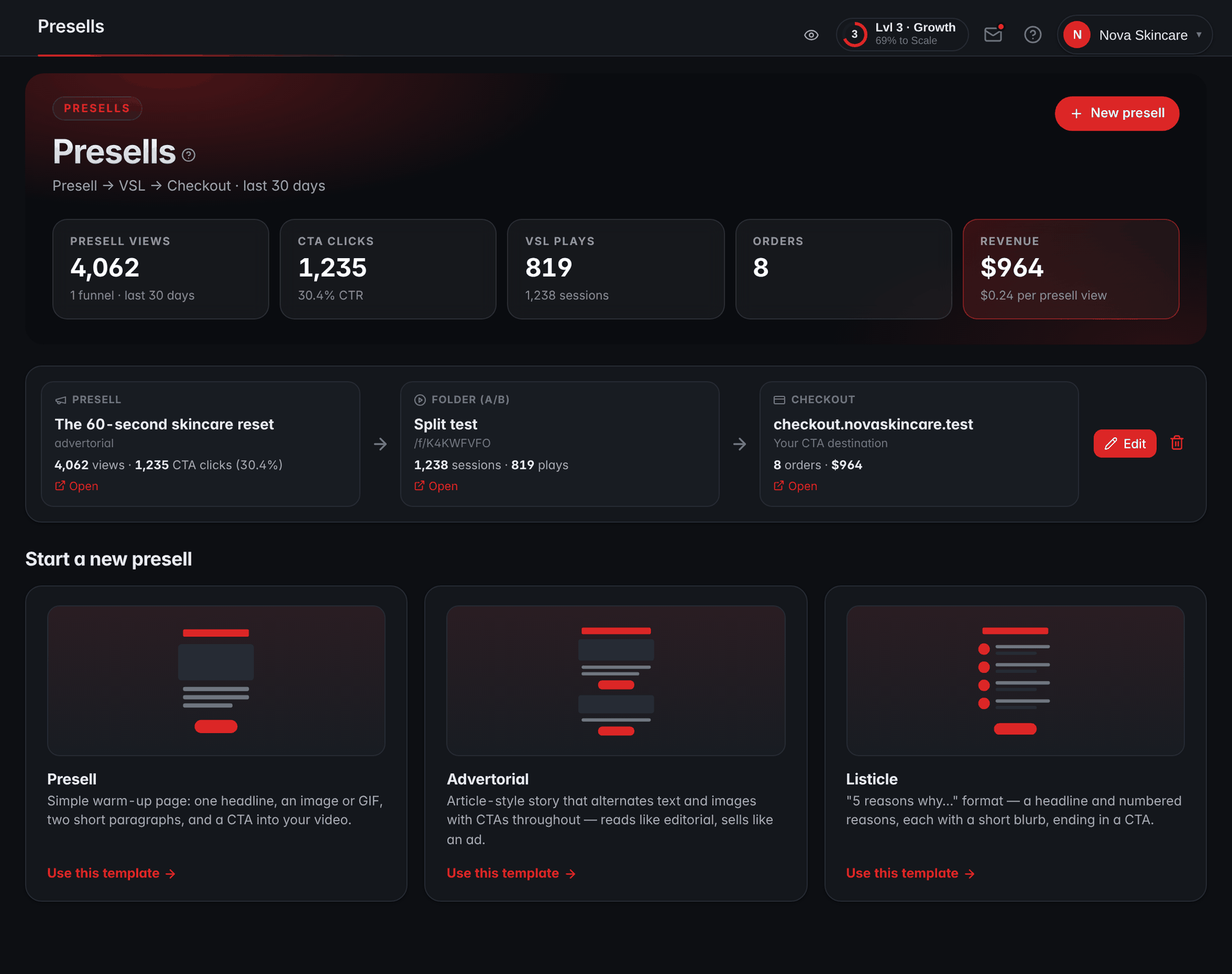
- The advertorialThis advertorial presell shows its views and CTA clicks.
- Folder (A/B)The presell's CTA leads to a folder that splits visitors between VSLs.
- CheckoutThe funnel ends on the checkout, which shows its orders and revenue.
- Advertorial templateThe Advertorial template starts you on an article-style story with CTAs throughout.
An advertorial checklist before you launch
Tick these off before launch; the ticks stay in this browser:
Before you launch
0 of 10 done
For the wider set of rules on claims, testimonials and disclosures across the whole funnel, see the VSL compliance guide.
Frequently asked questions
Is an advertorial legal?
Yes, when it is identifiable as an ad and its claims are truthful and substantiated. In the U.S., the FTC treats ads formatted to look like independent content as deceptive if they mislead people about their commercial nature, so a clear label such as Advertisement matters. Health, finance and earnings claims carry extra requirements. This is general information, not legal advice; check the FTC guidance and your own counsel.
What is the difference between an advertorial and sponsored content?
Both are paid content. Sponsored content usually means a publisher wrote or hosted the piece for a brand and ran it on the publisher site with a sponsorship label. An advertorial is usually written by the advertiser and, in direct response, hosted on the advertiser domain and reached from a native or social ad. Either way, readers must be able to tell it is advertising.
Can an advertorial be written in the first person?
Yes, if the narrator is a real person telling their own true experience, such as the founder or a customer who agreed to share their story. What crosses the line is an invented narrator, a composite of several people presented as one, or a story told as if by an independent reporter when the advertiser wrote it. Name the real author and their role.
Where does advertorial traffic come from?
Typically from native ad networks that place article-style ad units on publisher sites, from in-feed ads on social platforms, and from email or sponsored newsletter placements. Traffic quality varies a lot between placements and sites, so segment your results by placement where your network reports it, and judge each source by revenue per ad click rather than cost per click alone.
Should an advertorial link to a VSL or straight to checkout?
For complex, higher-priced or story-driven offers, link to a VSL: the advertorial creates interest and the video makes the full argument. For simple, low-priced products that need little explanation, a product page or checkout can work. Test both paths with the same advertorial and keep whichever earns more revenue per ad click after refunds.
Sources
- Native Advertising: A Guide for Businesses — Federal Trade Commission (Dec. 2015)
- FTC Issues Enforcement Policy Statement Addressing Native Advertising (Dec. 22, 2015) — Federal Trade Commission
- FTC Seeks to Halt 10 Operators of Fake News Sites (April 19, 2011) — Federal Trade Commission
- FTC Charges Second Affiliate Network of Internet Advertisers with Deceiving Consumers by Using Fake News Sites (Sept. 12, 2012) — Federal Trade Commission
- 16 CFR Part 255 — Guides Concerning Use of Endorsements and Testimonials in Advertising (eCFR)
- FTC's Endorsement Guides: What People Are Asking — Federal Trade Commission
- Unacceptable Business Practices — Meta Advertising Standards
- Advertorial — Merriam-Webster Dictionary