
Funnels, traffic and compliance
Presell page: what it is, when it beats sending ads straight to the VSL, and how to write one
A presell page is the short bridge between your ad and your VSL. This guide covers what it does, when it helps and when it hurts, the three formats, a structure you can copy, where the CTA goes, and how to prove it earns its place with a fair split test.
On this page
- What is a presell page?
- Why does a presell page work?
- Presell page formats: short presell, listicle and advertorial
- How to structure a presell page
- How long should a presell page be?
- Where should the CTA go on a presell page?
- How do you measure a presell page?
- How to split-test a presell against direct-to-VSL
- Presell compliance: what to avoid
- A presell launch checklist
- Frequently asked questions
A presell page is a short page between your ad and your VSL that gets a cold visitor ready to watch. It repeats the ad's promise, makes the problem concrete, hints at a new explanation and hands off to the video with one clear call to action. It can be a short presell, a listicle or a labeled advertorial. Keep it only if it raises revenue per ad click.
What is a presell page?
A presell page (also written pre-sell page, and often called a bridge page) is the page a visitor sees after clicking your ad and before your VSL. It doesn't sell the product. It sells the next step: watching the video.
Where the presell sits
- Your adThe visitor clicks its promise.
- The presell pageRepeats the ad's promise, makes the problem concrete and hints at a new explanation. It sells the next step: watching the video.
- Your VSLExplains the new idea in full, then shows the product, the price and the offer.
That distinction shapes everything on the page. A presell that tries to close the sale competes with your own VSL. A presell that explains the whole mechanism leaves the video nothing new to say. The best presells end with the reader curious and convinced the video is worth their time.
In a video sales funnel, the presell is optional. It's one of the bridge options between the ad and the VSL, along with the quiz funnel, and it has to earn its place in a test.
Why does a presell page work?
A presell adds a step, and every step loses people. It wins only when it changes who arrives at the VSL and how ready they are to watch. Four mechanisms do that work:
- It warms cold traffic. Someone scrolling a feed who clicks an ad about houseplants dying is not ready for a 15-minute video. Ninety seconds of reading that names their situation and gives them a reason to care can move them from mildly curious to wanting to see the answer.
- It filters. Readers who don't recognize themselves in the page leave before they reach the video. The people who click through have selected themselves, so more of them tend to watch to the pitch.
- It carries the ad's voice forward. An ad written as a story or a tip can land on a page in the same voice, instead of jumping straight into a sales video. That continuity keeps the click from feeling like a bait-and-switch.
- It frames the video. A good presell tells the reader what the video will show and why it's different, so they press play already expecting the hook.
There is also a policy angle, and it is not a loophole. Ad platforms review where an ad sends people. Google's Misrepresentation policy, for example, treats inconsistencies between the ad and the landing page as misleading ad design (Google Ads policy). A presell written in the ad's tone keeps the first page consistent with the ad. It does not make a non-compliant VSL acceptable. If the video makes claims you couldn't put in the ad, fix the video.
When a presell hurts
Skip it, or test it with low expectations, when the traffic is warm, when the visitor is product-aware, or when the VSL already opens with a strong, matching hook. Three questions tell you which case is yours:
Does this traffic need a presell?
Is the traffic warm: retargeting audiences, email subscribers or branded-search visitors?
Is the visitor product-aware: do they already know your product and want the offer?
Does the VSL already open with a strong hook that matches the ad?
Best fit
Warm traffic: skip it, or test it with low expectations
Retargeting audiences, email subscribers and branded-search visitors already know you. Make them read a bridge page and some of them leave.
Best fit
Product-aware visitors: skip it, or test it with low expectations
The visitor is product-aware. People searching for your product by name want the offer, not a story.
Best fit
A VSL that already hooks: skip it, or test it with low expectations
Cold traffic that isn't product-aware, but the VSL already opens with a strong, matching hook. If the first minute of the video does the presell's job, the page only adds a step.
Best fit
Test a presell
Cold traffic that isn't product-aware, and a VSL that doesn't open with a strong, matching hook. A presell helps most with cold, problem-aware traffic and native ad placements: it can warm, filter, carry the ad's voice forward and frame the video. Test it against sending the same ad straight to the VSL, and keep it only if it raises revenue per ad click.
Presell page formats: short presell, listicle and advertorial
Here are the three formats side by side:
Three presell formats
Short presell
What it looks like: Headline, a few short paragraphs, one image, a button
- Length to start testing: 200 to 500 words
- Best for: Paid social traffic that needs a nudge
Watch out for: Saying too little to change anything
Listicle
What it looks like: "5 reasons..." with a short item each
- Length to start testing: 500 to 1,200 words
- Best for: Comparison shoppers, e-commerce
Watch out for: Padding items; posing as an independent ranking
Advertorial
What it looks like: An article-style story with a discovery and a soft CTA
- Length to start testing: 800 to 2,000 words
- Best for: Native ad placements, story-led offers
Watch out for: Looking like a news site; a missing ad label
The word counts are starting points, not rules. The advertorial guide covers that format in depth, including how to label it.
A listicle has its own honesty trap. If you wrote the list and your product always wins, don't present it as an independent review. The FTC's 2022 dark patterns report calls out comparison shopping sites that claim to be neutral but rank companies by compensation (FTC press release). Present your listicle as what it is: your brand explaining why its approach works.
How to structure a presell page
Seven parts, in order. Each one has a single job: get the next part read.
The seven parts of a presell page
1A headline that matches the ad
What happens: Repeat the ad's promise in similar words, so the visitor knows they're in the right place.
What goes wrong:
- A different promise on the presell makes people wonder whether they clicked the wrong thing.
2A lede that names the reader's situation
What happens: One or two sentences the reader nods along to. Specific beats clever.
3The problem, made concrete
What happens: Explain why the usual fix fails, in short paragraphs and true terms.
Why it matters: This is where the reader starts to feel that someone finally understands their situation.
4A hint of the new idea
What happens: Name the new way of looking at the problem, but leave the full explanation for the video.
Why it matters: The presell opens the loop; the VSL closes it.
5One piece of honest proof
What happens: A real photo, a demonstration, a customer quote used with permission, a credible source.
Why it matters: One strong, true item beats five vague ones.
6The handoff
What happens: Tell the reader what the video shows. If you mention its length, state it accurately.
What goes wrong:
- Calling a 40-minute VSL a "short video" is a promise the video breaks in minute three.
7The CTA
What happens: A button that says what happens next, such as "Watch the presentation".
What goes wrong:
- Not "Buy now", and never an image of a play button that pretends the video is on this page.
Example: a short presell for a fictional product
Notice what the example doesn't do: it doesn't name the product, show a price, or explain how the insert works. Those belong to the VSL.
How long should a presell page be?
Long enough to change the reader's state, and no longer. Use awareness as your starting point (the levels of awareness guide explains the framework):
- Problem-aware readers who clicked an ad naming their problem: start with a short presell. They already care; they need a reason to believe the video has a new answer.
- Unaware readers from native placements, who clicked an interesting headline: they need a story before they care, so test an article-length advertorial.
- Solution-aware readers comparing approaches: a listicle that compares methods honestly fits how they already think.
Then let the data decide. If most readers never scroll to the first CTA, the page is too long or the first screen is too weak. If click-through is high but VSL retention is poor, the presell is probably promising something the video doesn't deliver.
Where should the CTA go on a presell page?
One destination, one action. Every link on the page goes to the VSL, or to the folder that splits traffic between VSL variants. No site navigation, no "related articles", no social links.
Repeat the CTA where readers decide. An in-text link right after the hint of the new idea, a button after the handoff paragraph, and a final button at the end. Readers commit at different points, and a long page with one button at the bottom loses the early deciders.
Test an early button on short presells. Some visitors are already convinced by the ad. A visible button in the first screen lets them go straight to the video. On story-led pages an early button can send people to the VSL before the setup has done its work, so test it rather than assuming.
Make it easy on a phone. Full-width buttons, large tap targets, and no sticky bars that cover the text people are trying to read.
In RevvyScales, presells use the Presell, Advertorial or Listicle template. The CTA can link to a VSL, a folder or any URL, and pixels flow from the funnel, so you don't set them up twice. On Growth plans and up, a presell can also have its own lead-capture gate. Setup is in the presells help doc.
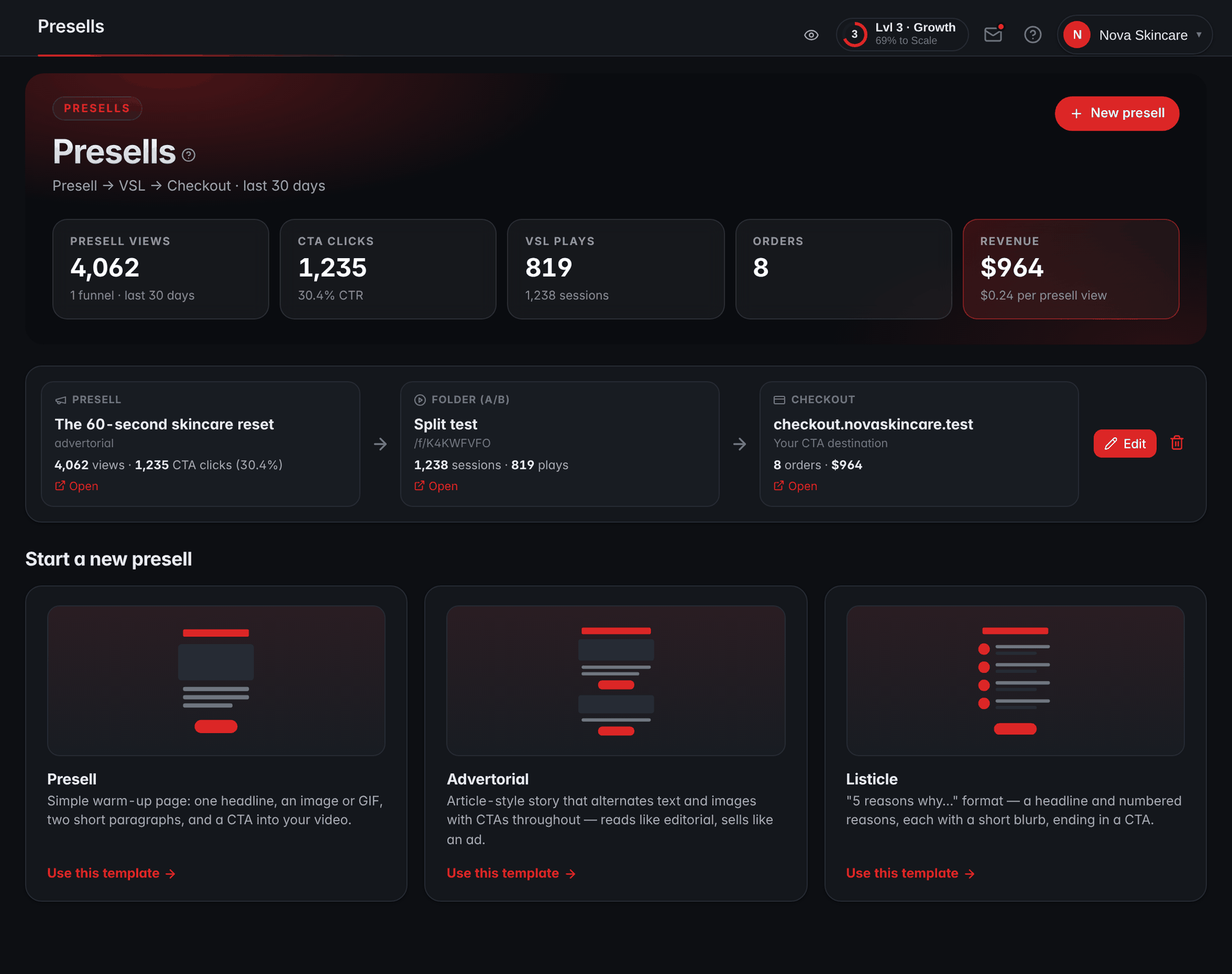
- PresellThe funnel's first page shows its views and CTA clicks.
- Where the CTA leadsHere the CTA leads to a folder that splits visitors between VSLs (A/B).
- CheckoutThe checkout at the end of the funnel shows its orders and revenue.
- TemplatesA new presell starts from one of three templates: Presell, Advertorial or Listicle.
How do you measure a presell page?
Four numbers, and only one of them gives the verdict:
- Presell click-through rate = clicks to the VSL ÷ presell visitors. It diagnoses the presell itself.
- VSL engagement for presell traffic: unmute or play rate and pitch retention. It shows whether the presell sends people ready to watch, or people who clicked out of curiosity.
- Revenue per ad click = total revenue ÷ ad clicks, counting everyone who never left the presell. This is the verdict.
- Refund rate for buyers who came through the presell. A presell that over-promises shows up here weeks later.
Here is why the verdict has to be revenue per ad click. In this illustrative test, the same ad sends 1,000 clicks to each of three paths, and the average order is $90:
Revenue per ad click on three paths
Illustrative test: the same ad sends 1,000 clicks to each path; average order $90
Presell A turns 1,000 clicks into $1,890, or $1.89 per click, against $1.62 for the direct path: about 17% more. Presell B has the best VSL conversion rate of the three, 6.0%, and the worst result: $1,350, or $1.35 per click. It filtered out too many people who would have bought. A VSL conversion rate usually looks better behind a presell, because the presell removes the least interested visitors. Only revenue per ad click tells you whether that filtering paid. The revenue per visitor guide goes deeper on this metric.
How to split-test a presell against direct-to-VSL
- Hold everything else constant. Same ad, same audience, same budget, same dates. The cleanest setup is one ad pointing at a redirect that splits new visitors 50/50 and keeps each one on the same path, so both arms share the same delivery. Duplicating the ad with two destination URLs also works, but the two copies won't necessarily reach the same people.
- Pick the metric before you start: revenue per ad click, with refund rate as a guardrail.
- Run full weeks, so weekday and weekend behavior even out in both arms.
- Wait for enough orders. Small differences need large samples. Telling a 1.8% conversion rate per click from 2.1% at 95% confidence and 80% power takes roughly 33,000 clicks per arm. Big differences show up much sooner, so use a significance calculator rather than a gut feeling.
- Then test inside the presell, one element at a time: headline first, then the lede, then the proof, then CTA wording and placement, then length.
The calculator starts from step 4's numbers: 1.8% per click, and a lift to 2.1%, entered as 16.67% relative. Change them to size your own test:
Calculator
A/B test sample size calculator
How many visitors each version needs before a difference in conversion rate means something.
- Visitors in all
- Days at your traffic
- Orders per version at the current rate
95% confidence and 80% power, the usual defaults for comparing two conversion rates. Fix the sample before you start and read the result when it is reached: stopping the moment one version pulls ahead finds winners that aren’t there. With more than two versions, each is compared with the control and needs this many visitors.
One caveat. A presell sometimes lets you run a different ad, such as an article-style ad that would feel jarring if it landed directly on a sales video. Then you're testing a whole path, not a page, and the fair comparison is profit per dollar of ad spend for each path.
Presell compliance: what to avoid
The tactics that make presells look shady are also the ones regulators have pursued. A few lines you shouldn't cross (this is not legal advice; check the primary sources):
- Don't impersonate a news site. In April 2011 the FTC asked federal courts to halt ten operations that, it alleged, used fake news sites to sell acai berry weight-loss products: pages made to look like real journalism, with the names and logos of major media outlets, fictional reporters and "comments" that were really more advertising. David Vladeck, then director of the FTC's Bureau of Consumer Protection, put it bluntly: "Almost everything about these sites is fake." (FTC press release).
- Label article-style pages as ads. The FTC's native advertising guidance says ads must be identifiable as advertising, and it lists labels such as "Advertisement" and "Paid Advertisement" as likely to be understood (FTC guide).
- Don't invent people. No made-up reporters, doctors or customers, and no comments you wrote yourself. The FTC's rule on consumer reviews and testimonials, in effect since October 21, 2024, bans fake testimonials, including AI-generated ones (Federal Register).
- Keep claims consistent from ad to VSL. The presell can't promise what the video won't back up, and neither can say what you couldn't substantiate.
The VSL compliance guide has the full checklist for claims, testimonials and disclosures.
A presell launch checklist
Tick these off before you send traffic; the ticks stay in this browser:
Before you send traffic
0 of 8 done
Frequently asked questions
What is the difference between a presell page and a landing page?
A landing page is any page an ad sends people to, and it usually asks for the main action: buy, sign up or book. A presell page is a specific kind of landing page whose only job is to prepare the visitor for the next page, usually a VSL. It sells the click to the video, not the product, so it avoids prices and leaves the full explanation to the video.
Should a presell page include a video?
Usually not a second sales video, because it competes with the VSL that follows. A short clip can help when it demonstrates the problem, such as a ten-second demonstration of the old way failing. Keep it brief, make sure it plays muted with captions, and test the page with and without it, judged by revenue per ad click rather than click-through alone.
Can a presell page collect email addresses?
Yes, but each field you add is a reason to leave before the VSL. Collecting emails makes sense when you have a follow-up sequence that earns more than the visitors you lose. Say plainly what people will receive, keep it optional unless you are testing a gate, and compare revenue per ad click with and without the form, counting the follow-up revenue you actually measure.
Is a presell page the same as a bridge page?
In practice, yes. Affiliate marketers often say bridge page for a page that sits between their ad and a merchant offer, and VSL advertisers say presell for a page that sits between the ad and their own video. The job is the same in both cases: match the ad, warm and filter the visitor, and hand off to the next page with one clear call to action.
How many presell variations should I test at once?
Usually one challenger against your control, plus the direct-to-VSL arm if you have never tested it. Every extra arm splits your traffic and stretches the time to a reliable answer. Change one major element per challenger, starting with the headline, and only run several challengers at once if your traffic can give each arm enough orders within a few weeks.
Sources
- Native Advertising: A Guide for Businesses — Federal Trade Commission
- FTC Seeks to Halt 10 Operators of Fake News Sites from Making Deceptive Claims About Acai Berry Weight Loss Products (April 19, 2011) — Federal Trade Commission
- FTC Report Shows Rise in Sophisticated Dark Patterns Designed to Trick and Trap Consumers (Sept. 15, 2022) — Federal Trade Commission
- Misrepresentation — Google Ads Policies Help
- Trade Regulation Rule on the Use of Consumer Reviews and Testimonials — Federal Register (Aug. 22, 2024)