
Funnels, traffic and compliance
Upsell funnel: order bumps, one-click upsells, downsells and upsell VSLs that raise revenue per visitor
An upsell funnel is the sequence of offers around and after the main purchase. This guide compares order bumps, one-click upsells and downsells, shows what to offer and how to script a short upsell video, works through the math, and covers the rules for honest consent and subscriptions.
On this page
- What is an upsell funnel?
- Order bump vs one-click upsell vs downsell
- What should you offer in an upsell?
- How to script an upsell VSL
- Upsell funnel math: judge by revenue per visitor, not take rate
- How should you sequence upsells?
- Upsell ethics, consent and subscription rules
- How do you test upsells?
- An upsell funnel checklist
- Frequently asked questions
An upsell funnel is the sequence of extra offers a buyer sees around the main purchase: an order bump on the checkout page, then one or more one-click upsells after payment, with a downsell for buyers who decline. Done well, it raises average order value and revenue per visitor without touching the front-end conversion rate. Judge every offer by net contribution per buyer, not by take rate.
What is an upsell funnel?
An upsell funnel is the back end of a video sales funnel: everything a buyer is offered between deciding to buy and landing on the thank-you page. A typical sequence:
A typical upsell sequence
- Checkout with an order bumpA small add-on next to the payment form.
- Upsell oneA page after payment, often with a short video.
- Downsell oneShown only to buyers who declined upsell one.
- Upsell twoOptional.
- Thank-you pageWith access details and next steps.
It works because of timing. The buyer has just made a decision, their payment details are on file, and a relevant add-on costs them one click instead of a second checkout. For the advertiser, the back end often decides how much you can afford to pay for a customer: the front end acquires buyers, and the back end helps pay the ad bill.
A few terms get used loosely. An upsell is more of the same or a better version. A cross-sell is a different, related product. A downsell is a smaller or cheaper option after a no. OTO (one-time offer) is common shorthand for a post-purchase upsell, but only call it one-time if it really is.
Order bump vs one-click upsell vs downsell
The three differ in where they appear, how big they are and how the buyer says yes:
Order bump vs one-click upsell vs downsell
Order bump
- Where: on the checkout, next to the payment form.
- Size: small relative to the main order.
- How the buyer says yes: ticks an unticked box.
- Typical offer: an accessory, a short add-on guide, express processing.
Main risk: pre-ticked boxes and buyers who didn't notice.
One-click upsell
- Where: a page after payment, before the thank-you page.
- Size: can match or exceed the front-end price.
- How the buyer says yes: clicks "Yes, add this to my order".
- Typical offer: more units, an advanced version, a done-for-you service, a membership.
Main risk: pushy pages, offers that undo the front end.
Downsell
- Where: after a buyer declines an upsell.
- Size: smaller or cheaper than the declined offer.
- How the buyer says yes: same as the upsell.
- Typical offer: a lighter version, fewer units, a payment plan.
Main risk: endless chains that feel like a trap.
One-click upsells are a checkout feature: the checkout platform charges the payment method the buyer just used. RevvyScales has no checkout builder, so the checkout and the upsell pages stay on your own platform. What RevvyScales does is host the videos: you can embed the player on your upsell page and restrict it to your own domains with domain lock (embedding and domain security).
What should you offer in an upsell?
Upsell offers tend to fall into five types. Here they are for a fictional phone-photography course:
Five types of upsell offer
Examples for a fictional phone-photography course
More
More of the same, often at a lower unit price.
A pack of 50 editing presets
Better
An advanced or premium version.
The advanced editing module
Faster
Gets the result sooner or with less effort.
A 30-day guided challenge with daily tasks
Done for you
You do part of the work.
A personal review of 20 of their photos
Ongoing
A subscription or membership.
A monthly assignment club, billed monthly
For physical products the same logic applies: more units at a lower price per unit, a refill subscription, a complementary product, express shipping.
The rule that keeps upsells profitable is complement, don't complete. If the front-end product doesn't work without the upsell, the front end was misrepresented, and buyers will tell you so through refunds and disputes. Sell a complete product first, then offer what makes it better.
Price the upsell honestly too. If you say it's "normally" a higher price, that has to be a price you actually charge elsewhere. The VSL offer guide covers honest anchoring and bundles in depth.
How to script an upsell VSL
An upsell video is a short sales letter, closer to a mini-VSL than to your main VSL. The buyer has already watched your main video and wants to finish the order, so get to the point and test shorter versions against longer ones. A structure to start from:
- Confirm the order. First sentence: the purchase went through and access is on its way.
- Bridge from what they bought. Tie the new offer to the decision they just made.
- Name the next problem or opportunity: what they'll want once they start using the product.
- Make one offer: what it is, what's included, what it costs.
- Give a true reason for the price. A discount that's only on this page is fine if it's really only on this page.
- Reverse the risk with your guarantee, if you offer one.
- End with a plain yes and a plain no.
The difference between a good upsell page and a manipulative one is mostly in a few lines of copy:
Manipulative vs honest upsell copy
Line for line: the same moment, said two ways
Don'tManipulative
- "Wait, your order is not complete" (when it is)
- "Your only chance, ever" (when it's sold later)
- A decline link in tiny grey text
- "No, I don't want better photos"
- An add-on the product can't work without
DoHonest
- "Your order is confirmed. One optional add-on before you go."
- "This price is only on this page" (when true)
- A "No thanks" link as easy to find as the yes
- "No thanks, continue to my order"
- An add-on that improves a complete product
Upsell funnel math: judge by revenue per visitor, not take rate
Take rate (the share of buyers who accept) is easy to quote and, on its own, misleading. Here is a worked example with illustrative numbers: 1,000 buyers of a $47 course see one of three candidate upsells.
Three candidate upsells, each shown to 1,000 buyers
Illustrative numbers: buyers of a $47 course
Highest gross revenueUpsell A: photo review
- Price: $197
- Take rate: 9%
- Gross revenue: $17,730
- Refunds: 10%
- Net revenue: $15,957
- Fulfillment cost: $60 per sale, $5,400 in all
- Contribution: $10,557
- Contribution per buyer: $10.56
Highest contributionUpsell B: advanced module
- Price: $67
- Take rate: 22%
- Gross revenue: $14,740
- Refunds: 4%
- Net revenue: $14,150
- Fulfillment cost: about zero
- Contribution: $14,150
- Contribution per buyer: $14.15
Highest take rateUpsell C: preset pack
- Price: $27
- Take rate: 40%
- Gross revenue: $10,800
- Refunds: 3%
- Net revenue: $10,476
- Fulfillment cost: about zero
- Contribution: $10,476
- Contribution per buyer: $10.48
Judged by take rate, C wins easily. Judged by gross revenue, A wins by $2,990. Once refunds and the cost of doing the reviews are counted, B contributes about $3,600 more than A per 1,000 buyers, and C finishes last. Compute contribution per buyer for every offer, and wait until most refunds have landed before you trust the numbers.
Now zoom out to the whole funnel. Say those 1,000 buyers came from 25,000 VSL visitors (a 4% conversion rate), with a $17 order bump taken by 35% of buyers and Upsell B in place:
- Front end only: $47,000, or $1.88 per visitor.
- Plus the bump: $52,950, or $2.12 per visitor.
- Plus the upsell: $67,690, or $2.71 per visitor, an average order of $67.69.
The back end raised gross revenue per visitor by about 44% without changing a single frame of the main VSL. That's why revenue per visitor is the number to judge funnel tests by. For the same reason, make sure the order value your checkout reports back includes accepted bumps and upsells; RevvyScales receives sales from Shopify, Whop, CartPanda, or any checkout that reports the click_id from its thank-you page (conversion tracking).
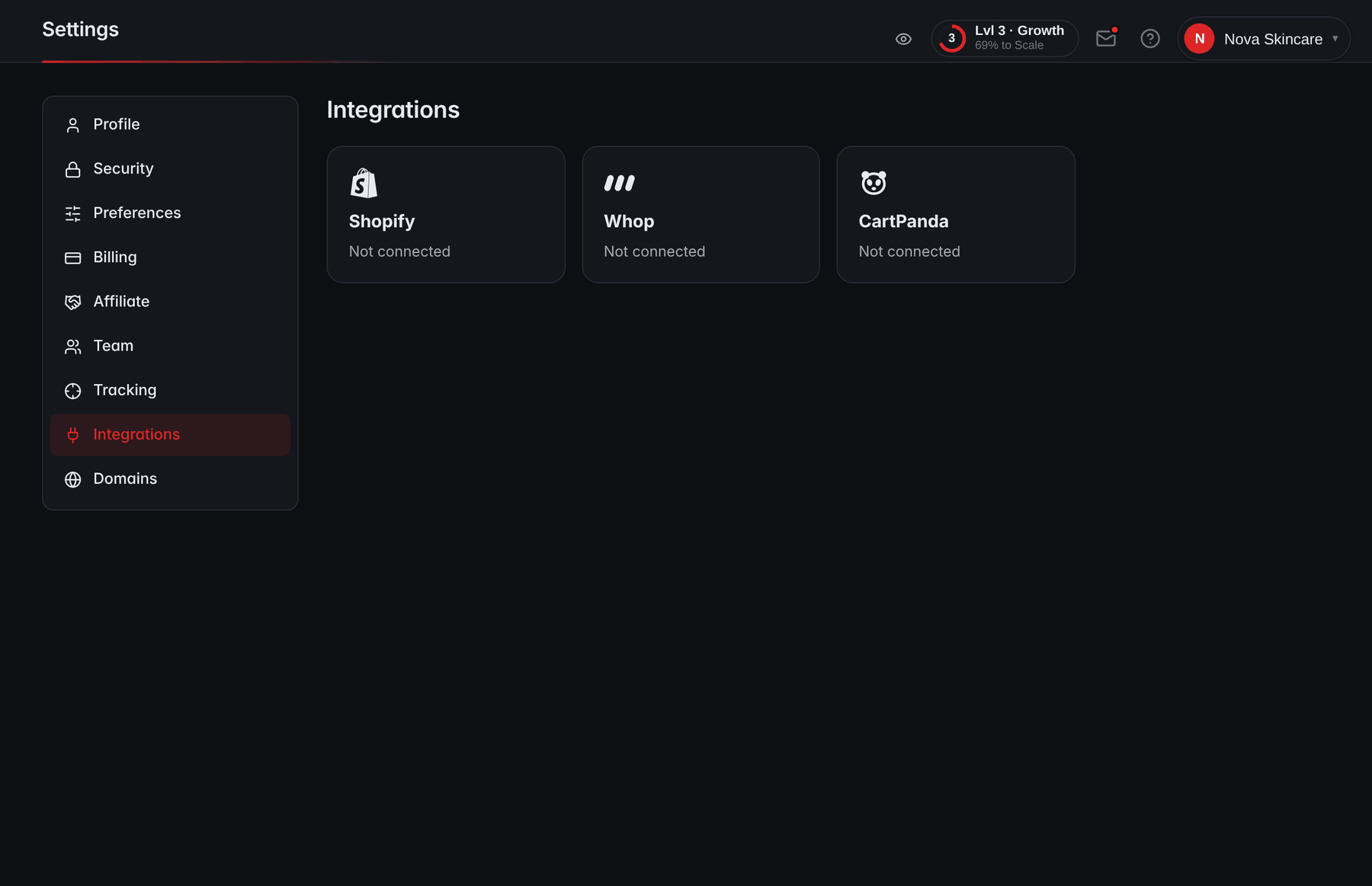
- Shopify, Whop and CartPandaConnect the store or checkout that takes the payment, and its sales report back to RevvyScales.
Two checks keep the math honest. A bump can lower checkout conversion, so compare checkout conversion with and without it. Our post on checkout abandonment shows how to count buyers who leave at that step, apart from payment declines. And an upsell with a high refund rate can drag front-end refunds up with it, because an unhappy buyer may ask for everything back.
How should you sequence upsells?
- Lead with the offer most buyers will value, the one with the highest contribution per buyer, not simply the most expensive.
- Start with one or two upsells and one downsell. Each extra page costs time and goodwill, so add a page only when a test shows it earns more than it costs in refunds and complaints.
- Make the downsell genuinely smaller: a lighter version, fewer units or a payment plan. Re-offering the same thing at the same price under a new name is a trick, and buyers notice.
- Always move forward. "No thanks" goes to the next step or the thank-you page, never back to the same offer.
- Save some offers for later. Not every complementary product belongs in the post-purchase flow. Some work better in an email a week later, once the buyer has used what they bought.
Upsell ethics, consent and subscription rules
This is not legal advice, but the rules here are clear enough to build into your pages from day one.
No pre-ticked bumps. The FTC's 2022 dark patterns report lists pre-checked boxes among the design tricks and psychological tactics sellers have long used on consumers (FTC press release). In the EU, Article 22 of the Consumer Rights Directive requires the trader to get the consumer's express consent to any extra payment; if consent was inferred from default options the consumer had to reject, the consumer is entitled to a refund of that payment (Directive 2011/83/EU).
Subscriptions must meet ROSCA. In the U.S., the Restore Online Shoppers' Confidence Act of 2010 makes it unlawful to charge for goods or services sold online through a negative option feature, such as a membership that renews until canceled, unless the seller (15 U.S.C. 8403):
- clearly and conspicuously discloses all material terms before collecting billing information,
- gets the consumer's express informed consent before charging them, and
- provides simple mechanisms to stop recurring charges.
On an upsell page, that means the price, the billing frequency, when the first charge happens and how to cancel sit right next to the yes button, and the button itself names the recurring charge, such as "Yes, add the club for $9 a month". And make online cancellation as easy as signing up: it's the clearest way to show that stopping the charges is simple.
Third-party offers have extra rules. If the post-purchase offer comes from a different, unaffiliated company, ROSCA requires that seller to disclose that it isn't affiliated with the original merchant and to obtain the full account number to be charged from the buyer, and it bars the original merchant from passing the buyer's billing details along (15 U.S.C. 8402).
Don't read the click-to-cancel ruling as a free pass. On July 8, 2025, the Eighth Circuit vacated the FTC's amended Negative Option Rule, the "click-to-cancel" rule, in Custom Communications, Inc. v. FTC (opinion). ROSCA is a statute, and that ruling didn't change it. Check also whether the states or countries you sell into have automatic-renewal rules of their own. The VSL compliance guide has the wider checklist.
How do you test upsells?
- Count buyers, not visitors. Upsell take rates are measured on buyers, so a test needs enough buyers in each arm, which takes far longer to collect than visitors.
- Pick one primary metric: contribution per buyer, net of refunds. Use refund rate, chargebacks and support tickets as guardrails.
- Test the biggest lever first: the offer itself, then the price, then the video and copy, then the page design.
- Wait out the early refunds before you call a winner. An upsell that wins in week one can lose by week six.
- Test the front end and the back end together. A bigger front-end bundle can lower upsell take rates, so judge the change by revenue per visitor for the whole funnel. Inside a RevvyScales VSL, offer split tests (Growth plan and up) show different bundles or prices by weight and keep each viewer on the same version (offer split tests).
An upsell funnel checklist
Tick each one off; the ticks stay in this browser:
An upsell funnel checklist
0 of 9 done
Frequently asked questions
What is a good upsell take rate?
There is no universal benchmark worth trusting, because take rates depend on the price of the upsell relative to the front end, how closely it relates to the purchase, and the traffic. A cheap add-on can have a high take rate and still earn less than an expensive one with a low take rate. Compare offers by contribution per buyer after refunds and fulfillment costs instead.
What is the difference between an upsell and a cross-sell?
An upsell offers more of the same product or a better version of it, such as three bottles instead of one or an advanced module. A cross-sell offers a different, related product, such as a case with a phone. In a post-purchase funnel both appear on upsell pages, and the same rule applies to each: it must add to a complete purchase, not finish an incomplete one.
Do one-click upsells work with any checkout?
No. A one-click upsell needs a checkout platform that can charge the stored payment method after the first purchase without asking for card details again. Confirm that your checkout supports it, and how its upsell pages work, before you plan the funnel. RevvyScales does not process payments; it hosts the videos and receives sale data from checkouts such as Shopify, Whop and CartPanda.
Should every upsell have a video?
Not necessarily. A short video helps when the offer needs explaining or costs as much as the front end, because it can show the product and answer objections quickly. A simple add-on, such as express shipping or a refill, often needs only a headline, an image and two clear buttons. Test both formats on your bigger upsells and judge them by contribution per buyer.
Can I offer a subscription as an upsell?
Yes. A subscription can keep earning long after the first order, provided the terms are clear. In the U.S., ROSCA requires clear disclosure of all material terms before billing details are collected, express informed consent before charging, and a simple way to stop recurring charges. Put the price, billing frequency, first charge date and cancellation method next to the button.
Sources
- 15 U.S. Code § 8403 — Negative option marketing on the Internet (Cornell LII)
- 15 U.S. Code § 8402 — Prohibitions on certain Internet-based sales (Cornell LII)
- Custom Communications, Inc. v. FTC, No. 24-3137 (8th Cir. July 8, 2025) — opinion
- Directive 2011/83/EU on consumer rights (EUR-Lex)
- FTC Report Shows Rise in Sophisticated Dark Patterns Designed to Trick and Trap Consumers (Sept. 15, 2022) — Federal Trade Commission