
Payments, retention and operations
Checkout abandonment: why buyers who clicked leave before paying, and how to fix each cause
A buyer who reaches your checkout from a VSL has watched the pitch, picked a bundle and clicked. Losing them there costs more than losing anyone else. Here's what Baymard's research says buyers leave for, how to count abandonment apart from declines, the fix for each cause and how to win buyers back honestly.
Reading pathPart 1 of 8 · Getting paid, from the CTA click to the bank
- Checkout Abandonment: Why Buyers Leave, How to Fix It
- Trust Badges: Which Help at Checkout and Which Mislead
- How Payment Processing Works, From Pay to Payout
- Payment Authorization Rate: Declines and Retry Rules
- 3D Secure: Liability Shift, SCA and When to Use It
- Card Testing: How to Spot and Stop a Carding Attack
- Chargeback Representment: How to Win a Chargeback
- How to Reduce Chargebacks: Fix Each Dispute Reason
On this page
- Why checkout abandonment costs a VSL funnel more than a store
- What Baymard's research says buyers leave for
- Four counts that show where buyers leave
- How to reduce checkout abandonment, reason by reason
- What a four-point fix is worth
- Winning back buyers who left, within the rules
- Checkout tricks that cost more than they recover
- What to do this week
- Frequently asked questions
Checkout abandonment means a buyer starts the checkout and leaves without paying. In Baymard Institute's 2025 survey, the reasons US shoppers gave most often for leaving a checkout were extra costs, slow delivery, not trusting the site with their card and a forced account. On a VSL funnel, count clicks, checkout loads, payment attempts and orders separately, then fix the step that leaks.
Here's an illustrative month on one VSL funnel, from the buy button to the bank's answer. Of 1,450 buyers who clicked, 500 paid:
One month on a VSL funnel, from the buy button to the bank
Illustrative numbers
- Clicked the buy button1,450
- Checkout page loaded86.2% of the step before1,250
- Pressed Pay44.4% of the step before555
- Order approved90.1% of the step before500
Why checkout abandonment costs a VSL funnel more than a store
A shopper who drops out of a store's cart may only have been browsing. A buyer who drops out of a VSL checkout came from an ad you paid for, watched the video to the pitch, heard the price, chose a bundle and clicked.
Put that month in money. Say the funnel spent $30,000 on ads. That's $24 for every checkout started, so the 750 started checkouts that didn't end in an order carried $18,000 of the month's spend, and each of the 500 orders cost $60.
Four things make a VSL funnel's checkout different from a store's:
- The price arrives late. On a VSL with a timed reveal, the offer and the buy button appear at the pitch (when to show the buy button), and the buyer decides on the price shown there. Anything the checkout adds afterwards arrives as a surprise.
- The bundle is already chosen. The checkout has to open on the bundle the buyer picked on the VSL page, at exactly that price.
- The checkout sits on another platform. A hosted VSL hands the buyer to a checkout on Shopify, CartPanda, Whop or elsewhere: a redirect, a new page to load, sometimes a different look.
- Upsells come after the payment, so they can't lose the front-end order. An order bump on the checkout page can, because it adds a decision next to the pay button (upsell funnel guide).
What Baymard's research says buyers leave for
Baymard's list puts the average documented cart abandonment rate at 70.22%, averaged from 50 studies by other organizations, vendor statistics among them (updated September 2025, Baymard). Baymard compiled it rather than measured it, and it counts carts, so it's neither a checkout abandonment rate nor a benchmark for a VSL funnel.
The reasons are more useful. Baymard first sets aside the 42% of US online shoppers who had abandoned a cart in the past three months because they were just browsing or not ready to buy, a group it says checkout design can do almost nothing about. Then it lists the reasons shoppers gave for abandoning during checkout:
Why US shoppers abandoned during checkout
Share of US online shoppers naming each reason (Baymard lists the 42% who were just browsing separately)
Read each bar the way Baymard frames it, as the share of US online shoppers surveyed who said they abandoned an order for that reason, not as a share of abandoners. Check the date on any figure you quote, too: older, higher numbers for extra costs and long checkouts still circulate.
Almost everything on the list is set, or at least shown, by the offer page and the checkout. The exception is the declined card: a payment problem, not a design one, and the reason to count declines on their own line.
Four counts that show where buyers leave
One abandonment rate hides three problems with three different fixes. Count four numbers for each VSL, over the same days:
- CTA clicks on the VSL page.
- Checkout loads, from your checkout's reports or a page-view event.
- Payment attempts: buyers who pressed Pay, counted once per order, not per retry.
- Orders the bank approved.
In the example, 200 of 1,450 clicks (13.8%) never reached the checkout: a slow redirect, a broken bundle link, a page that stalls on a phone. Of the 1,250 buyers who opened the checkout, 695 (55.6%) left without pressing Pay, which is checkout abandonment proper. And 55 of 555 payment attempts (9.9%) were declined. A single rate, 1 − orders ÷ checkouts started, gives 60%: it mixes the declines in with the buyers who left and misses the 200 who never arrived.
Declines need their own playbook. The buyer tried to pay and the issuing bank said no, so the fix lies in decline codes, retries and processor settings, not the page (payment authorization rate).
Shopify's own count has a blind spot. It treats a checkout as abandoned once it has stayed incomplete for more than ten minutes after the buyer entered an email address (Shopify), so by that definition a buyer who leaves before giving an email address isn't counted as abandoned.
The first and last counts live in your VSL analytics. In RevvyScales each CTA click gets a click ID that your checkout reports back with the sale (conversion tracking), so each VSL's analytics show its CTA clicks next to its orders (analytics):
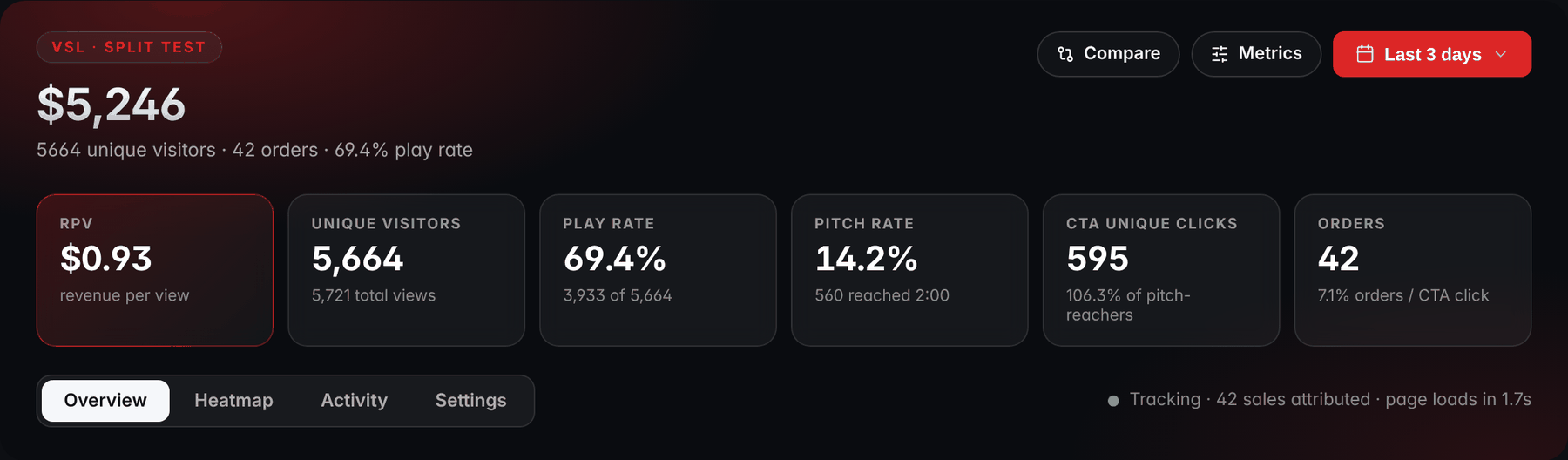
- CTA unique clicksThis tile counts the visitors who pressed the buy button on this VSL.
- OrdersThis tile counts the sales your checkout reported back, with orders per CTA click under the number.
- TrackingThis line shows how many sales were attributed to this VSL.
Orders per CTA click is the whole gap in one number. When it falls while clicks hold steady, look between the button and the bank before you touch the video. Earnings per CTA click puts the same gap in money, and the revenue per visitor guide shows how to read it beside RPV.
How to reduce checkout abandonment, reason by reason
Once you know which count drops, this tree points to the first fix to try:
Where are you losing buyers?
Where does your funnel lose the most buyers?
Compare your four counts for the same days.
Is the checkout's total higher than the price the VSL showed?
Can a buyer pay as a guest, with a wallet, on a short form?
Best fit
Fix the trip to the checkout
You lose buyers between the CTA click and the checkout, so fix the hand-off, not the form: press each bundle's button on a phone, on a slow connection, and check the load time, the bundle and the price.
Best fit
Treat it as a payment problem
You lose buyers at the pay button because their cards are declined, which no page change fixes. Read the decline codes, follow the networks' retry rules and ask your processor for approvals by card brand and country.
Read more: Payment Authorization Rate: Declines and Retry Rules
Best fit
Show the full price before the click
You lose buyers on the checkout form, and its total is higher than the price the VSL showed. Show shipping and any fee beside each bundle at the pitch, or build them into the price.
Read more: Free Shipping Threshold: How to Set One That Pays
Best fit
Cut the effort
You lose buyers on the form, the total matches, but paying takes an account, a long form or a typed card number. Make guest checkout the default, cut needless fields and offer a wallet.
Best fit
Answer the trust question at the pay button
You lose buyers on the form although the total matches and paying is quick, so the doubt is safety or refunds. Set the card fields apart, with one or two security icons, and repeat the guarantee beside the button.
Read more: Trust Badges: Which Help at Checkout and Which Mislead
Extra costs and a total nobody saw coming
Extra costs top Baymard's list at 40%, and 12% couldn't see or calculate the total up front. One fix covers both: show the full price, shipping included, beside each bundle at the pitch, and make the checkout's first total match it to the cent. The free shipping threshold post works out when a threshold pays for itself.
Showing the full price early also avoids what FTC staff called Drip Pricing in their 2022 dark-patterns report, where they wrote that companies "should include any unavoidable and mandatory fees in the upfront, advertised price" (FTC staff report). The FTC's separate fees rule, in force since May 12, 2025, covers only live-event tickets and short-term lodging; other industries get case-by-case enforcement under the FTC Act (FTC).
Forced accounts, long forms and missing ways to pay
In Baymard's 2025 survey of 1,026 US adults who had shopped online in the past three months, 18% said they had abandoned an order because the site wanted them to create an account (Baymard). On the same list, 17% named a long or complicated checkout and 9% too few payment methods.
- Guest checkout first. Baymard's benchmark found that 62% of sites fail to make guest checkout the most prominent option. Make it the default, and offer to save details after the order.
- Fewer fields. Baymard's list counts 23.48 form elements on the average US checkout (14.88 form fields), against 12 to 14 elements in an ideal flow, and a 2024 Baymard article says fields affect usability far more than steps (Baymard). Ask only for what you need to ship and charge.
- A wallet beside the card form. Shop Pay, for one, saves a buyer's email, payment and shipping details (Shopify). Test vendor conversion claims before trusting them: Stripe reported in April 2025 a 22.3% average increase in conversion for Apple Pay among eligible checkouts, measured on its own customers (Stripe).
Distrust at the card form
In the same 2025 survey, 19% had abandoned a checkout in the past three months because they didn't trust the site with their credit card information. Shoppers judge security by what they see, Baymard notes: every field on an HTTPS page is equally encrypted, yet some parts look safer than others. It suggests setting the card fields apart, with one or two icons inside that area and site seals close by (Baymard).
A VSL buyer has a second question there: what if the product doesn't work for me? Answer it beside the pay button with the guarantee, in the video's words; the trust badges post covers which badges help and which mislead.
Errors, slow pages, delivery and returns
Errors and crashes were named by 17%. Test the hand-off first, because a failure before the checkout loads never shows up in the checkout's own reports: press every bundle's button on a phone and a desktop, on a slow connection, and check that the checkout opens on the right bundle, at the right price, in your brand.
Slow delivery (20%) and an unsatisfying returns policy (13%) are business decisions, but the page decides when buyers learn about them. State the delivery time and what the guarantee covers before the buy button.
What a four-point fix is worth
Every order a checkout fix wins comes from a buyer you already paid for. Take the example month: 1,250 checkouts started, 500 orders, 40% completion. Say a fix lifts that to 44%, with a $130 average order and a 65% contribution margin before ad spend:
Calculator
Checkout completion calculator
What a better checkout is worth when the traffic and the ad spend stay the same.
- Orders a month, now → after
- 500 → 550
- More orders
- Extra revenue a month
Every extra order here comes from visitors you already paid for, so the whole contribution margin of those orders is profit. A lift you can’t measure isn’t one: count started checkouts and finished orders from the same days.
That's 50 more orders, a 10% rise, $6,500 more revenue and $4,225 more profit a month from the same $30,000 of ads, and the cost per order falls from $60 to $54.55. The lift is the one input you can't know in advance, so start modest.
Measure the lift rather than assume it: count started checkouts and orders for the same days before and after, over whole weeks, one change at a time. Check revenue per visitor too, because a change that adds orders but shrinks the average order can still lose money.
Winning back buyers who left, within the rules
A buyer who typed an email and left can get a reminder. On Shopify, the "Abandoned checkout emails by Shopify" automation goes by default only to customers subscribed to email marketing (Shopify).
That default fits the cautious reading of CAN-SPAM. The FTC's guide says what matters is an email's primary purpose, and that the law views the transactional categories narrowly; the first covers a transaction "the recipient already has agreed to", which a buyer who left hasn't (FTC). Our reading, not the FTC's: treat cart reminders as marketing email, with honest headers and subject lines, a valid postal address and an opt-out honored within 10 business days. Each email that breaks the law can cost up to $53,088.
Texts are stricter. Marketing texts sent with an autodialer need the recipient's prior express written consent (47 CFR 64.1200), so ask for it separately rather than treating the phone field as permission. This is a summary, not legal advice.
Write the reminder as a service: the bundle, the total with shipping, the guarantee in one line and a link back to the checkout, with no deadline that isn't real. Shopify lets you add a discount, but a discount in every reminder can teach buyers that leaving pays.
Checkout tricks that cost more than they recover
Some abandonment fixes work by pressure or by hiding things. FTC staff named them in "Bringing Dark Patterns to Light", a September 2022 staff report rather than a rule (FTC):
- Baseless Countdown Timer: a fake countdown clock that disappears or resets when it runs out.
- False Low Stock Message and False High Demand Message: scarcity or demand claims that aren't true.
- Sneak-into-Basket: items added without the buyer's permission, or a pre-checked box that buys something they didn't want.
- Preselection: a default that's good for the seller rather than the buyer.
If the checkout adds a subscription, ROSCA applies too: the terms disclosed clearly before you take billing details, express informed consent before the charge and a simple way to stop it. Tricks like these may win an order today and send it back as a refund or a dispute next month. The honest versions keep working: a real deadline with its reason, an unticked add-on with its price.
What to do this week
Work through it with last month's four counts open:
Checkout abandonment: what to do this week
0 of 10 done
Frequently asked questions
What is the difference between cart abandonment and checkout abandonment?
Cart abandonment counts shoppers who add something to a cart and leave. Checkout abandonment counts buyers who start the checkout itself and leave before paying. When a VSL's bundle buttons link straight to the checkout, there's no cart step at all, so the useful split is finer: buyers who never reach the checkout, buyers who leave the form, and cards the bank declines.
What is a good checkout abandonment rate?
There's no honest universal number. Baymard's 70.22% is a cart figure, averaged from 50 studies by other organizations, vendor statistics among them, and it says nothing specific about checkouts or VSL funnels. Measure your own rate for a few weeks, with declines and buyers who never reached the checkout counted separately, then judge every change against that baseline.
Are abandoned checkout emails allowed under CAN-SPAM?
The FTC's CAN-SPAM guide doesn't mention them, so the cautious approach is to treat them as marketing email, because a buyer who left hasn't agreed to the purchase, which the first transactional category requires. Use honest headers and subject lines, include your postal address and honor opt-outs within 10 business days. Shopify sends its abandoned-checkout emails only to marketing subscribers by default.
Does a one-page checkout reduce abandonment?
Not by itself. A 2024 Baymard article says the number of form fields affects usability far more than the number of steps, and a 2011 Baymard analysis noted that a one-page checkout won't necessarily beat an optimized multi-step one: big one-page wins in A/B tests often came against multi-step checkouts nobody had optimized. Cut fields and surprises first, then test the layout.
Should abandoned checkout emails include a discount?
Shopify lets you add a discount the buyer can use when they return, but it's a trade-off. A discount wins back some orders at a lower margin, and buyers who learn that leaving brings a code may start leaving on purpose. Start with a reminder that restates the bundle, the total and the guarantee, test a discount against it, and judge both by profit rather than orders.
Sources
- 50 Cart Abandonment Rate Statistics 2026 — Baymard Institute (updated September 22, 2025)
- Checkout UX 2025: 10 Pitfalls and Best Practices — Baymard Institute
- How Users Perceive Security During the Checkout Flow — Baymard Institute
- Checkout Optimization: 5 Ways to Minimize Form Fields in Checkout (June 26, 2024) — Baymard Institute
- One Page Checkouts – the Holy Grail of Checkout Usability? (April 26, 2011) — Baymard Institute
- Bringing Dark Patterns to Light (staff report, September 2022) — FTC
- FTC Report Shows Rise in Sophisticated Dark Patterns Designed to Trick and Trap Consumers (September 15, 2022) — FTC
- The Rule on Unfair or Deceptive Fees: Frequently Asked Questions — FTC
- CAN-SPAM Act: A Compliance Guide for Business — FTC
- 47 CFR 64.1200, Delivery restrictions — eCFR
- Recovering abandoned checkouts — Shopify Help Center
- Abandoned checkout emails by Shopify (automation) — Shopify Help Center
- Shop Pay — Shopify Help Center
- Testing the conversion impact of 50+ global payment methods (April 10, 2025) — Stripe