
Facebook attribution window: why Ads Manager counts more purchases than your store, and which setting to use
Ads Manager says 40 purchases; your store says 31. The attribution window is usually why. Meta credits every purchase that lands inside a window after a click or a view, and the same window decides what each ad set learns from, so knowing what it lets in tells you which number to trust for which decision.
Reading pathPart 5 of 8 · Meta ads for supplement offers
- Facebook Ads for Supplements: Rules, Hooks and Setup
- Advantage+ Sales Campaigns: What You Still Control
- Facebook Ads Learning Phase: 50 Events, Budget, Edits
- Facebook Ads URL Parameters: Macros, UTMs, Naming
- Facebook Attribution Window: 7-Day Click, 1-Day View
- Facebook Ad Scheduling: Setup and When It Pays Off
- Ad Fatigue: How to Spot It and What to Refresh First
- Ad Creative Testing: Budgets, Metrics and Kill Rules
On this page
- Why Ads Manager says 40 purchases and your store says 31
- How the Facebook attribution window counts one buyer
- The default, and the windows that no longer count
- One setting, two jobs: delivery and reporting
- View-through purchases and returning customers
- Which attribution setting fits a VSL offer?
- How to check Meta's number against your own
- Frequently asked questions
Meta gives your ad credit for a purchase made up to 7 days after someone clicks it or up to 1 day after they view it. That default is the Facebook attribution window, set per ad set. Meta uses the setting to decide what the ad set optimizes on and, by default, what Ads Manager reports, which is why its purchase count often runs higher than your store's.
Why Ads Manager says 40 purchases and your store says 31
Picture an illustrative week. Ads Manager reports 40 purchases for your campaign. Your store shows 31 orders that arrived through a click on a Meta ad. Nobody made a mistake. The two systems answer different questions: Meta asks which purchases happened inside a window after someone interacted with one of its ads, and your store asks which visit each order came from.
Count the same week four ways and the gap opens one step at a time:
One week, counted four ways
Illustrative campaign: purchases credited to Meta ads
Read the bars from the top. Dropping the 1-day view removes six purchases by people who saw an ad, never clicked, and bought within a day, perhaps after searching your brand. Narrowing the click window from 7 days to 1 removes eight buyers who came back later. Your store's 31 is a different count altogether: it misses every view-through buyer, credits some clickers to the email or search that brought them back, and can include a buyer whose click was more than 7 days old.
Now put a price on it. Say the campaign spent $1,800 that week. On the default count it cost $45 a purchase; on 7-day click, $52.94; on 1-day click, $69.23; by your store's count, $58.06. The ads and the spend didn't change, yet the cost per purchase runs from $45 to $69.23, and a $49 target is met or missed depending on which count you read. Decide which count your targets refer to before you judge a campaign by them.
Other gaps add to this one. Each ad platform credits sales by its own rules, so a buyer who clicked a Google ad and a Meta ad can show up in both reports; the break-even ROAS post works through what that does to your ROAS. Lost events push the other way. A sale your checkout never reports is a sale Meta can't count; finding where sales drop out of the chain is the job of the VSL tracking guide.
How the Facebook attribution window counts one buyer
The window opens with an interaction, a click on the ad or a view of it, and closes after a set number of days. A purchase inside the window is credited to the ad. A purchase outside it isn't, whatever else happened. Follow one illustrative buyer through a week:
One buyer, three windows
Illustrative buyer of a supplement bundle
- Mon 8:10 pmSees a video ad and scrolls pastA view. The 1-day view window opens.
- Tue 9:30 pmClicks the same adWatches 12 minutes of the VSL, then leaves. The 7-day click window opens.
- Sat 10:15 amSearches your brand and buysAbout three and a half days after the click, more than four days after the view.
Meta credits the clicked ad even though a search brought the buyer back, because its count looks at its own ads and the window, not at the last visit. And the VSL did its work on Tuesday, while the sale only showed up on Saturday. If your buyers take days to decide, as they may with a higher-priced bundle, a window shorter than that will miss them.
The default, and the windows that no longer count
The default is 7-day click and 1-day view. Meta's reporting API says so directly: when no window is requested, "default" means 7d_click plus 1d_view (Meta for Developers). It became the default on January 19, 2021, replacing 28-day click and 1-day view because of Apple's iOS 14 requirements (Meta for Developers). Plenty of older articles still quote the 28-day default.
On the delivery side, an ad set's attribution setting takes three kinds of event, each with a window in days: click-through, view-through and engaged video view (ad set reference). Meta's reporting API still lists 28-day click and 7-day and 28-day view windows, but none of them counts website purchases any more. What's left is 1-day and 7-day click, 1-day view and, for video ads, a 1-day engaged-view window.
Three changes explain why older numbers and articles don't match today's:
- 2021. Meta announced in January that it would stop supporting website conversions over 28-day click, 28-day view and 7-day view once Apple enforced its App Tracking Transparency prompt. Its changelog of April 27, 2021 confirmed that 28-day click and 28-day view were no longer supported (Meta for Developers).
- June 10, 2025. Meta's reporting API began ignoring two parameters that changed how results were attributed and timed, so that its responses "mimic Meta Ads Manager settings". Tools that read Meta's API now get the same attribution settings as Ads Manager.
- January 12, 2026. The 7-day and 28-day view windows stopped returning any data in Meta's reporting API, and hourly breakdowns stopped reaching back more than 13 months (Meta for Developers).
If a tool still shows 7-day or 28-day view numbers for recent dates, ask where they come from.
One setting, two jobs: delivery and reporting
The attribution setting isn't only a reporting filter. Meta's Marketing API describes the ad set's attribution spec as the one "used for attributing conversions for optimization": the purchases inside the window are the ones the ad set learns from. Reporting then uses the same setting by default, so one switch moves both:
What the attribution setting decides
What the ad set learns fromDelivery
- Set on each ad set
- Meta optimizes on the purchases counted inside the window
- A shorter window gives the ad set fewer purchases to learn from
- Changing it changes the campaign, not just the report
Change it only as a deliberate test, with a control.
What the columns showReporting
- Results use the ad set's setting by default
- Since June 10, 2025, Meta's reporting API mirrors Ads Manager's attribution settings
- A report that asks for no window gets 7-day click and 1-day view
- 7-day and 28-day view windows return no data since January 12, 2026
A report that asks for a different window changes the count, not the delivery.
That's the trap in switching to 1-day click to get "more accurate" numbers. The numbers do get stricter, but the ad set now learns only from buyers who purchase within a day of clicking, and for an offer whose buyers take a few days, that's a smaller and different group of people. If you want a stricter view for your own analysis, take it from a report that asks for a different window, or from your own sales data, and leave the live ad set alone.
The same logic reaches your bid strategy. If an ad set runs on a cost cap, the results it is held to are counted with the same window. Shorten the window and the same spend shows fewer results, so a cap that fit last month may now hold delivery back.
Meta's incremental attribution option, introduced in 2025, sits on the delivery side too: its API describes it as incremental attribution optimization. Switch it on as a test against a control, not as a reporting preference.
View-through purchases and returning customers
The 1-day view window credits a purchase to an ad the buyer saw but never clicked. For a VSL offer, that buyer still had to reach your page or store some other way: by searching your name, typing the address, opening an email or clicking another ad. Sometimes the ad prompted that search. Sometimes the buyer was coming anyway, and the view simply happened to be the most recent one.
Returning customers sharpen the problem. The window doesn't ask whether the buyer is new. A customer who sees a retargeting ad in the morning and reorders that evening, as she was going to anyway, counts as a view-through purchase for that ad. The more of your revenue comes from reorders, the more of this you'll see, and the better a campaign's cost per purchase will look next to its cost per new customer.
To see how much of a campaign rests on views, compare its purchases under the default with its purchases under 7-day click alone. The difference is the view-through share: 6 of 40 in the week above, or 15%. Track it per campaign, because a share that climbs while orders by click stay flat suggests the campaign is collecting credit, not customers.
Video ads can also be credited through the engaged-view window, which Meta's API lists at 1 day. Read Meta's current definition of an engaged view before you rely on those numbers.
Four quick cases test the rules before you pick a window:
Which window counts the sale?
Four cases under Meta's current windows
Show the answer
Yes. Thursday is within 7 days of the click, and the default counts purchases up to 7 days after a click.
Show the answer
No. The view window is 1 day. Five days later, with no click, the purchase falls outside every window in the default setting.
Show the answer
None. Fifteen days is well past the 7-day click window, and Meta stopped supporting 28-day click for website conversions in 2021. Your own tracking can still tie the order to the click if it stored the click.
Show the answer
The report and what the ad set learns from. Meta uses the ad set's attribution setting for optimization as well as for reporting, so the ad set now learns only from purchases made within a day of a click.
Which attribution setting fits a VSL offer?
There's no universally right window, but there is a sensible order of decisions:
- Start with the default. It counts clicks and views, so the ad set has more purchases to learn from than under a click-only window, and it's what Meta's reporting API returns when nobody asks for anything else.
- Match the click window to how long your buyers take. Check your own data for the days between the first visit to the VSL and the order. If most buyers need more than a day, a 1-day click window throws away sales your VSL earned.
- Be skeptical of view-through on retargeting. For ad sets aimed at past visitors or customers, compare the results with and without views against your own orders before you believe the view-through share.
- Compare campaigns only on the same window. A 1-day click campaign and a default campaign can't be ranked against each other.
- Change the setting as a test. Because it changes delivery, try the new window on a duplicate ad set against the original instead of switching the live one.
If your tracking records when each click happened, you can measure the second point directly. Say the last 200 orders that came through a Meta click break down like this: 110 within a day of the click, 60 later in the first week, 30 after that. A 1-day click window can see about 110 of them and a 7-day window about 170. The last 30 exist only in your own records.
How to check Meta's number against your own
Meta's count is one opinion about which ads earned which sales. Three checks keep it honest, and none of them depends on Meta's window.
The first is orders by click: the sales that arrived with a Meta click attached, by campaign, ad set and ad. On a VSL hosted with RevvyScales, the buyer's CTA click carries its own click_id, the checkout's thank-you page or a store webhook sends that ID back with the order (how sales are reported back), and the rvs parameter on your ads records which campaign, ad set and ad the visit came from (the rvs parameter). The result sits in the VSL's analytics:
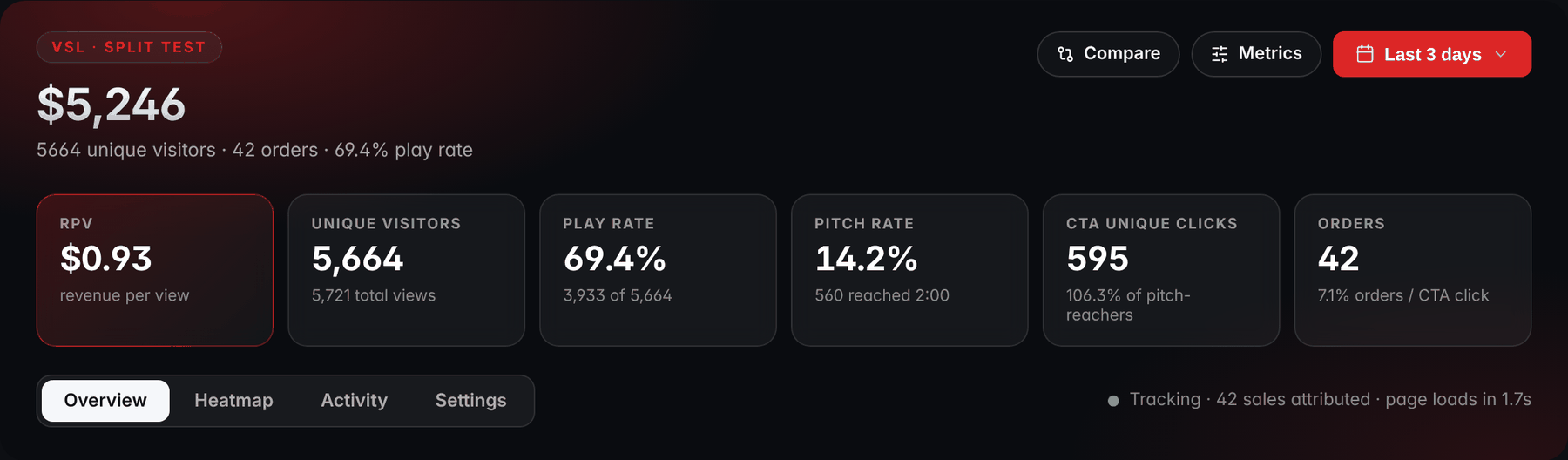
- OrdersThese are the sales your checkout reported back with the click_id of a CTA click on this VSL.
- Sales attributedThis counts the sales tied to a tracked visit by click_id, whatever any ad platform's attribution window says.
The second is blended efficiency. Total revenue over total ad spend, all channels together, ignores attribution windows entirely. When Meta's attributed numbers improve and the blended figure doesn't move, trust the blended figure; the post on marketing efficiency ratio shows how to read it.
The third is asking buyers. A one-question survey after checkout ("Where did you first hear about us?") picks up the ads people saw but didn't click, the same influence view-through credit tries to capture. The post-purchase survey guide covers the wording.
The three checks will rarely match Meta to the order, and they don't need to. Look at direction. If Meta says purchases rose 20% while orders by click, blended efficiency and survey answers stayed flat, the rise is in the counting, not the selling.
The comparison is most useful as a habit, run on the same day every week with the same date range on both sides:
The Monday attribution check
0 of 8 done
Frequently asked questions
Is 28-day click attribution still available on Facebook?
Not for website conversions. Meta announced in January 2021 that, with Apple's iOS 14 tracking changes coming, it would stop supporting website conversions over the 28-day click, 28-day view and 7-day view windows, and its April 2021 changelog confirmed that 28-day click and 28-day view were no longer supported. Today's default is 7-day click and 1-day view. Articles that still quote a 28-day default predate the change.
Does changing the attribution setting change how my ads are delivered?
Yes. Meta's Marketing API describes the ad set's attribution setting as the one used for attributing conversions for optimization, so the window decides which purchases the ad set learns from, not only which ones are reported, and a shorter window leaves it fewer to work with. If you only want a stricter view for analysis, use a report or your own sales data instead of changing the live ad set.
Why does Ads Manager show more purchases than Shopify?
Ads Manager counts every purchase inside the attribution window of a Meta ad: buyers who clicked up to 7 days earlier, even if a search or an email brought them back, and buyers who only saw the ad in the day before they bought. Your store counts each order once and credits it by its own rules. Purchases another ad platform also claims, and repeat buyers, widen the gap further.
Are view-through conversions real sales?
The purchases are real; the credit is the question. A view-through purchase was made by someone who saw the ad without clicking and bought within the view window, 1 day under the default. The ad may have prompted the purchase, or the buyer may have been coming anyway, as a returning customer might have been. Compare view-through-heavy campaigns with orders by click and survey answers before you scale them.
What attribution window should I use for a high-priced offer?
Start with the default, 7-day click or 1-day view, and check how long your own buyers take between the first visit and the order. If most need more than a day, a 1-day click window discards sales your VSL earned and shrinks what the ad set learns from. Whatever you choose, compare campaigns only on the same window and judge them against your own orders.
Why did my dashboard stop showing 7-day view numbers?
Since January 12, 2026, Meta's reporting API returns no data for the 7-day and 28-day view windows, a change Meta announced in October 2025. Tools that pulled those windows now get nothing for recent dates. Meta had first said in 2021 that it would stop supporting 7-day view for website conversions; today the only view window left for website purchases is 1 day.
Sources
- Graph API Reference v25.0: Ad Insights — Meta for Developers
- Ad Set reference, Graph API v25.0 — Meta for Developers
- Preparing our Partners for iOS 14: Changes to Marketing API and Ads Insights API — Meta for Developers
- Graph API changelog: April 27, 2021 — Meta for Developers
- Marketing API Out-of-Cycle Changes 2025 — Meta for Developers
- Ad Account Reporting — Meta for Developers
- 2026: AI Drives Performance — Meta