
VSL for ecommerce: which products fit, a demo-led script structure and bundle offers that pay for traffic
A VSL for ecommerce earns its place when a product has to be shown and explained before people will pay for it. This guide covers which products fit, a demo-led VSL structure, how to build bundle offers, when a VSL page beats a product page, and how to judge results on profit per visitor rather than ROAS.
On this page
- Which ecommerce products suit a VSL?
- How is an ecommerce VSL different from an info-product VSL?
- How to structure a VSL for ecommerce: a demo-led template
- How to build bundle offers that pay for cold traffic
- Should you send traffic to a VSL page or a product page?
- How to make an ecommerce VSL work on phones
- Do you need a presell or advertorial before the VSL?
- How to judge an ecommerce VSL: profit per visitor
- Your first ecommerce VSL: a one-week plan
- Frequently asked questions
A VSL for ecommerce works when a product has to be shown and explained before people will buy it: a visible problem, a demonstrable fix and enough margin for bundles. Lead with a demonstration, prove it with real customers, explain why it works, then present bundles at the pitch. Judge it on profit per visitor, not on views or ROAS.
Which ecommerce products suit a VSL?
A VSL costs more to produce than a product page and asks more of the viewer, so the product has to justify it. Score it on four questions, from 0 to 2 points each.
| Question | 0 points | 1 point | 2 points |
|---|---|---|---|
| Is the problem visible in five seconds? | Abstract or invisible | Needs a sentence of setup | Obvious on camera |
| Can you demonstrate the result? | Results take months or can't be shown | A partial demo | A clear before-and-after on camera that's real and typical |
| Is there a "why it works" story? | A commodity, nothing to explain | Some differentiation | A real, provable mechanism |
| Is there room for bundles? | Thin margin, one-off purchase | Some margin | Healthy margin and a reason to buy several |
Seven or eight points: build a VSL. Five or six: start with a short mini-VSL or a demo video on the product page. Four or fewer: product pages, short video ads and search will likely serve you better. It's a rule of thumb, not a law, but it stops you from producing a 12-minute video for a product with nothing to show.
Here is how four fictional products score. Pick the route each one points to, then open the answer to see its score:
Score four fictional products
Use the four questions above, from 0 to 2 points each
Show the answer
Build a VSL. It scores 8, in the seven-to-eight range.
Show the answer
Build a VSL. It scores 7, still in the seven-to-eight range.
Show the answer
Start with a short mini-VSL or a demo video on the product page. It scores 6, in the five-to-six range.
Show the answer
Product pages, short video ads and search. It scores 2. At four or fewer points, product pages, short video ads and search will likely serve you better.
Price and margin: run the math before the script
There's no magic price range for an ecommerce VSL. What matters is whether the gross profit on an average order can pay for acquiring that order. If you sell supplements, how to price supplements builds a price floor from your ad cost.
A worked example: each visitor costs $1.20 in ad spend and 2% of visitors buy, so cost per acquisition is $1.20 ÷ 0.02 = $60. A $29 product with a 60% gross margin after product cost and shipping earns $17.40 per order and loses $42.60 on every sale.
Bundle it so the average order is $98 at the same margin and gross profit becomes $58.80, still $1.20 short. Add a post-purchase upsell that 25% of buyers take at $39, and the average buyer brings another $5.85, so each order contributes $64.65 against $60 before payment fees and refunds.
A stronger VSL that lifts conversion to 2.4% cuts cost per acquisition to $50 and turns a thin margin into a workable one. The video didn't fix the economics alone; the offer and the video did it together.
How is an ecommerce VSL different from an info-product VSL?
Here is how the two differ, point by point:
Info-product VSL vs ecommerce VSL
Info-product VSL
- Length: Can run long; built on argument and story.
- Proof: Credentials, case studies, testimonials.
- Mechanism: Often the center of the argument.
- Offer: One product plus bonuses and a guarantee.
- Viewing: Desktop and phone.
- Call to action: Late, after the full argument.
Ecommerce VSL
- Length: Usually shorter; built on demonstration.
- Proof: Seeing it work: demos, real customer clips, reviews.
- Mechanism: A sentence or two, then shown on screen.
- Offer: Bundles, shipping terms and a guarantee.
- Viewing: Phone-first when traffic comes from social feeds.
- Call to action: Earlier and repeated, since some buyers are ready after the demo.
The practical consequence: in an ecommerce VSL the demo does the heavy lifting, so plan and shoot it first, then write the words around it. Short formats are covered in more depth in the mini-VSL guide.
How to structure a VSL for ecommerce: a demo-led template
Here is a beat sheet for a seven-minute VSL for the fictional no-pull head collar. The timings are a starting point; your retention graph will tell you where to cut.
A seven-minute demo-led VSL, beat by beat
Fictional no-pull head collar; each beat with its job and an example
- 0:00–0:10HookJob: Show the problem or the result. Example: A 70-pound dog dragging its owner down the sidewalk, then the same dog walking calmly.
- 0:10–0:40ProblemJob: Make it specific and personal. Example: "If your shoulder aches after every walk, it's not your dog's fault."
- 0:40–1:30DemoJob: Show it working, ideally uncut. Example: Same dog, same street, the head collar on.
- 1:30–2:30MechanismJob: Explain why it works in plain words. Example: When the dog pulls, the collar turns its head back toward you.
- 2:30–3:45ProofJob: Real customers, reviews, claims you can substantiate. Example: Customer clips used with written permission.
- 3:45–4:45ObjectionsJob: Fit, sizing, durability, shipping, returns. Example: "Measure around the snout and the top of the neck. Here's the chart."
- 4:45–6:00OfferJob: Bundles, real savings, shipping terms. Example: "Want a spare for the car? The two-pack saves $12."
- 6:00–6:30Guarantee and CTAJob: Remove risk, say exactly what to tap. Example: "Try it for 30 days. Tap the button below the video."
- 6:30–7:00Second closeJob: Recap for viewers still watching. Example: The before-and-after again, then the offer.
Reveal the offer block on the page at 4:45, when the bundles are first mentioned, so the button and the prices arrive together with the spoken offer.
Proof rules for ecommerce VSLs
- Real customers, real permission. Customer clips should come from people who bought and used the product and agreed to appear.
- Disclose material connections. If a creator was paid or received free or discounted product, the FTC's Endorsement Guides say that connection must be disclosed "clearly and conspicuously" when the audience wouldn't expect it (16 CFR 255.5).
- Disclose actors. An ad that presents endorsements as coming from actual consumers should use actual consumers, or clearly and conspicuously disclose that the people shown aren't (16 CFR 255.2).
- Typical means typical. If a testimonial implies a result buyers will generally get and you can't substantiate that, disclose what buyers can generally expect (same section).
- No fake reviews. The FTC's Rule on the Use of Consumer Reviews and Testimonials (16 CFR Part 465), in effect since October 21, 2024, prohibits reviews and testimonials that misrepresent whether the reviewer exists or actually used the product (eCFR Part 465).
- Health claims need science. Health-related claims require "competent and reliable scientific evidence" (FTC Health Products Compliance Guidance).
This isn't legal advice. The VSL compliance guide has the full checklist.
How to build bundle offers that pay for cold traffic
- Three choices at most. One, three and six units for consumables; one, two and four for durable goods where a spare makes sense.
- Make the middle option easy to choose. Highlight it, and call it "best value" only if the per-unit math says so.
- Real savings only. Per-unit savings must be real, and any reference price must be one you've actually charged.
- Set free shipping so the middle bundle qualifies. It gives buyers a concrete reason to step up.
- One guarantee for every bundle. A guarantee that shrinks as the order grows works against the upgrade.
A worked example with the fictional enzyme cleaner: each bottle costs $6 to make, shipping costs $5 per order, and the prices are $34, $84 and $144.
Here is the contribution per order for each bundle, with product costs of $6, $18 and $36; change any number to run your own:
Calculator
Bundle margin calculator
Profit on a 1, 3 and 6-bottle order, before the cost of the ad that brought the buyer.
- 1 bottle: profit per order
- 67.6% margin
- 3 bottles: profit per order
- 72.6% margin · $28.00 a bottle
- 6 bottles: profit per order
- 71.5% margin · $24.00 a bottle
One shipping cost per order, whatever its size — change it if your carrier charges by weight.
Now compare two offer layouts. In layout A the single bottle is the default, and the mix is 70% single, 25% three-packs and 5% six-packs: an average order of $52 and $36.50 of contribution per order. In layout B the three-pack is highlighted, and the mix shifts to 35%, 50% and 15%: an average order of $75.50 and $54.00 per order.
Suppose layout B also converts a little worse, 2.0% of visitors instead of 2.2%. Per visitor, A earns 2.2% × $36.50 ≈ $0.80 and B earns 2.0% × $54.00 = $1.08, about 34% more despite the lower conversion rate. That's why you judge offers per visitor, not by conversion rate. On the Growth plan and up, RevvyScales runs offer split tests inside one VSL, splitting bundles, prices or offer headlines by weight and keeping each viewer on the same version (offer split tests).
Should you send traffic to a VSL page or a product page?
It depends on who the traffic is:
VSL page or product page?
Where to send each kind of traffic
Who is this traffic?
Best fit
VSL page
Cold paid social, problem-aware: they need the demo and the reason it works before they'll weigh the price.
Best fit
VSL page
Retargeting viewers who left before the pitch: let them pick up the story rather than start from zero.
Best fit
Product page
Branded search: they already know what they want.
Best fit
Product page or offer page
Email to existing customers: trust is built; get to the point.
Best fit
Collection and product pages
Shoppers comparing several products: browsing is the job.
A sensible hybrid: a short cut of the VSL on the product page for organic visitors, and the full VSL page for paid traffic. To compare the two fairly, split cold traffic between them at the visitor level for at least two full weeks and judge by contribution per visitor. Store setup, including cart permalinks and checkout tracking, is in VSL for Shopify, and what the host behind the page has to handle is in the VSL hosting guide.
How to make an ecommerce VSL work on phones
If most of your traffic comes from social feeds on phones (your device report will tell you), edit for an upright screen. A landscape video on a phone held upright plays as a narrow strip, which shrinks the product, the hands and the captions that carry the demo.
- Cut a 9:16 version. Fill the frame with the product and the hands using it, and keep captions near the middle of the frame, clear of the player controls.
- Caption everything. With muted autoplay, every viewer starts without sound, so the demo has to make sense on mute.
- Make the first frame readable on a small screen. A big product, high contrast and few words.
RevvyScales' portrait companion video (Growth plan and up) attaches the 9:16 cut to the same VSL: phones and tablets get the vertical version, desktops get landscape, and both share one URL and one set of analytics (portrait companion video).
Do you need a presell or advertorial before the VSL?
Cold traffic that doesn't yet see itself as having the problem may not be ready for a sales video. A presell or advertorial warms it first: a short article that tells the problem story and sends readers to the VSL. Label it clearly as an advertisement, never imitate a news site or invent bylines, and judge it by revenue per ad click against sending the same ads straight to the VSL. The advertorial guide covers structure and disclosure.
How to judge an ecommerce VSL: profit per visitor
Contribution per visitor is revenue minus product cost, shipping, payment fees and refunds, divided by visitors. Subtract what each visitor cost you in ads and you have profit per visitor, the number that decides whether to scale.
A worked example: 10,000 visitors go to each page, and each visitor costs $0.80 in ads.
Product page vs VSL page, 10,000 visitors each
Worked example: each visitor costs $0.80 in ads
Product page
- Conversion rate: 2.6%
- Orders: 260
- Average order: $52
- Revenue: $13,520
- Product cost and shipping (35%): $4,732
- Payment fees (3%): $406
- Refunds: $541 (4%)
- Contribution per visitor: $0.78
- Profit per visitor after $0.80 ad cost: −$0.02
Higher profit per visitorVSL page
- Conversion rate: 2.0%
- Orders: 200
- Average order: $78
- Revenue: $15,600
- Product cost and shipping (35%): $5,460
- Payment fees (3%): $468
- Refunds: $1,092 (7%)
- Contribution per visitor: $0.86
- Profit per visitor after $0.80 ad cost: +$0.06
The VSL page wins despite converting worse and refunding more, because bundles lift the average order. Now watch refunds: if the VSL's refund rate climbed to 12%, its contribution per visitor would fall to $0.78 and the advantage would vanish. A VSL that overpromises can win on revenue and lose on profit, so track refunds by VSL version, not just store-wide. The revenue per visitor guide explains RPV, EPC and the sample-size traps.
RevvyScales' profit tracking (Growth plan and up) subtracts ad spend from a connected Meta account, product costs and gateway fees from revenue, and shows ROAS and margin by campaign. Here is its overview:
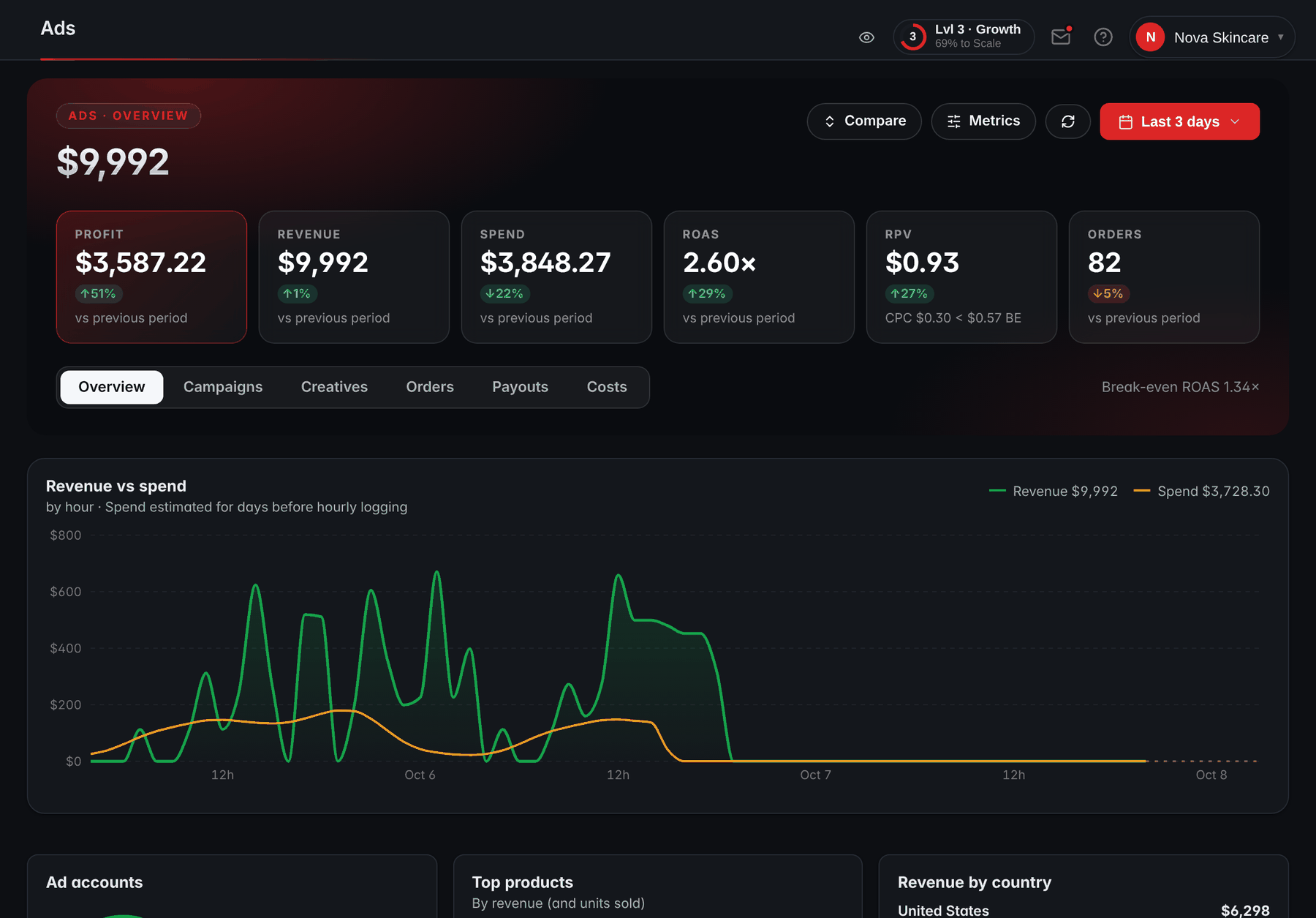
- ProfitRevenue minus ad spend, product costs and gateway fees.
- ROASROAS for the period; the Campaigns tab shows ROAS and margin by campaign.
- Revenue vs spendRevenue against ad spend over the period, by hour.
Your first ecommerce VSL: a one-week plan
Tick each day off as you go; the ticks stay in this browser:
Your first ecommerce VSL in one week
0 of 7 done
Frequently asked questions
How long should an ecommerce VSL be?
Usually shorter than an info-product VSL, because the demo carries much of the persuasion. A two-to-ten-minute mini-VSL is a sensible starting range. Treat it as a starting point, not a rule: check your retention graph and how many viewers reach the pitch, and cut anything that doesn't move the viewer closer to the offer.
Can I use UGC videos in an ecommerce VSL?
Yes, if they're honest. Use clips from real customers who used the product and agreed to appear, and disclose any payment or free product a creator received when viewers wouldn't expect it. If actors or creators portray customers, the FTC's Endorsement Guides call for a clear disclosure that they aren't actual customers, and the results they describe should be typical or qualified. This isn't legal advice.
Should I show the price in the video?
Yes, at the pitch, and make sure the same prices appear in the offer block and at checkout. A price that changes between the video, the page and checkout erodes trust, invites complaints and refund requests, and makes your test results meaningless. Reveal the offer block when the price is spoken, so the button and the numbers arrive together.
Do VSLs work for cheap products?
Only if the offer raises the order value. With cold traffic, cost per acquisition equals cost per visitor divided by conversion rate, and the gross profit on a single low-priced unit may not cover it. Bundles, multi-packs and a post-purchase upsell can lift the contribution per order enough to make the math work. Run the numbers before you produce anything; if they fail on paper, they'll fail live.
Do I need a separate website for an ecommerce VSL?
No. The simplest setup is a subdomain of your store's domain, such as try.yourbrand.com, pointed at your VSL host. The page carries your brand without the store's navigation, its buttons link to your existing checkout, and the store stays exactly as it is for shoppers who arrive through search or email.