
Facebook ads for supplements: what Meta restricts, hooks that pass review and a setup that tracks real sales
Meta lets you advertise most dietary supplements, but its ad standards restrict unsafe ingredients, copy that points at a viewer’s health and diet ads that feed negative self-image, while FDA and FTC rules limit the claims themselves. Here is how both shape your hooks, creative, tracking and first campaign.
Reading pathPart 1 of 8 · Meta ads for supplement offers
- Facebook Ads for Supplements: Rules, Hooks and Setup
- Advantage+ Sales Campaigns: What You Still Control
- Facebook Ads Learning Phase: 50 Events, Budget, Edits
- Facebook Ads URL Parameters: Macros, UTMs, Naming
- Facebook Attribution Window: 7-Day Click, 1-Day View
- Facebook Ad Scheduling: Setup and When It Pays Off
- Ad Fatigue: How to Spot It and What to Refresh First
- Ad Creative Testing: Budgets, Metrics and Kill Rules
On this page
- Can you run Facebook ads for supplements?
- Which claims can a supplement ad make?
- How to write supplement hooks that pass review
- How to set up tracking for supplement ads
- What creative works for supplement ads within the rules?
- How to structure your first supplement campaign
- How to read supplement ad results against real sales
- A pre-launch policy check for supplement ads
- Frequently asked questions
You can run Facebook ads for supplements, within two sets of rules. Meta's Advertising Standards ban supplements Meta considers unsafe, copy that asserts or implies a viewer's health condition, and diet or weight-loss creative that plays on negative self-image. The FDA and the FTC decide what you may claim at all: structure/function statements backed by evidence, never disease claims. A supplement ad has to pass both.
Can you run Facebook ads for supplements?
Yes. Meta's rules single out unsafe supplements rather than supplements as a category, so a typical vitamin or protein product can be advertised. Three of Meta's Advertising Standards matter most, and reviewers apply Meta's reading of them, not yours:
| Meta policy | What it restricts | Where supplement ads trip |
|---|---|---|
| Unsafe substances and supplements | Supplements Meta considers unsafe, at its sole discretion | Ingredients on its list, such as ephedra, comfrey or dehydroepiandrosterone |
| Personal attributes | Content that asserts or implies personal attributes, including physical or mental health | Hooks that tell viewers what condition they have |
| Personal health and appearance | Content that implies or tries to create negative self-perception to sell diet, weight-loss or other health products | Weight-loss before-and-after images, zoomed-in bodies, shame-based hooks |
Unsafe supplements. Meta bans ads for unsafe substances, products or supplements, "as determined by Meta at its sole discretion." Its open-ended list names anabolic steroids, chitosan, comfrey, dehydroepiandrosterone, ephedra and human growth hormones (Meta). No copy fixes a formula that contains one, and an unlisted ingredient can still be refused.
Personal attributes. Ads must not assert or imply personal attributes, directly or indirectly, and physical or mental health is on the list, medical conditions included. The example lines on Meta's policy page include "Do you have diabetes?" (Meta). That rules out the category's most tempting hook: telling viewers what's wrong with them.
Negative self-perception. Ad content must not imply or try to create negative self-perception to promote diet, weight-loss or other health-related products. Meta's non-compliant examples include a person before and after weight loss, a zoomed-in shot of abs, and a person on a scale in a diet or weight-loss ad (Meta). Cosmetics are outside this policy; a supplement, as a health-related product, is inside it.
Google and TikTok apply their own policies: see Google ads for supplements and TikTok ads for supplements.
Which claims can a supplement ad make?
Meta decides whether the ad runs, and its approval isn't legal clearance. The FDA and the FTC decide whether the claim is legal. This isn't legal advice, but the frame is short:
- Structure/function claims describe the role of a nutrient or dietary ingredient in the body's normal structure or function. The FDA's own examples include "calcium builds strong bones" and "fiber maintains bowel regularity." The FDA doesn't pre-approve them; you need substantiation that the claim is truthful and not misleading (FDA). Under 21 CFR 101.93 they carry the disclaimer: "This statement has not been evaluated by the Food and Drug Administration. This product is not intended to diagnose, treat, cure, or prevent any disease."
- Disease claims say or imply an effect on a disease or on its characteristic signs or symptoms. The FDA's definition of disease names hypertension as an example, so "lowers high blood pressure" is a disease claim. A disease claim can also be implied by the product name, a cited study, or pictures and symbols. The structure/function route doesn't allow them, so keep them out of the ad and the page.
- Evidence. The FTC expects health claims to rest on "competent and reliable scientific evidence," generally randomized controlled trials, and says "individual experiences aren't a substitute for scientific research" (FTC). Testimonials can't carry a claim on their own.
Our post on structure/function claims goes through the wording line by line.
How to write supplement hooks that pass review
The hook is where supplement copy breaks the rules most easily, because the most natural opening in the category is to name the viewer's problem. The habit that fixes it: describe the product, the ingredient, the routine or the situation, never the viewer's body or condition.
Here are four hooks for two fictional products, a joint formula and a weight-management formula, each with a rewrite:
Four supplement hooks, rewritten
Fictional examples for a joint formula and a weight-management formula
Rejected, or an illegal claimRisky hook
- “Do you have joint pain? Watch this.” Asks about the viewer’s health condition.
- “Melts belly fat while you sleep.” A result no study on your formula supports.
- “Hate how you look in photos?” Plays on negative self-image to sell weight loss.
- “Ends arthritis pain in 7 days.” Claims to treat a disease.
Fits the rules, if it is trueRewrite
- “What’s in our joint formula, ingredient by ingredient.” Describes the product.
- “The fiber in every scoop, and the study behind the dose.” An ingredient story you can document.
- “Our founder builds a 400-calorie breakfast in 60 seconds.” Same topic, no shame.
- “Formulated to support healthy joints.*” A structure/function claim, with the FDA disclaimer and evidence on file.
Each rewrite moves the subject: from the viewer to the bottle, from an impossible promise to an ingredient you can document, from shame to the same topic without it, and from a disease to a body function, with the disclaimer.
Run every line through two checks before you submit it:
- The viewer test. Does the line tell viewers what they have, what they are or what's wrong with how they look? Rewrite it around the product or the situation.
- The evidence test. Does the line name a disease, a symptom or a result? Could you show the studies for this exact claim, on this formula, at this dose? The FTC's guidance asks how the dosage and formulation of the advertised product compare with the product that was studied. If you can't answer, cut the line.
The landing page has to say the same thing. Your VSL page carries the claims in long form, so the same rules apply there. Put the FDA disclaimer next to each structure/function statement, or link it with an asterisk, the way 21 CFR 101.93 places it on labeling. The nutra marketing guide covers the rest of a supplement funnel.
How to set up tracking for supplement ads
Your copy isn't the only thing that has to be clean. The tracking itself works as for any VSL, with the Pixel and the Conversions API sending matching events and your checkout reporting purchases back; the Facebook ads for a VSL guide walks through it.
One part is specific to health products. Beginning September 2, 2025, Meta started rolling out restrictions that flag custom conversions suggesting specific health conditions, with examples such as "arthritis" and "diabetes", and prevent them from being used to run ad campaigns (Meta). So keep conditions out of everything your funnel sends: page URLs such as /joint-pain-offer, event names and custom conversion rules. The point isn't to hide what you sell. It's not to send Meta health information about your visitors in the first place.
The other half is knowing which ad produced each sale. In RevvyScales, the rvs parameter attributes visits and sales to the campaign, ad set and ad (how the rvs parameter works), and the Conversions API integration (Growth plan and up) is deduplicated so each sale reaches Meta once (Conversions API setup). You copy one line per ad platform:
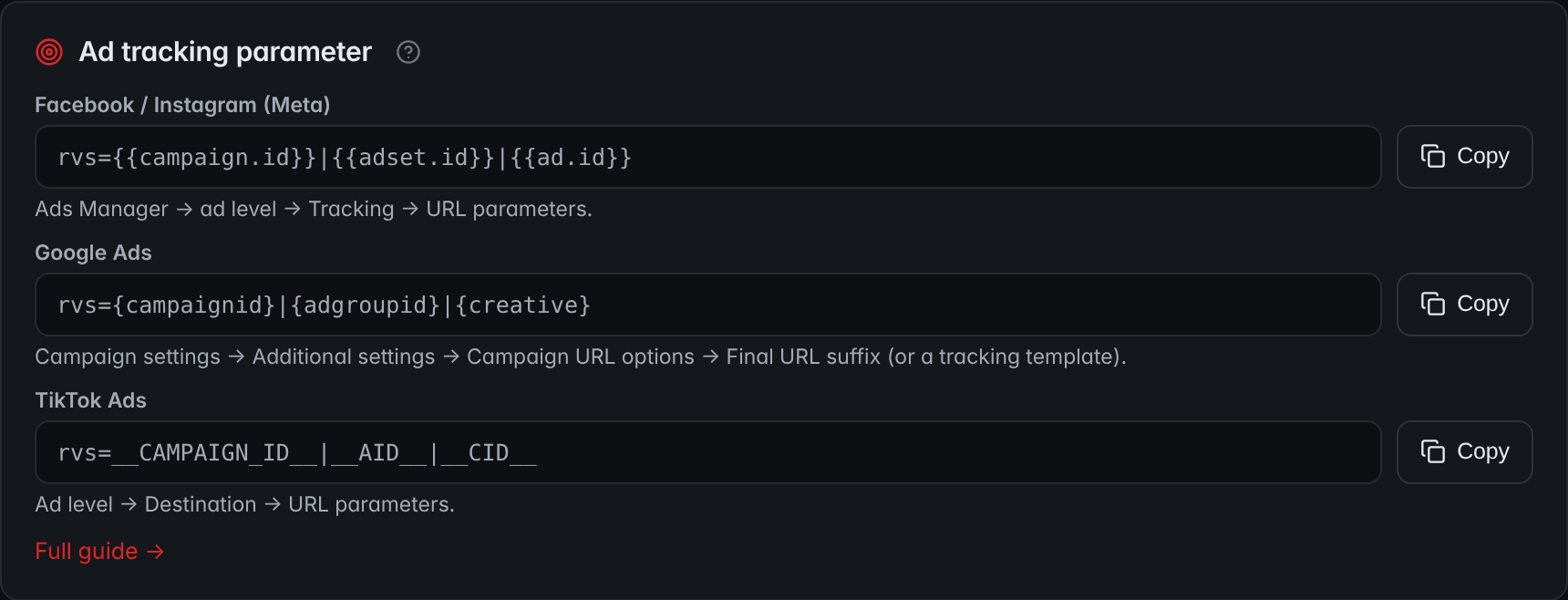
Put it in the URL parameters of every ad from the first test, so that every later decision rests on the same data.
What creative works for supplement ads within the rules?
Formats that show something, rather than promise something, are the easiest to keep inside the rules, because the proof is on screen. Four that suit supplements:
| Format | What it shows | Watch out for |
|---|---|---|
| Demonstration | The product in use: mixing it, taking it, the daily routine | Implied results; a demo shows use, not efficacy |
| Ingredient story | What's in the formula, where it comes from, why that dose | Citing disease studies, which can imply a disease claim |
| Founder story | Why the product exists and who makes it | A personal health story that names a disease |
| Creator or customer video | A real person using the product, in their own words | Paid creators need a clear disclosure; their claims count as yours |
Creators and customers bring the most rules. Under the FTC's Endorsement Guides, endorsements must reflect the endorser's honest experience, the advertiser is liable for misleading claims made through them, and a material connection such as payment or free product must be disclosed clearly and conspicuously (16 CFR Part 255). In a video, put the disclosure in the video itself, not only in the caption. And a claim you couldn't make yourself doesn't become acceptable because a customer says it: "this fixed my arthritis" is still about a disease. Our post on UGC ads covers creator briefs and disclosure.
Once a concept is approved and selling, iterate inside it. New hooks, presenters and cuts that carry the same approved claim are low-risk; a new claim means a new review, a new evidence file and a new chance of rejection. Keep a claims sheet that lists every approved line with its evidence, and brief every creator and editor from it.
Before-and-after shots for weight loss are out on Meta, given its own policy example. For any other product, read this first:
How to structure your first supplement campaign
Use the same structure as for any VSL offer, with one habit that matters more for supplements: launch fewer, cleaner ads, since every rejected ad costs a review cycle and an edit. The order of work:
A launch sequence for a supplement offer
- Policy checkIngredients, hooks, claims and the page, against Meta’s standards and FDA and FTC rules
- Tracking testOne real order, seen once in Events Manager and once in your checkout
- Testing campaignAd set budgets, one concept per ad set, decision rules written down
- Read real ordersCost per kept order, refunds and chargebacks by ad
- Scale winnersAdvantage+ campaign budget, or an Advantage+ sales campaign once purchases flow
Test with ad set budgets, one concept per ad set, so each concept gets a fair share of spend. Scale winners in a campaign under Advantage+ campaign budget, or in an Advantage+ sales campaign once purchases flow steadily; the CBO vs ABO guide compares the two. Size each ad set from your expected cost per purchase, so it can collect enough purchases to finish Meta's learning phase. Our post on the Facebook ads learning phase has the budget math.
Keep the first round narrow: two or three concepts, each with a hook you have already checked against both tests above. A rejected ad teaches you nothing about demand, and a clean round tells you which angle the market wants.
How to read supplement ad results against real sales
Meta's purchase numbers come from the purchase events your pixel and server send it. They can't see the refund three weeks later or the chargeback after that, and supplement offers live or die on both. So reconcile every week, and compare ads on the customers you keep.
A worked example with illustrative numbers. Two ads each spend $3,000, and Meta reports 60 purchases for each: a $50 cost per purchase. Your own records tell a different story:
| Ad A: ingredient story | Ad B: bold promise | |
|---|---|---|
| Spend | $3,000 | $3,000 |
| Purchases reported by Meta | 60 | 60 |
| Orders in your checkout tracked to the ad | 52 | 55 |
| Refunded within 30 days | 3 | 12 |
| Orders kept | 49 | 43 |
| Cost per kept order | $61.22 | $69.77 |
Meta sees two equal ads. Your bank sees Ad A buying customers $8.54 cheaper ($3,000 ÷ 49 against $3,000 ÷ 43), and Ad B's buyers asking for refunds nearly four times as often (22% against 6%). An ad that overpromises shows up here first, as refunds now and chargebacks later. Cut it before it scales, whatever its reported cost per purchase.
A weekly routine keeps this honest:
- Export last week's orders with the ad each one came from, plus refunds and chargebacks.
- Put Meta's reported purchases next to your orders, ad by ad. A steady gap is normal; a sudden jump means tracking broke or attribution changed.
- Rank ads by cost per kept order, and cut the weakest before you raise any budget.
If a winner's refunds climb after you scale it, new buyers are probably hearing a promise the product can't keep. The fix is in the hook or the page, not the budget.
A pre-launch policy check for supplement ads
Run this before every new concept goes live. It's a working checklist, not legal advice; take anything you're unsure about to a lawyer who knows supplement advertising.
Pre-launch policy check for a supplement ad
0 of 10 done
When an ad fails a line, rewrite the ad before you spend on it. A rejection costs a day; a claim you can't support costs refunds, chargebacks and the brand.
Frequently asked questions
Does Facebook allow supplement ads?
Yes, for most supplements. Meta’s Advertising Standards ban supplements Meta considers unsafe, such as products with ephedra, comfrey or dehydroepiandrosterone, and restrict how health products are advertised: no copy that asserts or implies a viewer’s health condition, and no diet or weight-loss content that tries to create negative self-perception. FDA and FTC rules on claims apply on top, whatever Meta approves.
What supplements are banned from Facebook ads?
Meta’s policy on unsafe substances bans ads for supplements it considers unsafe, as determined at its sole discretion. Its list, which is not exhaustive, names anabolic steroids, chitosan, comfrey, dehydroepiandrosterone, ephedra and human growth hormones. Because the list is open-ended, an ingredient that isn’t named can still be refused. Prescription drugs fall under a separate Meta policy.
Why was my supplement ad rejected on Facebook?
Start with the reason Meta gives. Common causes in supplement ads are a hook that implies the viewer has a condition, a body-focused or before-and-after image in a weight-loss ad, and an ingredient on Meta’s unsafe-supplements list. Fix the ad or the landing page, and request a review if you believe the decision was wrong. Don’t resubmit the same claim in new words.
Can I use before-and-after photos in supplement ads on Facebook?
Not for weight loss. Meta’s own policy examples call an image of a person before and after weight loss non-compliant, along with zoomed-in body shots and, in diet ads, a person on a scale. For other products, a before-and-after presented as a customer’s result implies typical results, so the FTC expects you to disclose what people can generally expect. Product demonstrations are a safer way to show change.
How much should I spend to test a supplement ad on Facebook?
Size it from your expected cost per purchase, not a round number. One simple starting rule is to let each concept spend two to three times your target cost per purchase before judging it, so three concepts at a $45 target need roughly $270 to $405. An ad set you want to carry through Meta’s full learning phase needs far more, so test first and scale only what sells.
Can paid creators promote supplements in Facebook ads?
Yes, with disclosure and the same limits on claims. The FTC’s Endorsement Guides require a material connection, such as payment or free product, to be disclosed clearly and conspicuously, and they make the advertiser liable for misleading statements made through endorsements. Put the disclosure in the video itself, and give creators a brief that rules out disease claims and results you can’t substantiate.
Sources
- Advertising Standards: unsafe substances and supplements — Meta Transparency Center
- Advertising Standards: personal attributes — Meta Transparency Center
- Advertising Standards: personal health and appearance — Meta Transparency Center
- Structure/Function Claims — FDA
- 21 CFR 101.93, Certain types of statements for dietary supplements — eCFR
- Health Products Compliance Guidance — FTC
- 16 CFR Part 255, Guides Concerning the Use of Endorsements and Testimonials in Advertising — eCFR
- Conversion Tracking — Meta for Developers