
Google ads for supplements: what Google's policies allow, what gets disapproved and how to appeal
Google lets supplement brands advertise without a certification, but its rules reject pharmaceutical ingredients, drug comparisons, disease claims and unrealistic weight-loss promises. Here is what each policy says, how health targeting limits your audiences, what Google checks on a VSL page and how to fix or appeal a disapproval.
On this page
- What Google's Unapproved substances rule bans
- Which claims Google rejects in supplement ads
- Who you can target: health is a sensitive category
- Where a supplement VSL fits in Google Ads
- What Google checks on your VSL page
- When a supplement ad is disapproved: fix first, appeal second
- Before you launch Google ads for supplements
- Frequently asked questions
Yes, you can run Google ads for supplements. Google's global policy has no supplement ban and no supplement certification to apply for. Two policies decide instead: the Unapproved substances section of Healthcare and medicines, which bars pharmaceutical or dangerous ingredients, implied prescription-drug strength and disease claims, and the Misrepresentation policy, which limits weight-loss promises and testimonials.
Whether a given ad runs comes down to what's in the bottle, what the ad and its landing page claim, and whom you target. The tree turns that into four questions, because claims come in two kinds: drug and disease claims, and weight-loss promises. Answer them in order. This is a summary of Google's published policies, not legal advice.
Will this supplement ad run on Google?
Four questions, in order, from Google's policy pages
Does the product contain ephedra, hCG promoted for weight loss, or a pharmaceutical or dangerous ingredient, or is it on Google's unapproved list?
The list is non-exhaustive and mostly brand names, so check close names too.
Does the ad or its page compare the product to a prescription drug, or imply it prevents, cures or treats a disease?
Does it promise unrealistic weight loss within a set time or with little effort, or show a testimonial with specific results and no disclaimer?
Is the product promoted around a health condition, such as blood sugar?
Best fit
It won't run, whatever the copy says
The product contains ephedra, hCG promoted for weight loss or a pharmaceutical or dangerous ingredient, or it is on Google's list. Google bars these "regardless of any claims of legality", so a new ad for the same product meets the same rule.
Best fit
Disapproved until the claim changes
The formula passes, but the ad or page compares the product to a prescription drug or implies it treats a disease, and both are in Google's Unapproved substances rule. Rewrite the claim everywhere it appears, the video included.
Read more: Structure/Function Claims: Rules, Examples, Disclaimer
Best fit
Not allowed as written
The formula and claims pass, but the copy promises unrealistic weight loss in a set time or with little effort, or shows a testimonial with specific results and no disclaimer. Google's Misrepresentation policy prohibits the first and requires a visible disclaimer for the second.
Best fit
It can run, but not to your own audiences
The formula, claims and promises pass, and the product is promoted around a health condition, which Google treats as a sensitive interest category. Customer Match, your data segments, audience expansion and lookalikes are off; Google's predefined audiences remain.
Best fit
Ready for review
The formula, claims and promises pass, and the product isn't promoted around a health condition. The ad still goes through review, and the landing page has to work, match the ad and be crawlable.
What Google's Unapproved substances rule bans
Google's Healthcare and medicines policy has sections for prescription drug services, unauthorized pharmacies, clinical trial recruitment, addiction services and more, but none for dietary supplements. They're handled in its Unapproved substances rule, which opens: "Google doesn't allow the promotion of certain products, regardless of any claims of legality." These are the bullets that reach supplement brands:
- Everything on Google's list of unapproved pharmaceuticals and supplements.
- Products containing ephedra, and products containing hCG "in relation to weight loss or weight control".
- "Herbal and dietary supplements with active pharmaceutical or dangerous ingredients".
- "Products that imply they are as effective as prescription drugs or controlled substances".
- Products without government approval, marketed in a way that implies they're safe or effective for preventing, curing or treating a disease or ailment.
- "Products that have been subject to any government or regulatory action or warning".
- Products with names "confusingly similar" to an unapproved pharmaceutical, supplement or controlled substance.
- DHEA products, except in campaigns that target the United States.
Google's unapproved list is mostly brand and product names. Its weight-loss entries include Meizitang, P57 Hoodia and Pai You Guo Slim Tea, and its bodybuilding entries include superdrol and turinabol. Google says "This is not an exhaustive list", so a product missing from it isn't cleared. The policy names LegitScript as a source of information on the products it monitors.
Two bullets reach further than they first look. On our reading (Google doesn't spell this out), a product that has received an FDA or FTC warning letter is the kind of product the "regulatory action or warning" bullet describes. A supplement sold as "like Ozempic", or with "GLP-1" in its name, is likely to meet the prescription-drug and confusingly-similar bullets. None of these Google pages names GLP-1 drugs, so treat this as caution, not as Google's stated rule.
Melatonin, Shopping and country limits
In June 2025 Google removed a prohibition on promoting melatonin outside the United States and Canada. Since then advertisers may promote melatonin products "in accordance with local laws and regulations", and the current Unapproved substances page doesn't mention melatonin at all.
Shopping ads and free listings follow a parallel rule in Merchant Center that covers the same kinds of items, with country limits on top: dietary supplements may not be promoted in Turkey or Mexico, and in Spain weight-loss products are restricted if they claim medicinal properties, promise specific results or use endorsements. Merchant Center also judges the store as a whole: why supplement stores get suspended for misrepresentation covers that account-level policy and how a review works.
Which claims Google rejects in supplement ads
Google's Misrepresentation policy has a section headed "Claims related to health and weight loss". It prohibits "making claims of unrealistic weight loss within a specific time frame or requiring little effort", and its example is an ad that says you can eat whatever you want and lose 10 pounds in a month. Unproven claims to cure incurable ailments are out too.
Two rules in the same policy are easy to miss:
- Testimonials that claim specific results "must include a visible disclaimer" saying there's no guarantee of specific results and that results can vary.
- A money-back promise on results requires "a clear and easily accessible refund (money-back) policy".
Here's how the rules sort a few ad lines. The lines are fictional, and each flagged one breaks the rule named after it:
Supplement ad lines on Google: flagged or can run
Fictional lines, each matched to the rule it meets
Breaks a Google ruleFlagged
- "Works like a prescription appetite drug, no prescription needed": implies it is as effective as a prescription drug
- "Reverses joint damage in 30 days": implies it treats a disease or ailment
- "Eat anything and still lose 15 pounds this month": unrealistic weight loss in a set time, with little effort
- A customer saying "I lost 22 pounds" with no disclaimer: specific results without the required disclaimer
If you can prove itCan run
- "200 mg of magnesium per capsule": a fact about the formula, no drug comparison
- "Supports joint comfort after exercise": a claim about the body, not a disease
- "Part of a plan with a balanced diet and regular exercise": no deadline, no effortless promise
- The same testimonial with "No guarantee of specific results. Results can vary." on screen
The right-hand column isn't a safe list. Google can still disapprove an ad because of its landing page, and every health claim needs competent and reliable scientific evidence under the FTC's rules, whatever Google allows. Supplement advertising rules covers that standard, and structure/function claims covers which claims about the body a supplement may make at all.
Google adds that it may defer to local regulators' guidelines on health claims, testimonials included. The page says nothing about before-and-after photos, so don't read a ban into it; the FTC's rules on them still apply, and weight loss supplement advertising covers those.
Who you can target: health is a sensitive category
The last question is about audiences. Google's Health in personalized advertising page calls health "a sensitive interest category". It covers physical and mental health conditions, chronic ones included; products that treat or manage chronic conditions, over-the-counter medicines and medical devices among them; issues with intimate body parts or functions; invasive procedures; and disabilities.
Advertisers promoting in a sensitive category "can't use advertiser-curated audiences": Customer Match, your data segments, audience expansion and lookalike segments, because those "may inadvertently contain sensitive user signals". Google's predefined audiences remain, among them in-market, affinity, demographics, life events and location. Users under 18 get no personalized ads at all.
Google's examples include treatments for chronic conditions such as diabetes or arthritis, mental-health counseling and CPAP machines. Weight loss, diet and obesity aren't mentioned on these pages, so don't assume a weight-loss product is in the category. A product promoted around a condition is the case to plan for.
Say a brand sells a blood-sugar formula through a VSL and planned three audiences: its buyers through Customer Match for a reorder offer, lookalikes of those buyers, and an in-market audience. If Google treats the campaign as promoting in the health category, the first two are off and only the third remains. Campaign type matters too: Google's restricted targeting page says Demand Gen campaigns "use advertiser-curated audiences by default" and "may be restricted from serving" in sensitive categories.
Meta draws a similar line. Beginning September 2, 2025, it started flagging custom audiences and lookalikes that suggest specific health conditions, with "arthritis" and "diabetes" as its examples, and a flagged audience can't be used in new campaigns (Meta for Developers). The rest of Meta's rules for supplement brands are in Facebook ads for supplements.
Where a supplement VSL fits in Google Ads
Google's campaign types give a VSL a few ways in. Search campaigns put text ads on search results, reaching people while they search on Google for what you sell; the ad is text, so the page has to do the selling. Video campaigns put video ads on YouTube, where a short ad can send viewers on to the full VSL. Performance Max reaches all of Google's ad inventory from a single campaign, and every asset you give it has to pass the rules above on its own. Shopping campaigns need a Merchant Center account and are built on product listings rather than a video page.
Whichever you use, tag every click so sales can be traced to the campaign, ad group and ad. Google Analytics says you "should always use utm_source, utm_medium, and utm_campaign", and it treats values as case sensitive: utm_source=google and utm_source=Google count as two different sources (Google Analytics). In RevvyScales, the rvs parameter records the campaign, ad group and ad behind each visit to your VSL (ad tracking), with one line for each ad platform:
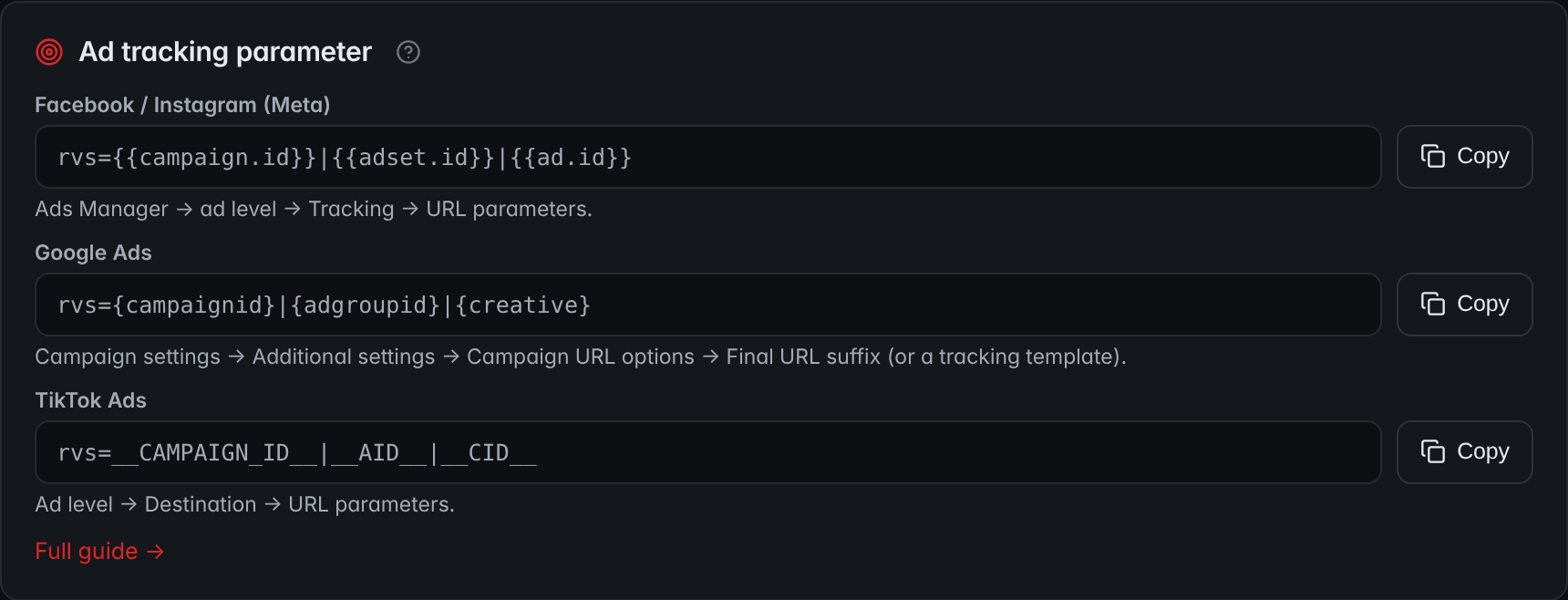
- Google Ads lineThis is the line for Google Ads: it carries the campaign, ad group and ad IDs into each visit.
- Where it goesThe note under each line says where that platform takes URL parameters.
What Google checks on your VSL page
Google's rules cover the page an ad sends people to, not only the ad. Its destination requirements list the ways a page fails, among them:
- Not working: the page doesn't load or work, including error codes returned to Google's AdsBot.
- Mismatch: a redirect from the final URL to a different domain, or a tracking template that doesn't lead to the same content as the final URL.
- Out of reach: a page Google can't crawl, or one that can't be reached in the targeted location.
- Hard to use: a page that's "unnecessarily difficult or frustrating to navigate" or doesn't meet the Better Ads Standards.
- Built for ads: a page "designed for the primary purpose of showing ads".
The mismatch rule deserves a second look if your funnel uses tracking links. Google's page doesn't name link trackers, but a final URL that's a short link or tracker on another domain, forwarding to the VSL, matches the redirect it describes. Put the VSL's own address in the final URL, and if you use a tracking template, make sure it leads to the same content as the final URL. A June 2026 update allows redirects to another domain "in certain circumstances" with "prior approval", Google's example being a consumer-goods maker sending shoppers to approved retailers.
There's no VSL-specific rule in these requirements: a video page is judged like any other, and everything on it counts. Google's own fix list for a disapproval includes correcting the landing page or pointing the ad at a compliant one, so the claims in your video, headline, testimonials and bottle shot need the same review as the ad. The VSL compliance guide covers the video itself.
When a supplement ad is disapproved: fix first, appeal second
To see why an ad was disapproved, hover over its "Disapproved" status. Google's fix-or-appeal page then gives three routes: edit the ad and save it ("Your ad will automatically be reviewed again"); fix the destination by correcting the page or pointing the ad at a compliant one; or appeal, if you've fixed both or believe the review was wrong. To appeal, open Tools > Troubleshooting > Policy manager, go to the "Policy issues" tab, select Appeal, and choose "Dispute decision" or "Made changes to comply with policy".
The limits are strict. "Each ad is limited to 3 appeals", and after three unsuccessful ones you have to contact customer support. Appeals for the same ads or campaigns need at least 24 hours between them or they're marked as duplicates, and too many unique appeals in 24 hours can get processing suspended. Starting July 21, 2026, in-account appeals aren't available for policy decisions made more than six months earlier.
Breaking these policies can put the account at risk too, though not without notice. For the Unapproved substances, Misrepresentation and destination rules alike, Google says a warning comes at least 7 days before any account suspension; the Unapproved substances page adds that violations "won't lead to immediate account suspension without prior warning". Treat that week as a deadline to fix the product, the page and the ads.
Here's the whole path from launch to appeal. Open each stage to see what goes wrong there:
From policy check to appeal
1Check the product and every claim before launch
What happens: Run the formula, the ad, the landing page and the video through the Unapproved substances rule and the Misrepresentation policy.
Why it matters: An ingredient problem can't be fixed by rewriting, and a claim on the page can sink an ad whose text is clean.
What goes wrong:
- Checking the ad text but not the video or the page
- A product name close to one on Google's list
2Submit, and read the reason if it fails
What happens: Google reviews the ad. If it is disapproved, hover over the "Disapproved" status to see which policy applies.
Why it matters: The policy named tells you whether to fix the ad, the page or the product.
What goes wrong:
- Putting a whole budget behind one ad with no approved backup
3Fix the ad or the destination
What happens: Edit the ad and save it, or correct the landing page or point the ad at a compliant one. An edited ad is reviewed again automatically.
Why it matters: A fix doesn't use any of the three appeals each ad gets.
What goes wrong:
- Changing the ad but leaving the same claim on the page
4Appeal only when the review was wrong
What happens: In Policy manager, choose "Dispute decision" or "Made changes to comply with policy" and submit.
Why it matters: Each ad gets three appeals; after three unsuccessful ones you have to contact customer support.
What goes wrong:
- A second appeal for the same ads within 24 hours: marked as a duplicate
- Too many unique appeals in 24 hours: processing may be suspended
- A decision more than six months old: since July 21, 2026, no in-account appeal
Appeal when the review was wrong, say a reviewer read a disease claim into a line that doesn't make one, or after you've changed the claim. If the reason is a claim you can't substantiate, an appeal spends one of three tries on a decision that's unlikely to change. When an appeal fails or is marked a duplicate, Google's advice is to make a minor edit to the ad text or final URL to trigger a new crawl, rather than resubmitting.
Google gives no general review time; for an appeal in progress it only says to check back in 24 hours. Keep an approved ad in each ad group while you fix another, so one disapproval doesn't stop the campaign. Google's own short walkthrough shows the appeal flow in Policy manager:

Before you launch Google ads for supplements
Run this list against the product, the ad, the landing page and the video before you submit anything:
Before a supplement ad goes to Google
0 of 11 done
Frequently asked questions
Do you need Google certification to advertise supplements?
No. Google has no dietary-supplement certification, and its Healthcare and medicines policy has no separate supplement section. Supplements are judged under the Unapproved substances rules and the Misrepresentation policy, so what decides approval is the ingredients and the claims in the ad and on the landing page. Some countries add limits: Merchant Center, for example, says dietary supplements may not be promoted in Turkey or Mexico through Shopping ads and free listings.
Can you run Google ads for weight loss supplements?
Yes, within the rules. The product can't contain ephedra or hCG promoted for weight loss, or appear on Google's non-exhaustive list of unapproved supplements, which names many slimming products. The ad and page can't promise unrealistic weight loss within a specific time frame or with little effort, imply prescription-drug strength, or show testimonials with specific results without a visible disclaimer that results can vary.
Why was my supplement ad disapproved?
Hover over the Disapproved status in your account to see which policy Google applied. For supplements, check three policies first: the Unapproved substances rule (an ingredient, a prescription-drug comparison or a disease claim), the Misrepresentation policy (unrealistic weight loss in a set time, testimonials without a disclaimer) and the destination requirements (a page that fails, mismatches the ad or cannot be crawled). Fix the ad or the page and it is reviewed again automatically.
How many times can you appeal a Google Ads disapproval?
Three times per ad. After three unsuccessful appeals, Google says you have to contact customer support. Leave at least 24 hours between appeals for the same ads or campaigns, or they are marked as duplicates, and avoid filing many unique appeals in one day, which can get processing suspended. Since July 21, 2026, decisions made more than six months earlier cannot be appealed from inside the account.
Can supplement brands use Customer Match on Google?
Not when the ads promote in a sensitive interest category such as health. Google says advertisers promoting in those categories cannot use advertiser-curated audiences: Customer Match, your data segments, audience expansion and lookalike segments. Google's health category covers health conditions and products that treat or manage chronic conditions; its pages do not mention weight loss. Predefined Google audiences such as in-market, affinity and demographics remain available.
Is melatonin allowed in Google ads?
Yes, subject to local law. Google's June 2025 update to its healthcare and medicines policy removed a prohibition on promoting melatonin products outside the United States and Canada, and said advertisers may promote melatonin in accordance with local laws and regulations. The current Unapproved substances page does not mention melatonin. The claims rules still apply: a melatonin ad cannot imply it treats a disease or works like a prescription drug.
Sources
- Healthcare and medicines — Google Advertising Policies Help
- Unapproved substances — Google Advertising Policies Help
- Unapproved pharmaceuticals and supplements — Google Advertising Policies Help
- Update to healthcare and medicines policy (June 2025) — Google Advertising Policies Help
- Healthcare & medicines — Google Merchant Center Help
- Misrepresentation: Unreliable claims — Google Advertising Policies Help
- Health in personalized advertising — Google Advertising Policies Help
- Restricted targeting in Personalized advertising — Google Advertising Policies Help
- Destination requirements — Google Advertising Policies Help
- Update to destination requirements policy (June 2026) — Google Advertising Policies Help
- Choose the right campaign type — Google Ads Help
- URL builders: Collect campaign data with custom URLs — Analytics Help
- Fix a disapproved ad or appeal a policy decision — Google Advertising Policies Help
- Customer File Custom Audiences — Meta for Developers