
TikTok ads for supplements: weight-loss rules, market limits, creator posts and tracking to your VSL
TikTok's rules for supplement ads sit in four policies: weight management, misleading content, healthcare market tables and branded content. Here is what each allows, where weight-loss supplements may run, why paid creator posts are off-limits for some products, and how to track a TikTok click through your VSL.
On this page
TikTok ads for supplements are possible, but the rules sit in several policies, and what runs depends on the claim, the market and who posts the video. Weight-loss claims must target people 18 and older. Weight-loss supplements are listed as allowed only in certain Asia-Pacific markets, with the US not named. And the Branded Content Policy lists weight-loss supplements and vitamins among prohibited industries for paid creator posts.
Four policies do the deciding, each on its own page with its own update date. Check the date before you rely on any summary, this one included, and read this as a guide to the policies, not legal advice.
- Weight Management and Body Image (last updated June 2026): age limits, weight-loss claims, body image and the markets that accept weight-loss supplements.
- Misleading and false content (April 2026): exaggerated results, before-and-after comparisons, undisclosed AI.
- Healthcare and Pharmaceuticals (September 2026): rules set out market by market, in tables.
- Branded Content Policy (November 2023): what creators may be paid to promote, and the disclosure setting.
TikTok's weight-loss rules: who sees the ad and what it can't promise
TikTok's Weight Management and Body Image policy covers the ad and its landing page, which must carry no exaggerated or harmful weight-loss claims and nothing that promotes disordered eating. Its age rule is blunt: any weight-loss or muscle-gain claim "must be restricted to audiences aged 18 years or older." It also rules out:
- "References to unrealistic muscle gain or weight loss".
- Encouraging unhealthy lifestyles or an unhealthy relationship with food.
- Claims that "the product alone, without diet or exercise, can lead to weight loss or muscle gain".
- "Suggestions that losing weight or gaining muscles is easy or guaranteed."
The body-image half matters as much for creative. No ad may promote a negative or unhealthy body image, suggest a "right" or "perfect" way to look, or claim that looking a certain way makes people more desirable, successful, happy or popular. That last point excludes the story arc where a new body brings a new partner or a promotion.
Where weight-loss supplements may run
The same page's market rules decide whether a weight-loss supplement can be advertised at all. They list weight-loss supplements as "allowed in select countries" for Group 1 only: Australia, Cambodia, Indonesia, Malaysia, New Zealand, the Philippines, Singapore, Sri Lanka, Thailand and Vietnam, "subject to age restrictions, applicable local licensing requirements, and full compliance with all advertising policies". Group 2, which includes the UAE, Egypt, Nigeria, Pakistan, South Africa and Türkiye among others, accepts meal replacements and weight-loss surgery but not supplements. In both groups advertisers must work with a TikTok sales representative to confirm eligibility (May 2026 update).
The page doesn't mention the United States, the UK or the EU, so don't read an answer for those markets into it in either direction. If you sell there, confirm eligibility with TikTok for each market before you build creative. Google handles the same products under different rules, set out in Google ads for supplements, and weight loss supplement advertising puts TikTok's rules beside the FTC's and Meta's.
Here's how the weight-management wording sorts a few ad lines. They're fictional, and lines on the right still need evidence, 18-plus targeting and an eligible market:
Weight-loss ad lines on TikTok
Fictional lines, sorted by the Weight Management and Body Image policy
Against the policyRejected
- "Drop two sizes without changing what you eat": the product alone, without diet or exercise
- "Effortless results in 14 days": weight loss made to sound easy
- "Finally get the body you deserve": a "right" or "perfect" way to look
- A new body, then a new partner and a promotion: looking a certain way makes people more desirable or successful
Still needs evidence, 18+ and an eligible marketFits the wording
- "What I eat in a day, and where the capsule fits": diet stays in the picture
- "My routine: walking, meal prep, and this": the product isn't doing it alone
- The label and the serving, filmed close up: no promise at all
- A real customer's typical result, with the time it took
What TikTok's misleading-content policy rejects
TikTok's Misleading and false content policy applies to every supplement ad, weight loss or not: "Ad content and landing pages must not promise or exaggerate results concerning a product's effect." One of its examples is a lotion ad promising "Get slim legs right away." The same policy:
- restricts before-and-after comparisons "which may cause viewers to have a false or distorted impression" of a product's results;
- prohibits claims of cures for incurable diseases;
- prohibits a discount in the ad that doesn't match the landing page, its example being "up to 50% off" against "up to 30% off";
- prohibits fake play or close buttons, and endorsements by public figures who didn't authorize them.
Some markets go further. A few of the Healthcare and Pharmaceuticals policy's market tables, Jordan, Lebanon and the Gulf among them, prohibit before-and-after comparisons outright for food supplements.
One more line matters for anyone testing AI-made creators: when TikTok identifies AI-generated content "that has not been disclosed, your ad will be rejected or restricted."
Openings that make no claim to defend
None of this rules out people talking to camera. It rules out faking it. Honest material includes real customers who agreed to be filmed, founders and staff who say who they are, and demonstrations. Paid creators who have used the product belong on that list only for products TikTok lets creators be paid to promote: the next section covers which, and UGC ads covers the brief and the rights. What doesn't belong is anything staged as a customer story: in its case against NextMed, a telehealth seller of GLP-1 weight-loss programs, the FTC alleged "fake testimonials created by hired individuals, employees, and family members" (FTC).
Four openings for one fictional magnesium capsule show what that leaves. None makes a claim you'd have to defend in the first seconds; measuring hook rate tells you which one holds viewers, and the video ad script post builds the rest of the ad:
Four honest openings for one supplement
A fictional magnesium capsule; every line is fictional
Show the label, say the number
"Two capsules, 200 mg of magnesium glycinate. Here's what else is on the label."
Opens on a fact the bottle proves. Nothing to substantiate beyond the label.
A real routine, filmed as it happens
"My morning: water, a walk, two capsules with breakfast."
Shows use and promises nothing. The person has to be a real user; check the branded content rules below before you pay anyone to post it.
Answer a question about the formula
"Why magnesium glycinate and not another form? Here's how we chose it."
Education the brand can source. Keep it about the ingredient, never a disease.
Why the product exists
"I'm the founder. We made this because we wanted a capsule with nothing extra in it."
It has to be true, and a founder's story is still an ad: no health promises in it.
Paying creators: what TikTok's branded content rules exclude
TikTok defines branded content as content that "promotes a third party brand or its products or services" in exchange for payment or any other incentive, and a creator posting it "must enable the commercial content disclosure toggle". Its Branded Content Policy then lists prohibited industries, and two reach supplement brands directly: "Weight loss products or services", which names "weight loss/management supplements", and "Pharmaceuticals, healthcare and medicine products", whose list names vitamins alongside "powders, shakes or gummies claiming to have vitamin or health benefits". For weight-loss products, the policy points to region-specific guidance for exceptions.
Put plainly: under TikTok's own policy, a creator paid to post about a weight-loss supplement or a vitamin would be posting prohibited branded content. Check the region-specific guidance for your market before you budget for creators.
Spark Ads raise the next question. They're ads built from organic TikTok posts, your own or a creator's "with their authorization", and creators "can choose to provide a code to authorize using their post in your Spark Ad" (About Spark Ads). When a creator tags you as a brand partner in their disclosure settings, you can use the post in ads by default for 60 days (Brand Partner tag). TikTok's Spark Ads pages don't say whether the branded-content prohibitions carry over to an ad built on a creator's post. For a weight-loss supplement or a vitamin, don't assume that route is open; confirm it with TikTok for your market.
Your own account is a different case. TikTok's definition of branded content is about promoting a third party's brand, so on that wording a post about your own product isn't branded content; the disclosure setting's "Your brand" option labels such a post "Commercial content". Turning that post into an ad doesn't take it outside the ad rules: TikTok calls Spark Ads "a native ad format", so expect the weight-management, market and healthcare rules above to apply.
Where creator content is allowed, two disclosure duties stack. TikTok's setting labels a post "Commercial content" when it promotes your own brand and "Paid partnership" when a creator promotes a third party, and a post without the proper disclosure "may be removed or restricted" (TikTok). The FTC's guidance sits on top: for an endorsement in a video, the disclosure should be in the video itself, not just in the description, and the FTC says "Don't assume that a platform's disclosure tool is good enough" (FTC).
The same FTC page sets two limits that matter for supplements: a creator can't talk about their experience with a product they haven't tried, and can't make claims that would need proof the advertiser doesn't have. US law also reaches creators abroad when it's reasonably foreseeable that their post will affect US consumers.
Tracking a TikTok click through your VSL to the sale
A TikTok click carries more than a visit. TikTok appends its click ID, ttclid, to the landing-page URL when someone clicks an ad, and matches it to the events your pixel or server sends: "We use matched event information for attribution, audience building, ad delivery optimization, and measurement" (TikTok Click ID). TikTok can attach the ID automatically, or you can add it to your landing-page URL yourself. On a VSL funnel it has to survive every hop between the ad and the order:
A TikTok click, from ad to order
- TikTok adTikTok adds ttclid to the URL; your parameters add the campaign, ad group and ad.
- VSL pageThe TikTok pixel sends page events, and the click ID has to arrive with the visit.
- CheckoutThe buy button carries the visit to the checkout; keep the click ID with it.
- OrderThe purchase reaches TikTok from the pixel and, through the Events API, from your server, deduplicated.
Here's where it can get lost. Say the funnel runs ad, presell, VSL, checkout, and the presell's button links to the VSL with a bare URL: the click ID and your campaign parameters stop at the presell, and the order arrives without one of TikTok's matching keys. Pass the query string along at every step, and check it with a test visit that carries the same parameters.
TikTok describes its Events API as "a secure server-to-server interface" for sharing what customers do on your website, and recommends running it next to the pixel: "Use both TikTok's Pixel and Events API together with Event Deduplication." Among the benefits it lists is "improved ad delivery and targeting by capturing missing conversions". The matching keys include the click ID, hashed email and phone, IP address and user agent, and IP and user agent are "shared by default for Pixel and require manual configuration for Events API" (matching events).
If you also tag links with UTM parameters, fix the spelling once: Google Analytics treats values as case sensitive, so utm_source=tiktok and utm_source=TikTok land as two sources (Google Analytics).
In RevvyScales the TikTok pixel is set once on a folder or a VSL (pixels), and the rvs parameter records the campaign, ad group and ad behind each visit, on TikTok as on Meta and Google (ad tracking). This is where the pixel goes:
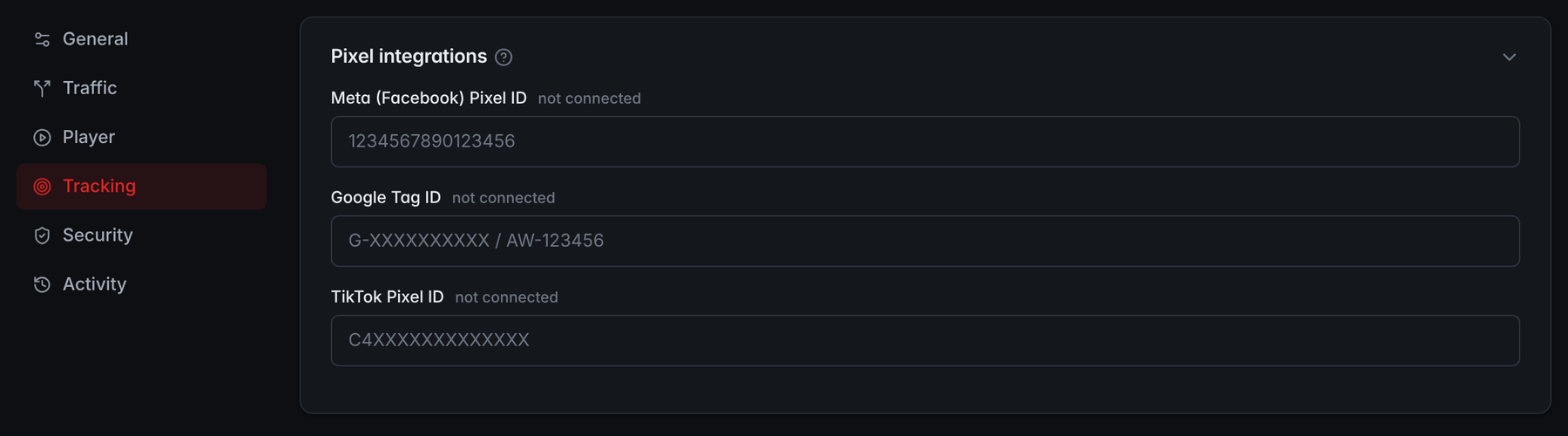
- TikTok Pixel IDThe TikTok pixel ID goes here, set once for the folder or the VSL.
Everything above is about ads that send people to your own page. Selling through TikTok Shop is a separate channel with rules of its own; selling supplements on TikTok Shop covers them, including why Shop content can't send buyers to a VSL.
Before you launch TikTok ads for supplements
Put the rules together for one fictional brand with two products and two markets. Its fiber capsule is sold for weight management. In Australia, a Group 1 market, TikTok lists it as allowed, subject to 18-plus targeting, local licensing requirements, full compliance with the ad policies and confirmation through a sales representative. In the US the policy gives no answer, so the brand asks TikTok before building anything. In both markets, paying creators to post about the capsule is prohibited branded content unless TikTok's region-specific guidance makes an exception.
Its magnesium capsule makes no weight claims, so the weight-management market list doesn't decide it; the healthcare policy's market tables are where to check that one. Before paying a creator to post about it, the brand also checks the healthcare category of the branded-content list.
Then go through this list for every market and every creative before you submit:
Before a supplement ad goes live on TikTok
0 of 11 done
Frequently asked questions
Can you advertise weight loss supplements on TikTok in the US?
TikTok's weight management policy lists weight-loss supplements as allowed in select Group 1 markets: Australia, Cambodia, Indonesia, Malaysia, New Zealand, the Philippines, Singapore, Sri Lanka, Thailand and Vietnam. The page does not mention the United States, so it gives no US answer either way. Confirm eligibility with TikTok, through a sales representative, before you build creative, and target any weight-loss claim at people 18 and older.
Do TikTok supplement ads have to target 18+?
Any ad with a weight-loss or muscle-gain claim must be restricted to audiences aged 18 or older under TikTok's Weight Management and Body Image policy. For other supplement claims, check the market table in TikTok's Healthcare and Pharmaceuticals policy for each country you target, because that policy sets out its rules market by market rather than in one global list.
Can I pay a TikTok creator to promote my supplement?
Not for every supplement. TikTok's Branded Content Policy lists weight loss and weight management supplements among the prohibited industries for branded content, and its healthcare category names vitamins, along with powders, shakes or gummies claiming vitamin or health benefits. For weight-loss products it points to region-specific guidance for exceptions. For other products, the creator must turn on the commercial content disclosure setting, and the FTC expects the paid relationship to be disclosed in the video itself.
Are Spark Ads allowed for supplement brands?
Spark Ads are built from organic TikTok posts, either your own or a creator's that the creator authorizes, for example with a code. TikTok's Spark Ads pages do not say whether the branded content prohibitions apply to an ad built on a creator's post. If your product is a weight-loss supplement or a vitamin, confirm with TikTok for your market before you pay for a post you plan to promote.
What is ttclid in TikTok ads?
TikTok Click ID, or ttclid, is a tracking parameter TikTok appends to the landing-page URL when someone clicks an ad. TikTok matches it to events sent by the pixel or the Events API and uses the matches for attribution, audience building, delivery optimization and measurement. Keep it in the URL through any redirect or presell before your VSL; that is general good practice rather than a TikTok rule.
Do I need the TikTok Events API if I have the pixel?
TikTok recommends both, deduplicated, rather than one or the other. The Events API is a server-to-server connection for sharing what customers do on your website, and TikTok lists capturing missing conversions among its benefits. One setup difference matters: IP address and user agent are shared by default for the pixel but need manual configuration for the Events API.
Sources
- Weight Management and Body Image — TikTok Business Help Center
- Update to Weight Management and Body Image Policy (May 2026) — TikTok Business Help Center
- Misleading and false content — TikTok Business Help Center
- Healthcare and Pharmaceuticals — TikTok Business Help Center
- Branded Content Policy — TikTok
- How to turn on the Commercial Content Disclosure setting in TikTok — TikTok Business Help Center
- About Spark Ads — TikTok Business Help Center
- About the Brand Partner tag in content disclosure settings — TikTok Business Help Center
- About Events API — TikTok Business Help Center
- How to set up matching events with Events API — TikTok Business Help Center
- About TikTok Click ID — TikTok Business Help Center
- Disclosures 101 for Social Media Influencers — FTC
- FTC Takes Action Against Telemedicine Firm NextMed (July 14, 2025) — FTC
- URL builders: Collect campaign data with custom URLs — Analytics Help