
TikTok Shop supplements: invite-only selling, the banned categories, the documents, and why Shop sales can’t feed a VSL
TikTok Shop’s US seller pages make supplements an invite-only category and ban several kinds outright. Here is who can sell, which products are out, the documents and claims rules, how creators are paid, and why a Shop video can’t send buyers to your VSL when an ad to your own page can.
On this page
- Who can sell supplements on TikTok Shop
- The supplements TikTok Shop bans outright
- The documents TikTok asks for
- What a TikTok Shop listing and a creator may say
- How creators sell supplements through TikTok Shop
- TikTok Shop vs TikTok ads to a VSL
- Before you apply to sell supplements on TikTok Shop
- Frequently asked questions
You can sell supplements on TikTok Shop US only by invitation. Dietary supplements are an invite-only category there, and an invited seller then qualifies with documents such as FDA facility registration, a cGMP certificate and a lab report from the last 180 days. Weight-management, mental-wellness, GLP-branded, peptide and CBD products are prohibited outright, and because creators may not send buyers off TikTok Shop, Shop content can't feed a VSL.
Three questions decide whether a product can get as far as a listing:
Can your supplement be sold on TikTok Shop US?
Based on TikTok Shop's US seller pages, dated 9 and 20 October 2026
Has TikTok invited you to sell in the dietary supplement category?
TikTok tells sellers to ask their account manager.
Is the product on the prohibited list?
Weight management, mental wellness, GLP in the name or branding, peptides, CBD and the rest of the list below.
Are the documents ready?
FDA facility registration, a cGMP certificate, a lab report from the last 180 days and photos of the real packaging.
Best fit
Not on TikTok Shop yet
No invitation to the dietary supplement category means no supplement listings on TikTok Shop US. Ask your account manager; TikTok's pages give no criteria for being invited. TikTok ads to your own page are a separate route, under the ad policies.
Read more: TikTok Ads for Supplements: Rules, Creators, Tracking
Best fit
Not on TikTok Shop US
Invited or not, a product on the prohibited list can't be sold on TikTok Shop US. For weight management the ban names the product types as well as the claims, so rewording the listing doesn't help.
Best fit
Gather the paperwork first
Invited and not prohibited, but the documents aren't ready. Start with the lab report, which must come from an accredited partner laboratory or a qualifying in-house lab within the last 180 days, and photograph the real packaging, not a mockup.
Best fit
Apply for category qualification
Invited, not prohibited and with the documents ready: apply in Seller Center's category qualification. Most applications are reviewed within 6 days, approval isn't guaranteed, and every listing and creator video must then follow the claims rules.
Who can sell supplements on TikTok Shop
TikTok's Dietary Supplements Requirements for the US put it in one line: "Eligibility to sell dietary supplements is limited to invite-only sellers." The same page tells sellers they "must be invited to offer products in the category" and points them to their account manager. TikTok's restricted products policy lists dietary supplements twice, among products that need qualification and among those with invite-only approval, and the supplement page makes supplements for infants and toddlers a separate invite-only category. TikTok's pages give no criteria for an invitation, so treat any list of them you read elsewhere as a guess.
An invited seller then applies for the category in Seller Center's qualification center. TikTok's category qualification guide says "Most applications are reviewed within 6 days", and its restricted products policy adds that approval isn't guaranteed and that TikTok may ask for more documents during the process or once a product is live. The supplement page and the restricted products policy are dated 9 October 2026 and the prohibited products policy 20 October 2026, so check the current versions before you apply. This post summarizes them; it isn't legal advice.
The supplements TikTok Shop bans outright
TikTok's Prohibited Products Policy says that "TikTok Shop does not prohibit dietary supplements generally under this policy", and it names what it does prohibit. Read together with the supplement page, the line falls here:
What TikTok Shop US names, and what it bans
From the Dietary Supplements Requirements (9 October 2026) and the Prohibited Products Policy (20 October 2026)
By invitationCan be qualified
The kinds of supplement the US page names:
- Beauty supplements
- Fitness supplements
- Vitamin, mineral and wellness supplements
- Herbal supplements
- Sexual-wellness supplements, with a separate TikTok page on promoting them
Each still needs the documents, a compliant label and claims that follow the content rules.
Invitation or notProhibited
- Weight-management supplements, and products that claim to aid weight management or fat reduction
- Mental wellness supplements
- CBD and other hemp or cannabis cannabinoids
- Peptides and GLP-1 agonists, and products with "GLP" in the title or branding
- Height-growth supplements, steroids and prohormones
- Products named in FDA recalls, warning letters or safety alerts
- Bulk pure caffeine
Weight management is the ban that matters most to supplement brands, and it's written two ways. The supplement page bans the products: appetite suppressants and carbohydrate control supplements, diet shakes, fat burners and weight-loss bars. The prohibited products policy bans the claim: "Products and supplements that claim to aid weight management, fat reduction, or similar goals." Between the two, a weight-loss supplement can't be listed on TikTok Shop US, and rewording the listing doesn't change what the product is.
The GLP rule is about names. It covers products that use "GLP," "GLP 1," "Glucagon like peptide 1" or similar terms in the title or branding, with one exception: products "clearly marketed as supportive, non drug products for individuals already using GLP 1 medications". Peptides and GLP-1 agonists themselves are banned as unapproved drug ingredients.
One more rule catches formulas that look ordinary. If one serving exceeds the adult Tolerable Upper Intake Level for a vitamin or mineral, the listing "is subject to immediate enforcement": it's frozen without notice, and it comes back only after reformulation and a matching certificate of analysis, through an appeal.
The documents TikTok asks for
The supplement page lists what manufacturers, importers and repackers may need to provide:
- FDA food facility registration: a screenshot from FDA Direct, an official FDA website, or a verification letter from a third party, showing a valid registration under the name on the label.
- A cGMP certificate that confirms the establishment complies with 21 CFR Part 111.
- A product test report "issued by a TikTok Shop Accredited Partner Laboratory", or by an in-house lab with ISO/IEC 17025 accreditation or a cGMP certificate. It must be "Issued within the last 180 days" and cover microbiology, heavy metals, contaminants and potency. Sexual-enhancement and bodybuilding products also need NSF/ANSI 173-2024 adulterant testing.
- Clear photos of the physical packaging.
Time the lab work around that 180-day window. A report on a batch tested in the spring may already be too old for an application in the autumn, so arrange a fresh test of a current batch shortly before you apply.
Resellers need a purchase invoice dated within the last 180 days that reflects "a combined purchase of at least 400 units", a qualifying lab report, and photos of the front, the back and the Supplement Facts panel. Label photos have to be unedited photos of real packaging; TikTok refuses mockups and design files.
The label itself must carry what TikTok checks for: the "Dietary Supplement" statement and the net quantity on the front, a boxed Supplement Facts panel, the other ingredients, allergen declarations, the manufacturer's or distributor's name and street address, a US contact for adverse events, and directions. The supplement label requirements post covers each element, and certificate of analysis covers what a lab report should show.
The first document comes with a catch. TikTok asks for proof of FDA facility registration, then forbids using registration statements to imply approval. That matches FDA's own position: a registration number "does NOT convey FDA approval or endorsement of the facility or its products" (FDA).
What a TikTok Shop listing and a creator may say
TikTok's claims rules cover the listing and every video and LIVE that sells it, whether the seller or a creator makes it (health content requirements). Disease claims are out, explicit or implied, and so is any claim of FDA approval. Structure/function claims need the FDA disclaimer on the listing and on the label. A claim violation deactivates the listing first; repeated ones freeze it. Here is what's out in practice, and what to say instead:
What TikTok Shop content rules out
Fictional lines for a fictional supplement, sorted by TikTok's US rules for listings, videos and LIVE
No disease or medical claims
Out: "Lowers cholesterol." "Stops hair loss."
Instead: what is in the product, how much, and how to take it, as the label states.
Those two lines are TikTok's own examples. Implied claims count too, in titles, images and descriptions.
No borrowed approval
Out: "FDA approved." "Made in an FDA-registered facility" used as a seal.
Instead: no FDA wording beyond the disclaimer your structure/function claims need.
TikTok bans claims of approval, endorsement or certification by FDA or any other regulator, and registration statements used to imply approval.
No weight or muscle promises
Out: "Melts belly fat." A before-and-after body photo next to the bottle.
Instead: nothing. Weight-management supplements are prohibited products, however they are described.
High-risk statements suggesting a product might cause weight loss, weight gain, fat reduction or muscle gain are not permitted, and dramatic before-and-after body comparisons tied to a product are high-risk.
No guaranteed or effortless results
Out: "Works for everyone, guaranteed." A testimonial saying the capsules alone changed someone's life.
Instead: how a real customer fits the product into a routine, with no result you can't stand behind.
Exaggerated promises about effects or results may be considered prohibited "even with disclaimers", and for weight claims "guaranteed, effortless, or permanent results must not be suggested".
No borrowed white coats
Out: a creator in scrubs or a lab coat recommending the product.
Instead: the creator as who they are.
Doctor or nurse imagery that implies an endorsement is prohibited.
One sentence in TikTok's creator guide closes the usual loophole: creators may not say a promoted product prevents or cures any wellness condition, "even if disclaimers are provided." On TikTok Shop, a disclaimer doesn't rescue a claim.
How creators sell supplements through TikTok Shop
Creators sell your product through affiliate collaborations you set up in Seller Center (affiliate collaborations). A target collaboration invites specific creators; an open collaboration shows the product to every TikTok Shop creator, with an option to approve each one. You set the commission, from 1% to 80%, per product or group, "Target rates override open rates", and a change takes effect only after a delay. You can offer free samples.
The creator sells through TikTok Shop's own product links, in shoppable videos and LIVE. TikTok's creator policy tells creators to "Avoid prompts to purchase through external links, usernames, websites, social media, and messaging services", and its content policy says content with "links, references, or other calls to action" pointing away from TikTok Shop may be removed, with restricted commission among the penalties. Creators also wait for their money: "the commission settlement period may be extended from 15-31 days after order delivery", and it can wait on open disputes, refunds or returns.
Brief creators well, because breaking the rules costs them too. A creator whose account-health score falls to 150 points or below can't make shoppable videos or LIVEs for a period. Fake activity is out as well: the content policy bans artificially generated orders, likes, "positive customer feedback, or ratings".
Disclosure is the gap to fill yourself. These Shop pages say nothing about disclosure labels, but the FTC's rules still apply. A commission is a material connection, the FTC suggests plain wording such as "I get commissions for purchases made through links in this post", and it expects advertisers to "have reasonable programs in place to train and monitor members of their network" (FTC). Its influencer guide adds that the disclosure belongs in the video itself and warns, "Don't assume that a platform's disclosure tool is good enough" (FTC). The Endorsement Guides post covers the rules, and UGC ads covers the creator brief.
The pages leave one question open. TikTok's separate Branded Content Policy lists weight-loss supplements and vitamins among the industries creators may not be paid to promote, and the Shop pages don't say how that policy applies to Shop affiliate collaborations. Ask TikTok about your product before you brief creators.
TikTok Shop vs TikTok ads to a VSL
The biggest difference is where the sale happens. On TikTok Shop it happens inside TikTok: the creator's video, then TikTok Shop's own product link. Because creators may not send buyers off TikTok Shop, Shop content can't drive traffic to a VSL, a presell or your own store. If your funnel runs through a VSL, the route on TikTok is an ad:
TikTok Shop or TikTok ads to your VSL
Two routes on one app, under different rules
The sale stays on TikTokTikTok Shop
- Invited sellers who pass category qualification
- No weight management, mental wellness, GLP branding, peptides or CBD
- Creators sell on a commission you set, paid after delivery
- Buyers stay on TikTok Shop: no outside links or websites
The catch: everything happens on TikTok's page and on TikTok's terms, so there is no VSL in the funnel.
The sale happens on your pageTikTok ads to your VSL
- The ad links to your own VSL and your checkout
- Weight-loss claims only to audiences 18 and older, and no product-alone or easy results
- Weight-loss supplements listed as allowed only in some Asia-Pacific markets; the US isn't named
- Paid creator posts: weight-loss supplements and vitamins are prohibited industries under the Branded Content Policy
- Your own pixel and tracking on every visit
The catch: you pay for the traffic, and for a weight-loss supplement the policy gives no US answer.
That changes what the Shop listing has to do. A buyer who finds you through a Shop video buys from the listing and never sees your VSL, so the story, the bundle choice after the pitch and the way the VSL frames the guarantee never reach them. The listing has to work on its own as a product page, inside the claims rules above. For a brand whose margin rests on bundles and upsells, that's a different business on the same app.
Ads come with their own rulebook. TikTok's ad policy says weight loss or muscle gain claims "must be restricted to audiences aged 18 years or older", rules out claims that the product works without diet or exercise, and lists weight-loss supplements as allowed only in certain Asia-Pacific markets, without naming the US (TikTok). So for a weight-loss supplement in the US, Shop is closed and ads are a question to put to TikTok before you build anything. The TikTok ads for supplements post works through those rules and the tracking.
Take one fictional brand with two products. Its magnesium capsule is a mineral supplement, a kind TikTok's US page names: with an invitation and the documents it can apply for qualification, and if TikTok approves it, creators can sell it in Shop videos on commission. Its fat burner can't be listed at all, and for ads TikTok's weight policy gives no US answer, so the brand asks TikTok before anyone writes a script. Whichever product runs as an ad sends people to the brand's own VSL, where the offer, the guarantee and the tracking are its own.
What an ad to your own page gives you is the visit. The page is yours, so the pixel, the click and the order are yours to measure. In RevvyScales, the TikTok pixel is set once on a folder or a VSL (pixels), and the rvs line for TikTok records the campaign, ad group and ad behind each visit (ad tracking):
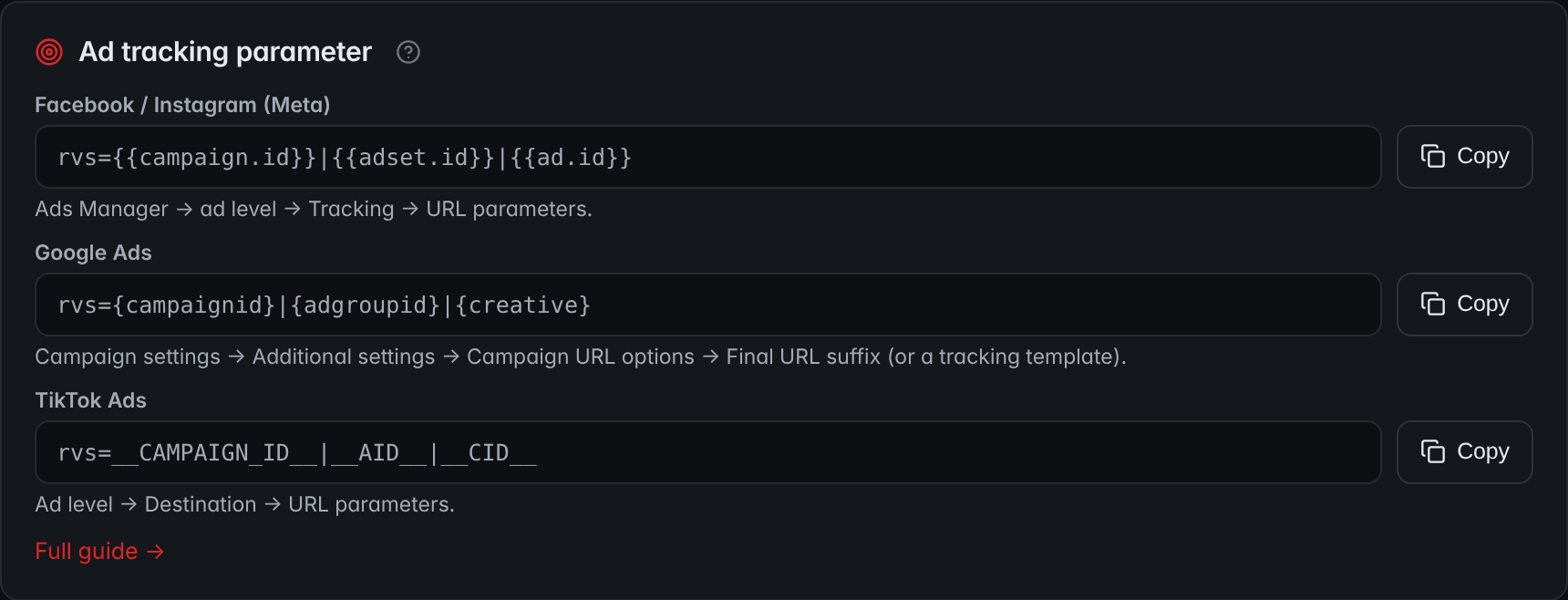
- The TikTok linePaste this line into the TikTok ad's URL parameters, at ad level, and each visit to your VSL records its campaign, ad group and ad.
Before you apply to sell supplements on TikTok Shop
Check every item before you ask your account manager about an invitation, and again before each new listing:
Before you apply to sell supplements on TikTok Shop
0 of 10 done
Frequently asked questions
How do I get invited to sell supplements on TikTok Shop?
TikTok's US supplement page says eligibility is limited to invite-only sellers and tells sellers to contact their account manager. Its pages give no criteria for an invitation, such as sales history or follower counts, so be wary of anyone who claims to know them. Once invited, you still apply for category qualification with your documents, and approval isn't guaranteed.
Can I sell weight loss supplements on TikTok Shop?
Not in the US. TikTok Shop's supplement page prohibits weight-management supplements, naming appetite suppressants, carbohydrate control supplements, diet shakes, fat burners and weight-loss bars, and its prohibited products policy bans products that claim to aid weight management or fat reduction. TikTok ads are a separate track, where TikTok lists weight-loss supplements as allowed only in certain Asia-Pacific markets.
Can TikTok Shop creators link to my website?
No. TikTok tells Shop creators to avoid prompts to purchase through external links, usernames, websites, social media and messaging services, and its content policy says content that directs users away from TikTok Shop may be removed, with commission restricted. The sale is meant to happen through TikTok Shop's own product links. To send viewers to your own page, use TikTok ads instead.
How much commission do TikTok Shop affiliates earn?
The seller sets it. TikTok takes commission rates from 1% to 80% in its affiliate collaboration settings, per product or group, and a rate set for invited creators overrides the open rate. Changes take effect after a delay. Payment can wait too: TikTok says the commission settlement period may be extended to 15 to 31 days after delivery, and it can wait on open disputes, refunds or returns.
Do TikTok Shop creators have to disclose commissions?
TikTok Shop's pages don't mention disclosure labels, but the FTC's rules apply to affiliate creators like any other endorser. A commission is a material connection, and the FTC suggests plain wording such as "I get commissions for purchases made through links in this post". The disclosure belongs in the video itself, and the FTC says not to rely on a platform's tool alone.
What lab testing does TikTok Shop require for supplements?
At least one product test report from a TikTok Shop accredited partner laboratory, or from an in-house lab with ISO/IEC 17025 accreditation or a cGMP certificate, issued within the last 180 days. It has to cover microbiology, heavy metals, contaminants and potency. Sexual-enhancement and bodybuilding products also need NSF/ANSI 173-2024 adulterant testing, and resellers need a qualifying report too.
Sources
- Dietary Supplements Requirements — TikTok Shop Academy (US)
- Restricted Products Policy — TikTok Shop Academy (US)
- Your Guide to Category Qualification — TikTok Shop Academy (US)
- Prohibited Products Policy — TikTok Shop Academy (US)
- Requirements for Responsible Health-Related Content — TikTok Shop Academy (US)
- Setting Up Affiliate Collaborations — TikTok Shop Academy (US)
- TikTok Shop Creator and Content Policy Guide — TikTok Shop Academy (US)
- TikTok Shop Content Policy — TikTok Shop Academy (US)
- Weight Management and Body Image — TikTok Business Help Center
- Branded Content Policy — TikTok
- FTC's Endorsement Guides: What People Are Asking — FTC
- Disclosures 101 for Social Media Influencers — FTC
- Registration of Food Facilities: Small Entity Compliance Guide — FDA