
Native ads for ecommerce: how the networks work, where to send the click, and the rules on labels and claims
Native networks place your headline and image inside publisher sites, among the articles. This post explains how the auction and placements work, why ecommerce brands send that click to an advertorial or listicle rather than a product page, how to label it, what the networks reject in health ads, and how to judge it all by revenue per click.
On this page
- What are native ads for ecommerce?
- How native ad networks work: auctions, CPC bids and publisher control
- Why native traffic goes to an advertorial, not a product page
- Native ad creative: headlines and images that earn the right click
- Native ad disclosure: labeling the ad and the advertorial
- Health and supplement ads on native networks: what gets rejected
- How to measure native ads: revenue per click by publisher
- A native ads launch checklist
- Frequently asked questions
Native ads for ecommerce are paid placements that match the look of the site around them: a headline and an image among a publisher's articles, bought through networks such as Taboola, whose advertiser platform is now called Realize, and Outbrain, which now operates under the Teads brand. The reader came to read, so send the click to a labeled advertorial or listicle, then the VSL, and judge every placement by revenue per click.
What are native ads for ecommerce?
Native ads are ads formatted to fit the page they appear on. On the open web, a native network places an advertiser's thumbnail and headline inside publisher sites, styled like the content around them. Realize, for example, describes its ads as natively integrated into sites like Yahoo, and it shows a campaign only on publishers that accept that type of content (How Realize works).
Two networks you'll meet early:
- Taboola, whose advertiser platform and help center now go by Realize (Realize help center).
- Outbrain, which operates under the Teads brand following the merger of the two companies (Outbrain guidelines).
For an ecommerce brand, native traffic is cold traffic in reading mode: people who clicked a headline while reading about something else. They didn't search for your product, and they didn't arrive ready to buy. That shapes everything that happens after the click, from the page you send them to the way you measure it.
How native ad networks work: auctions, CPC bids and publisher control
Each time a placement opens, Realize runs an auction, and your cost-per-click bid enters you into it (Realize campaign settings). A higher CPC makes your ads more competitive, and Realize uses your CPC together with your click-through rate to decide where to recommend them (How Realize works). The consequence: a headline that earns more clicks can win placements without a higher bid, and a headline that earns clicks from the wrong people wins placements you'd rather not pay for.
What you control, using Realize as the example:
- Bid strategy: Fixed Bid (a manual CPC), Enhanced CPC, or Maximize Conversions with an optional target CPA (Realize bid strategies).
- Publishers: a Block Publishers setting excludes sites, though Realize advises against blocking when you set up a new campaign unless you're sure a publisher doesn't suit your brand (Realize campaign settings).
- Creative: Realize suggests three distinct titles and three unique images per campaign, with its default "Ad Optimization" mode left on (Realize campaign setup).
- Tracking: install the Taboola pixel on every page of your site, track the purchase and the event just before it, and use the {site} macro in your tracking code so every visit carries the publisher site that sent it (Realize campaign setup).
Whichever network you start on, the practical shape is the same: launch broad, let the data build up by publisher site, then cut or bid down the sites that don't pay.
Why native traffic goes to an advertorial, not a product page
A product page asks for a decision the moment it loads: price, add to cart, checkout. The native reader clicked a headline in the middle of an article and isn't ready for that. An advertorial continues what they were doing. It tells a story, introduces the idea behind the product, lets the reader who isn't a fit leave early, and hands the rest to the VSL that makes the full argument. A listicle does the same job for readers who are already comparing options.
This post won't repeat how to write them: the advertorial guide covers structure and labeling, and the presell page guide covers the shorter bridge and how to test it. The path looks like this:
The native ad funnel for a product with a story
- Native adA thumbnail and headline on a publisher site
- Advertorial or listicleLabeled "Advertisement" at the top; tells the story
- VSL pageMakes the full argument and the offer
- CheckoutYour store or checkout platform
Keep the promise intact at each handoff. The native headline's promise should open the advertorial, and the advertorial's promise should open the VSL. Outbrain's guidelines put it plainly: align headlines with the content they link to, so "12 things..." must not lead to 40 slides, and every image must be relevant to the linked content (Outbrain guidelines). Test the direct path too: send part of the traffic straight to the VSL and keep whichever path earns more per click.
In RevvyScales, presells come in three templates: Presell, Advertorial and Listicle. Each CTA links to a VSL, a folder or any URL, and a presell whose CTA points to a VSL or folder fires that funnel's pixels without a second setup (presells help doc). Point an advertorial at a folder and the folder splits its traffic between whole VSLs by weight, so one native campaign can test VSLs behind the same page.
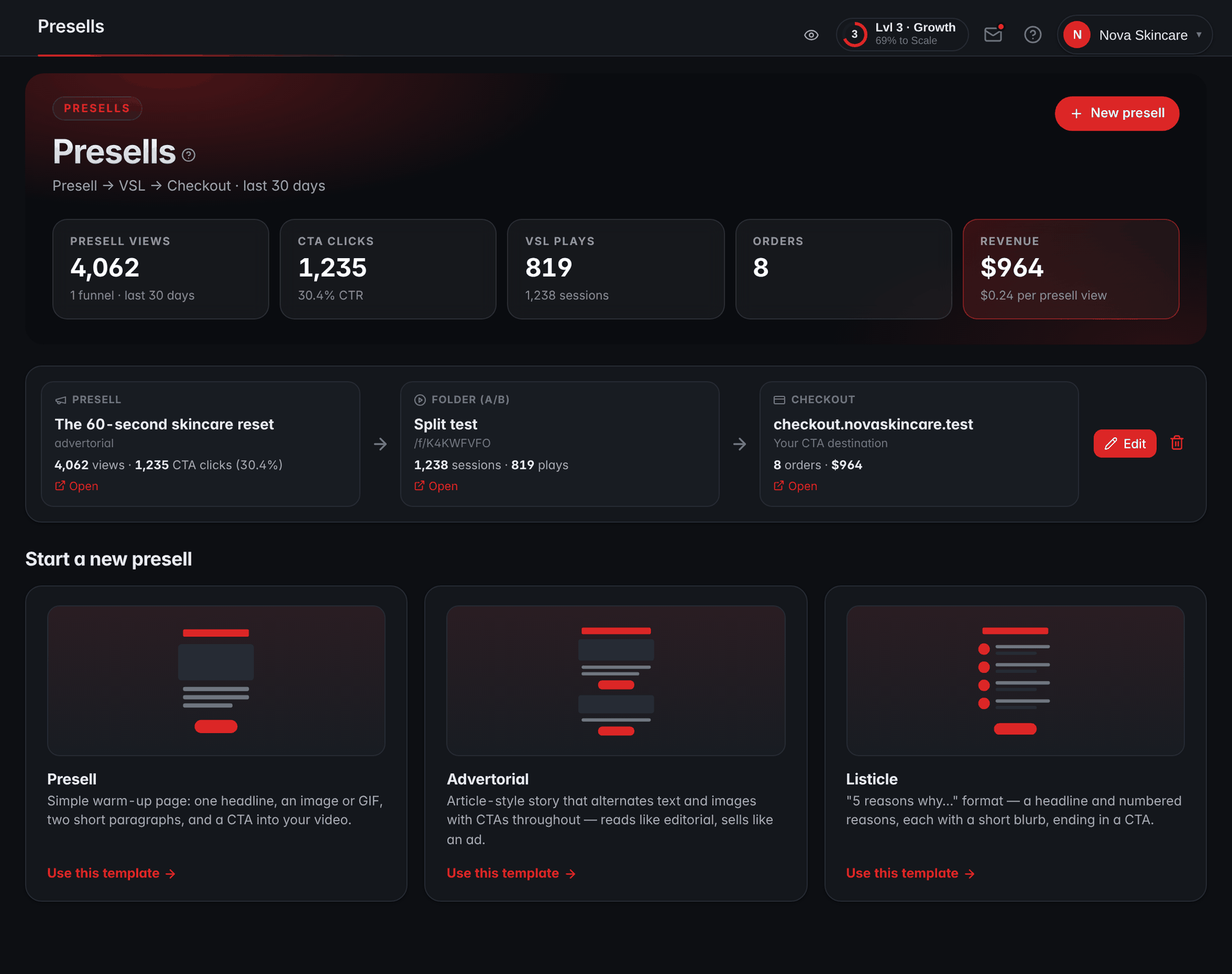
The page you build there is the page the network reviews, so the rules in the next two sections apply to it as much as to the ad.
Native ad creative: headlines and images that earn the right click
On a native network, the headline is your targeting: it decides who clicks. Write for the reader you want, not for the most clicks. Three formats that suit a product with a story, shown for a fictional digestive supplement:
- Founder story: "Why we built a digestive supplement around the biggest meal of the day"
- Listicle: "6 things to check before you buy a digestive enzyme"
- Explainer: "What's actually in a digestive enzyme supplement, in plain English"
None of these promises a result. A headline that promises one has to be backed by evidence, and it pulls in readers your VSL will then disappoint.
Images follow the same logic. Show the product, a serving or real use, in a picture that matches the page behind it. Outbrain bans before-and-after photos in thumbnails, and Realize's health and beauty policy lists extreme close-ups and images that make people feel self-conscious about their bodies among common rejections (Realize health and beauty policy).
Test titles and images in combinations, three by three, and pick winners by revenue per click, not by click-through rate. You pay for every click, so a title that doubles CTR with clicks that don't buy roughly doubles your cost per order.
Native ad disclosure: labeling the ad and the advertorial
The FTC's position, in its December 2015 guidance on native advertising, is that ads and promotional messages must be identifiable as advertising. It suggests labels such as "Ad", "Advertisement", "Paid Advertisement" and "Sponsored Advertising Content", calls "Promoted" and "Promoted Stories" ambiguous, and recommends placing the disclosure in front of or above the headline (FTC native advertising guide).
The networks apply the same idea to your page. Outbrain's guidelines say "Advertisement" or "Advertorial" must appear clearly and prominently at the top of applicable pages, and they prohibit fake navigation that makes a page look like a larger editorial site, fake media logos, fake testimonials, fake comments and false endorsements by celebrities or others (Outbrain guidelines). Realize lists pages that give the impression of a news site without prominent "Advertorial" lettering at the top as a common rejection, along with false claims that a healthcare professional recommends the product (Realize health and beauty policy).
So: your brand in the header, "Advertisement" above the headline, a real author, real customers quoted with permission, and no media logos for coverage that didn't happen. For reviews and testimonials on the page, the fake reviews rule post sets out what the FTC prohibits. This is not legal advice: read the FTC's guide and your network's current policy before you launch. The advertorial guide walks through the label, the byline and the honest version of each deceptive tactic:
Health and supplement ads on native networks: what gets rejected
Network policies for health products go further than general advertising law. Realize's health and beauty policy lists, among frequent rejections: unrealistic or photoshopped before-and-after images, specific weight-loss amounts in creatives, claims of losing 2 pounds or more a week for a month or more without diet or exercise, claims about diseases or conditions rather than symptoms, absolute claims of results that allude to curing, preventing, treating or reversing a condition, and discouraging the use of conventional medicine. Weight-loss creatives there must say the loss comes as part of a healthy reduced-calorie diet and exercise program, and landing pages should carry disclosures where they apply, link the studies behind their claims and, for the US, state whether the FDA has evaluated the product.
Outbrain's guidelines say health and beauty ads may not allude to diagnosing, curing, preventing, treating or reversing any disease, condition or illness. They require "Results may vary" or "Results may not be typical" next to any before-and-after images on landing pages, and they exclude whole categories of supplements, among them anabolic steroids, ephedra, HGH and nootropic "brain pills". Teads' own ad policies prohibit before-and-after images and claims of specific weight-loss amounts (Teads ad policies). Here is the difference in practice:
Health ads on native networks
Rewrite itLikely rejected
- Before-and-after photos in the thumbnail
- "Lose 20 lbs in a month without dieting"
- "Reverses joint damage", or any cure, treat or prevent claim
- A news-style page with no "Advertorial" label at the top
- "Recommended by doctors" when no doctor recommends it
Use insteadSafer version
- The product, a serving or real use, in an image that matches the page
- Structure/function language, with the disclaimer on the page
- "Advertisement" or "Advertorial" clearly at the top of the page
- A real, named expert who holds the view, with any payment disclosed
- A link to the study behind each claim
For the claims themselves, the structure/function claims post sets out what a supplement may say, and the before-and-after photos post covers the platform rules on those images.
How to measure native ads: revenue per click by publisher
Two numbers decide whether native traffic works. Revenue per click is revenue divided by paid clicks, counting everyone who left the advertorial without buying. Break-even CPC is revenue per click times your contribution margin: the most a click can cost before it loses money. Because one paid click brings one visitor, the revenue per visitor calculator gives you both. Here is an illustrative week: 10,000 clicks, 140 orders, an $89 average order and a 55% contribution margin:
Calculator
Revenue per visitor calculator
From one traffic source or one VSL over the same period.
- Conversion rate
- orders ÷ unique visitors
- Revenue
- Break-even cost per visitor
- the most a visitor can cost you
If one ad click brings one visitor, the break-even cost per visitor is also your break-even cost per click.
At $1.25 of revenue per click and a 55% margin, a click is worth about $0.69 before ad cost. Pay $0.55 a click and you keep about $0.14 a click, or $1,353 on 10,000 clicks, before fixed costs. Pay $0.75 and you lose about $0.06 on every click. The revenue per visitor guide goes deeper on the metric.
The average hides the spread. Split the same week by the {site} value in your tracking and the publishers separate:
Revenue per click by publisher site
The same illustrative week, $0.55 CPC
At a $0.55 CPC, Site A's 2,000 clicks earned about $1,210 of contribution and Site B's 3,000 about $660. Site C roughly broke even. Site D's 1,500 clicks lost about $480: each brought $0.42 of revenue, or $0.23 of contribution, against $0.55 paid. Bid D down or block it, raise the bid on A, and leave C until it has more data. Seven or so orders from Site D is a small sample, so decide on several weeks of orders, not a few days of clicks, and count revenue after refunds: a site that sends buyers who ask for their money back isn't a good site.
A native ads launch checklist
- The advertorial or listicle carries "Advertisement" or "Advertorial" clearly at the top, and your brand in the header.
- The native headline's promise opens the advertorial, and the advertorial's promise opens the VSL.
- No disease claims, no before-and-after images in thumbnails, no specific weight-loss amounts, and every claim on the page links to its evidence.
- Every expert, testimonial and comment on the page is real and used with permission.
- The network's pixel is on every page, with the purchase and the step before it tracked.
- The tracking code carries the publisher site, so revenue can be split by placement.
- Three titles and three images are ready for the first test.
- You know your break-even CPC before launch, and you review revenue per click by site every week.
- A direct-to-VSL path runs as a control, judged on revenue per click after refunds.
Frequently asked questions
Are native ads good for ecommerce?
They suit products that need explaining, such as a supplement with a story or a new kind of gadget, sold through an advertorial or listicle and a VSL. Native readers are cold and in reading mode, so a product page alone tends to waste the click. Test a small budget, measure revenue per click by publisher site, and keep native only if it beats your break-even CPC.
How much do native ads cost?
On Realize you bid per click, and what you pay depends on your bid, your click-through rate, the publishers and the competition, so there is no honest single figure. Work it out from your own numbers instead: revenue per click times your contribution margin is the most a click can cost you. Start your bids below that, and let the per-site data tell you where to raise them.
What is the difference between Taboola and Outbrain?
Both place advertisers’ headlines and images inside publisher sites on the open web. Taboola’s advertiser platform and help center now go by Realize, and Outbrain operates under the Teads brand. Their policies differ in detail: Outbrain bans before-and-after photos in thumbnails, while Realize rejects unrealistic or photoshopped ones. Read each network’s current policy and test both.
Do native ads need to be labeled?
Yes. FTC guidance says ads must be identifiable as advertising and suggests labels such as Ad, Advertisement or Paid Advertisement, placed in front of or above the headline. The networks also expect article-style landing pages to carry Advertisement or Advertorial clearly at the top. A logo alone, or a word like Promoted, is weaker. This is general information, not legal advice.
Should native ads go to a product page or an advertorial?
Usually to an advertorial or listicle first, because the reader clicked a headline while reading and is not ready for a price and a cart. The advertorial carries the story and hands off to the VSL. Still run a direct path as a control: send part of the traffic straight to the VSL and keep whichever earns more revenue per click after refunds.
Can I run supplement ads on native networks?
Yes, within their policies. Expect no disease claims, no unrealistic before-and-after images, no specific weight-loss amounts and links to the studies behind your claims. Some categories are excluded outright: Outbrain, for example, does not accept anabolic steroids, ephedra, HGH or nootropic brain pills. Check the current health policy of each network before you build the page.
Sources
- Native Advertising: A Guide for Businesses — Federal Trade Commission
- How Realize Works — Realize Advertiser Help Center
- About Campaign Settings — Realize Advertiser Help Center
- Setting Your Bid Strategy — Realize Advertiser Help Center
- Perfecting Campaign Setup — Realize Advertiser Help Center
- Policy FAQ: Health & Beauty — Realize Advertiser Help Center
- Trust & Authenticity: Our Advertising Guidelines — Outbrain
- Ad policies — Teads