
Best VSL hosting software: the criteria that matter, a weighted scorecard and a two-week bake-off
There is no single best VSL hosting platform for everyone, and a ranked list can't know your traffic, offer or checkout. This buyer's guide gives you the platform types, the criteria that move revenue, a weighted scorecard, the questions to ask vendors and a two-week bake-off that lets your own traffic pick the winner.
On this page
- Why can't a ranked list pick your VSL host?
- What types of VSL hosting software are there?
- Which criteria decide the best VSL hosting for you?
- How should you weight the criteria? A scorecard by business model
- How do you run a two-week VSL hosting bake-off?
- What should you ask a VSL hosting vendor?
- Where RevvyScales fits
- Build your shortlist this afternoon
- Frequently asked questions
The best VSL hosting is the platform that earns the most revenue per visitor on your own traffic while keeping the video fast, protected and measurable. Shortlist on the criteria that touch revenue (start speed, player mechanics, timed offers, sale attribution, revenue-based testing and protection), then let a two-week split test pick the winner instead of a ranking.
Why can't a ranked list pick your VSL host?
A ranked list scores tools on features or reviews. Neither measures what decides the question: how much revenue each platform produces per visitor with your traffic, your offer and your checkout. Two platforms with matching feature lists can differ in how fast they start on a weak phone connection, in how the unmute moment feels and in how many of your sales they actually attribute.
The useful sequence is categories to narrow the field, criteria to score it and a test to decide. If you want the background on what each layer of hosting does first, start with the VSL hosting guide.
What types of VSL hosting software are there?
There are four, each built for a different job:
Four types of VSL hosting software
What each is built for, and its gaps for a VSL on paid traffic
General video platforms
Examples: YouTube. Built for: Reach and discovery on the platform.
Gaps for a VSL on paid traffic: Platform ads and branding, related videos at the end, no overlays on the player, no sale attribution.
Marketing video hosts
Examples: Vimeo, Wistia. Built for: Brand, lead-gen and webinar video.
Gaps for a VSL on paid traffic: Reports built on viewing rather than revenue per visitor; plan limits to read closely.
Self-hosted stack
Examples: Cloud storage, a CDN and an open-source player such as hls.js. Built for: Teams that want full control.
Gaps for a VSL on paid traffic: Every direct-response feature is yours to build and maintain.
Dedicated direct-response hosts
Examples: RevvyScales and others. Built for: Paid traffic to sales videos.
Gaps for a VSL on paid traffic: A monthly plan; depth varies between vendors, so test.
A few documented details are worth knowing before you shortlist a general host. YouTube's rules for embedded players prohibit "overlays, frames, or other visual elements in front of any part" of the player, so an unmute prompt or buy button can't sit on the video (YouTube Required Minimum Functionality). Since 2018, related videos at the end can only be limited to your own channel, not switched off (YouTube player parameters).
Paid Vimeo plans remove most branding and let you choose which sites can embed a video (Vimeo plan features), and Vimeo publishes a 2TB monthly bandwidth threshold with a suspension process for accounts that keep exceeding it (Bandwidth on Vimeo). Wistia's A/B test, on paid plans, compares engagement, play rate and plays, plus clicks on in-player calls to action, between two embeds (Wistia A/B testing). That's useful data, but revenue isn't on the list. The platform-by-platform detail is in hosting a VSL on YouTube, Vimeo or Wistia.
Which criteria decide the best VSL hosting for you?
Each criterion connects to revenue through a specific mechanism. The red-flag column is what to watch for in a demo or a trial.
| Criterion | What good looks like | Red flag |
|---|---|---|
| Start speed | Adaptive HLS from a CDN; a fast first frame on a weak phone connection | One MP4 file for every device |
| Unmute behavior | Muted autoplay, and the first tap for sound restarts at 0:00 | Sound comes on mid-sentence, so the hook is lost |
| Timed offer reveal | Offer block and button appear at the pitch second you set | Button only at the end, or visible from the start |
| Progress and seek control | Seek bar can be hidden; progress bar options | Viewers can scrub straight to the price |
| Retention analytics | A second-by-second curve with the pitch marked, comparable across periods | Views and average watch time only |
| Revenue attribution | Each CTA click carries an ID to checkout; sales tie back to ad and variant | Revenue known only from the ad platform |
| Testing | Sticky assignment; winners judged on revenue with a confidence rule | Winners picked on play rate or by eye |
| Protection | No MP4 exposed, encrypted stream, domain allowlist, watermark option | A file URL anyone can save |
| Custom domains | Your own subdomain with automatic SSL | Vendor domain only, so switching means editing every ad |
| Pricing model | Cost per visitor stays small at three times today's traffic | Overage terms you can't find |
| Support and reliability | Broken streams detected automatically; people reachable on scaling days | No clear answer on monitoring |
Two criteria are easy to underweight in a demo because they don't look like features. Unmute behavior decides whether the hook, the part of the script that does the most work, is heard at all. Attribution decides whether you can act on anything else in this table, because a test you can't tie to revenue is a popularity contest. The full list of player behaviors and why each one matters is in the VSL player guide.
How should you weight the criteria? A scorecard by business model
Not every criterion matters equally to every business. Setting weights before you look at vendors forces you to decide what you're buying, and it protects you from features you'll never use. Here are starting weights for three common profiles; each column adds up to 100, and you should adjust them to your situation.
| Criterion | Cold-traffic info product | Shopify or ecommerce brand | Agency with many clients |
|---|---|---|---|
| Start speed and delivery | 15 | 15 | 10 |
| Player mechanics | 20 | 10 | 15 |
| Revenue attribution | 20 | 25 | 20 |
| Testing | 15 | 10 | 10 |
| Analytics depth | 10 | 10 | 15 |
| Protection | 10 | 5 | 10 |
| Pricing model fit | 5 | 15 | 10 |
| Support | 5 | 10 | 10 |
Why the differences: long info-product VSLs live or die on the hook and the pitch reveal, so player mechanics weigh heavily. Ecommerce brands sell through a store checkout on another platform and pay product costs on every order, so attribution and pricing fit lead. Agencies juggle many clients and report to each of them, so analytics and support count for more.
A worked scoring example
Say a Shopify brand scores two hypothetical platforms from 1 to 5 on each criterion. Multiply each score by its weight, add the results and divide by 5 to get a score out of 100.
A Shopify brand scores two platforms
Hypothetical platforms, each criterion scored from 1 to 5, its weight in parentheses
Platform A
- Start speed (15): 4
- Player mechanics (10): 5
- Revenue attribution (25): 2
- Testing (10): 4
- Analytics depth (10): 4
- Protection (5): 4
- Pricing fit (15): 5
- Support (10): 3
Weighted score: 73
Higher weighted scorePlatform B
- Start speed (15): 4
- Player mechanics (10): 4
- Revenue attribution (25): 5
- Testing (10): 3
- Analytics depth (10): 4
- Protection (5): 3
- Pricing fit (15): 3
- Support (10): 4
Weighted score: 79
Platform A has the richer player and the friendlier price, and it still loses, because it struggles to connect sales from the Shopify checkout back to ads and the brand weighted that at 25. That's the point of weights: they stop the longest feature list from winning by default. The scorecard narrows the field to two. Live traffic decides.
How do you run a two-week VSL hosting bake-off?
A bake-off is a split test where the variable is the platform. Everything else, from the video and poster to the headline, offer, prices and checkout, stays identical, or you'll measure the wrong thing.
A two-week bake-off, step by step
Open each step for what to do and why
1Freeze the creative
What happens: Same video file, poster, headline, pitch second, offer block and checkout links on both arms.
2Split at the visitor level and keep it sticky
What happens: Each new visitor is assigned to one arm and stays there on return visits.
Why it matters: So a returning buyer isn't counted on both sides.
3Pick the cleanest split for your question
What happens: If the question is which player sells better, keep the page and tracking identical and swap only the player: RevvyScales' bring-your-own player (Growth plan and up) embeds an external player on a VSL page (bring-your-own player), and a folder splits traffic between the two pages by weight, sticky per new visitor (folders and A/B splitting). If the question is which whole platform does better, use a link-level splitter that assigns and remembers each visitor.
What goes wrong:
- Duplicate ad sets, one per platform, are the least clean option, because the ad platform optimizes each ad set separately and the two can drift toward different people.
4Run 14 days
What happens: Set the end date before you start and don't stop early because one side leads on a good day.
Why it matters: Two full weekly cycles even out weekday and weekend behavior.
5Use revenue per visitor as the primary metric
What happens: Watch play rate, pitch retention, refund rate and page errors as guardrails.
Why it matters: Revenue per visitor combines conversion rate and order value, upsells included (why RPV is the north star).
6Reconcile tracking first
What happens: Compare each arm's attributed orders with the orders your checkout actually received.
Why it matters: If one platform attributes 95% of orders and the other 80%, you're comparing tracking, not hosting. Fix that before you read the result.
7Decide with a significance check, or call it a tie
What happens: Run the check in the worked example below before you name a winner.
A worked example: is the difference real?
After 14 days, arm A had 6,000 visitors, 102 orders and $6,630 in revenue. Arm B had 6,000 visitors, 117 orders and $7,605. Revenue per visitor is $1.11 against $1.27, a 14.7% lead for B. Tempting.
Now check it. Conversion is 1.70% against 1.95%, and a standard two-proportion z-test on those order counts gives z ≈ 1.02, a two-sided p-value of about 0.31. At 95% confidence that is not a winner. Detecting a gap this size reliably, with 80% power, would take roughly 45,000 visitors per arm.
Here is that sample-size math, set to this test; change the numbers to plan your own:
Calculator
A/B test sample size calculator
How many visitors each version needs before a difference in conversion rate means something.
- Visitors in all
- Days at your traffic
- Orders per version at the current rate
95% confidence and 80% power, the usual defaults for comparing two conversion rates. Fix the sample before you start and read the result when it is reached: stopping the moment one version pulls ahead finds winners that aren’t there. With more than two versions, each is compared with the control and needs this many visitors.
So the honest call at this sample size is a tie. Choose on the criteria your scorecard weights most, on cost and on workflow, or keep the test running if traffic allows. What you shouldn't do is announce B the winner because it's ahead. Sample size, peeking and stopping rules are covered in depth in the VSL A/B testing guide.
What should you ask a VSL hosting vendor?
- How is the video delivered? You want an adaptive HLS ladder on a CDN, not a single file.
- Is an MP4 ever exposed, and how are stream keys protected? Look for encryption with short-lived, signed key URLs.
- Can I restrict playback to my domains, with wildcards? Ask whether connected domains are added automatically.
- What happens when a first-time viewer taps for sound? The right answer is a restart from the first word.
- Can the offer appear at a set second, and what do returning viewers see?
- How are sales attributed? Ask which checkouts are supported, how click IDs reach the checkout and whether events reach ad platforms server-side without duplicates.
- How does a test pick a winner? Ask for the metric, the confidence rule and whether assignment is sticky.
- What are the limits? Bandwidth, plays, seats, domains, pages and overage terms, in writing.
- What can I export if I leave? Orders, leads, test results and raw events.
- How are broken streams detected, and who answers support on a weekend?
- What does the trial include? You need enough time and features to run the bake-off.
Where RevvyScales fits
RevvyScales is built for one job: VSLs on paid traffic. Every upload becomes an AES-128-encrypted HLS ladder delivered from a CDN, with no downloadable MP4, and the player runs smart muted autoplay, restart on unmute, resume for returning viewers and a timed pitch reveal on every plan.
In RevvyScales, a new VSL starts on this page:
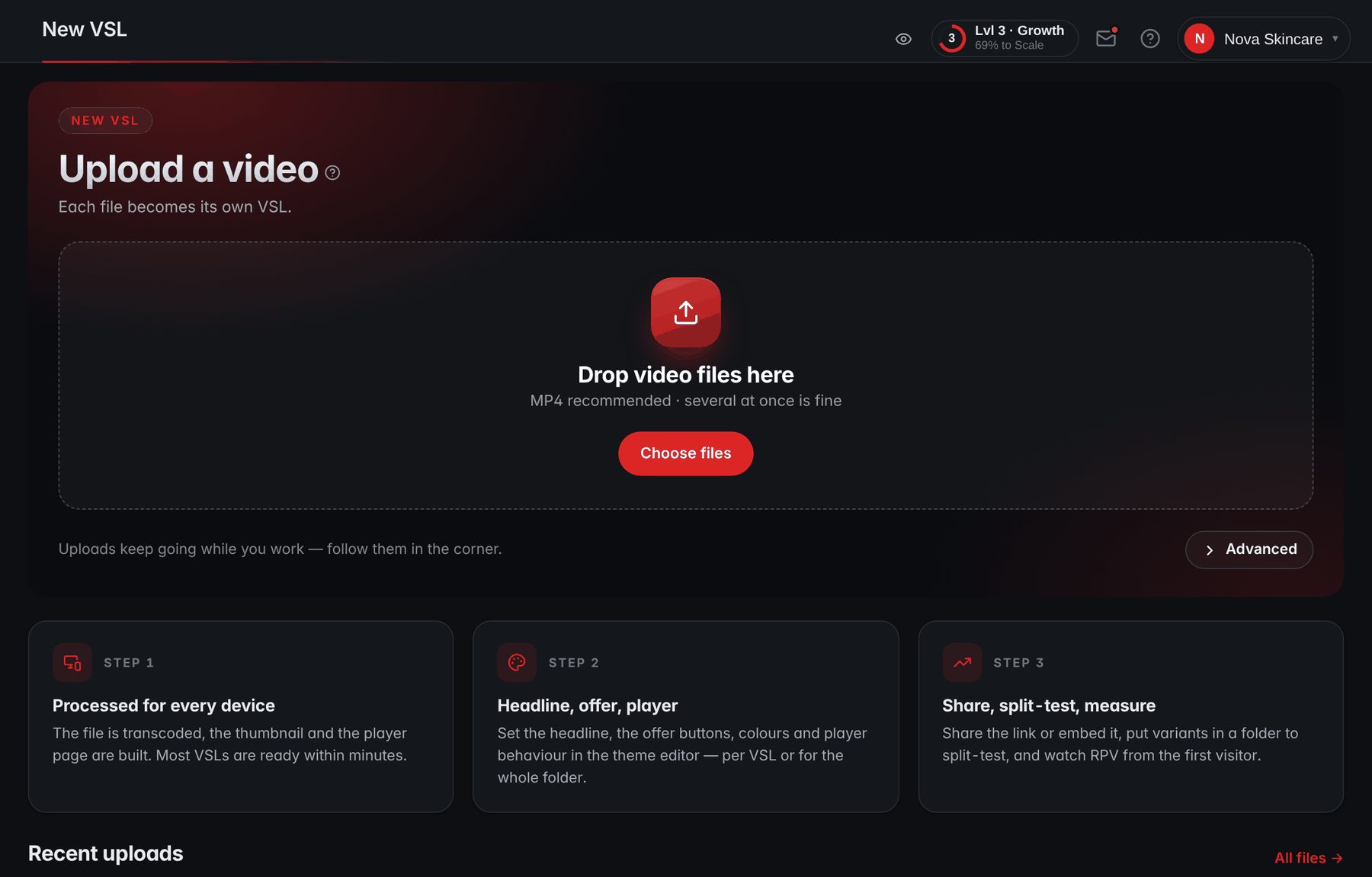
- Processed for every deviceThe upload is transcoded for every device, and its thumbnail and player page are built.
- Headline, offer, playerThe headline, offer buttons, colors and player behavior are set in the theme editor, per VSL or for the whole folder.
- Share, split-test, measureShare the link or embed it, put variants in a folder to split-test, and watch revenue per visitor (RPV).
Each CTA click gets a click_id. Sales come back through the Shopify, Whop or CartPanda integrations, or from any checkout that can report that ID from its thank-you page. Folders split traffic between whole VSLs on every plan, and on the Growth plan and up you can test headline, poster, offer and playback-speed variants inside one VSL, each shown by weight and sticky per viewer (variant tests).
It doesn't build checkouts, quizzes, email campaigns or course libraries. If you need those, pair it with tools that do, or choose a different category. There's a free trial on Starter and up — 14 days on Starter, 7 on Growth, 3 on Scale — and current plans are on the plans page.
Build your shortlist this afternoon
Work down the list; your ticks are saved in this browser:
Build your shortlist this afternoon
0 of 7 done
Frequently asked questions
Is YouTube good enough for a VSL?
For organic content and very early message tests, yes. For paid traffic it gets expensive in quieter ways: YouTube keeps its branding on embeds, shows related videos at the end, reserves the right to show ads on your video and prohibits overlays such as an unmute prompt or a buy button on its player. It also can't tell you which ad produced a sale, because the purchase happens on your checkout.
How long should a VSL hosting test run?
At least two full weeks, so both arms see the same weekdays and weekends, and longer if order counts are low. Fix the stopping rule before you start, either an end date or a target number of orders per arm, and don't stop early because one side is ahead on a good day. Early leads in small samples often shrink or reverse as more data comes in.
Should I choose usage-based pricing or a flat monthly plan?
Model both at today's traffic and at three times that, because the plan has to survive success. Usage pricing tracks data delivered or plays, so a long VSL with strong retention costs more per visitor. Flat plans are predictable but can carry bandwidth thresholds, play caps or feature tiers. Pick the model whose cost per visitor stays small next to your revenue per visitor at scale.
Can I change VSL hosts without editing my ads?
Yes, if your ads point at a domain you control. Build and test the new page on a temporary subdomain, recreate pixels and server-side events, run a test purchase end to end, then point the live address at the new host. If your ads point at the old vendor's domain, every ad needs a new URL, which is the best argument for using your own domain from day one.
What makes a VSL player different from a regular video player?
A regular player is built to show a video. A VSL player is built to sell with one: it starts muted, restarts when a first-time viewer taps for sound, can hide the seek bar, reveals the offer at the pitch second, resumes returning viewers where they left and reports retention and clicks next to sales. Those behaviors change revenue without changing a word of the script.
Sources
- YouTube API Services: Required Minimum Functionality — Google for Developers
- YouTube embedded players and player parameters — Google for Developers
- Embedding features by plan type — Vimeo Help Center
- Bandwidth on Vimeo — Vimeo Help Center
- A/B Testing — Wistia Help Center
- hls.js — HTTP Live Streaming client (GitHub)