
Scientific Advertising: Claude Hopkins' 1923 rules, rebuilt as a modern VSL testing playbook
Claude Hopkins' Scientific Advertising (1923) argued that ads should be judged like salespeople and settled by tests, not opinions. This guide summarizes the principles that still hold, flags what has aged, and turns each idea into a concrete practice for scripting, tracking and testing a VSL.
On this page
- Who was Claude Hopkins?
- Scientific Advertising summary: the principles that still work
- From keyed coupons to click IDs: Hopkins' tools in a VSL funnel
- Keyed returns today: trace every sale to its source
- A Hopkins-style testing playbook for VSLs
- Specifics beat generalities: rewriting VSL claims
- Offer service: demos, samples and value-first VSLs
- Headlines that pick out the right viewer
- What's outdated in Scientific Advertising
- How to apply this to your VSL tomorrow
- Frequently asked questions
Scientific Advertising is a 1923 book by Claude C. Hopkins that treats advertising as salesmanship measured by results. Its core rules: key every ad so you can trace its sales, test small before you spend big, be specific, offer service instead of demanding a purchase, and let real buyers settle arguments. For a VSL, the modern version is click-level tracking, revenue per visitor and disciplined split tests.
Who was Claude Hopkins?
Claude C. Hopkins (1866–1932) was an American copywriter best known for his years at the agency Lord & Thomas, where he worked with its owner, Albert Lasker, for 17 years (Albert Lasker, Wikipedia). He insisted that copywriters research the products they sold and write reason-why copy, popularized test campaigns that used coupons to attribute sales to specific ads, and was a strong believer in sampling. His campaigns for Pepsodent are credited with popularizing tooth brushing (Claude C. Hopkins, Wikipedia).
A small example of how he worked: while at the Bissell Carpet Sweeper Company, he sent five thousand letters suggesting carpet sweepers as Christmas presents, and a thousand people sent in orders. The count of orders, not anyone's opinion, showed whether the idea worked.
Scientific Advertising came out in 1923, followed by his autobiography, My Life in Advertising, in 1927. The book is cited as the original description of split testing and coupon-based tracking, and David Ogilvy said nobody should be allowed near advertising until they had read it seven times (Scientific Advertising, Wikipedia).
The man and the book, at a glance:
Claude Hopkins and his book, at a glance
Scientific Advertising summary: the principles that still work
The book is a set of short chapters with titles such as "Just Salesmanship", "Offer Service", "Headlines", "Being Specific", "Use of Samples" and "Test Campaigns" (full text). Here are the ideas that matter most to anyone selling with a VSL, paraphrased.
Advertising is salesmanship
Hopkins argued that an ad has one purpose, which is to make sales, and should be judged by the standard you'd apply to a salesperson: what it sells and what each sale costs. Ads written to entertain, or to impress other advertisers, fail that test. For a VSL, this rules out judging a script by how it sounds in a meeting. It's judged by revenue per visitor.
Key every ad
He measured results through keyed advertising: coupons and codes that traced each response to the ad that produced it, so one ad could be compared with another. He wrote that he had keyed returns on nearly two thousand headlines used for a single product. Without a key, an ad's results dissolve into total sales and nobody learns anything.
Test small, then scale
His test campaigns ran in a few towns, at a cost he could afford to lose, and measured the cost per customer before any big spend. A small test predicts what the large one will do, and a failure costs little. In his words, "Now we let the thousands decide what the millions will do."
Headlines pick out the reader
He saw the headline's job as selecting the people the product can interest, not attracting everyone. A headline that draws the wrong crowd wastes the rest of the ad.
Be specific
Generalities and superlatives slide off the reader, he argued, while specific facts and figures are believed and remembered. "The best" means nothing; a measured claim carries weight.
Offer service
His best ads didn't ask for the sale. They offered something useful, such as a sample, information or a trial, because people act in their own interest, and an offer that serves them draws more response than a demand to buy.
Tell the full story, and let the product sell itself
Mail-order ads, which had to pay for themselves, taught him that interested readers want the whole story. He also treated the product as its own best salesperson, and favored sending samples to people who had asked for them rather than handing them out to everyone.
Stay positive
He preferred to show the result people want rather than dwell on the problem or attack rivals. That one needs a modern caveat, covered below.
Three of these principles, as a quick check:
Three principles, checked
Show the answer
What it sells and what each sale costs. Hopkins argued that an ad has one purpose, which is to make sales, and should be judged by the standard you'd apply to a salesperson: what it sells and what each sale costs. Ads written to entertain, or to impress other advertisers, fail that test.
Show the answer
Its results dissolve into total sales, and nobody learns anything. He measured results through keyed advertising: coupons and codes that traced each response to the ad that produced it, so one ad could be compared with another. Without a key, an ad's results dissolve into total sales and nobody learns anything.
Show the answer
A specific fact or figure. Generalities and superlatives slide off the reader, he argued, while specific facts and figures are believed and remembered. "The best" means nothing; a measured claim carries weight.
From keyed coupons to click IDs: Hopkins' tools in a VSL funnel
| Hopkins' principle | His tool | VSL equivalent | Judge it by |
|---|---|---|---|
| Judge ads like salespeople | Cost per sale | Revenue and profit per visitor | RPV, EPC, CPA |
| Key every ad | Coupons and codes | URL parameters per ad, a click ID per CTA click | Revenue by campaign, ad and VSL version |
| Test small, then scale | Test campaigns in a few towns | A small, fixed-budget test against your control | Cost per acquisition, RPV |
| Headlines pick the reader | Keyed headline comparisons | Headline and poster tests above the player | Unmute or play rate, pitch reach |
| Offer service | Samples and free information | An early demo, a real trial, a helpful presell | Trial starts, click-through to the VSL |
| Be specific | Facts and figures in the copy | Specific, documented claims on screen | Retention at the claim, CTA click rate (÷ pitch reachers) |
Keyed returns today: trace every sale to its source
The modern key is a chain of identifiers. The ad link carries campaign, ad set and ad parameters; the VSL page records which version the visitor saw; each click on the buy button gets its own ID; and the checkout reports the sale back with that ID. When the chain is complete, you can compare ads, VSL versions and offers by the money they made, exactly the way Hopkins compared coupons.
RevvyScales handles the middle of that chain. The rvs parameter carries campaign, ad set and ad attribution across Meta, Google and TikTok (the rvs parameter), each CTA click gets a click_id, and the checkout's thank-you page or a store webhook reports the sale back (conversion tracking).
The key itself is one line per ad platform, pasted into the ad's URL settings:
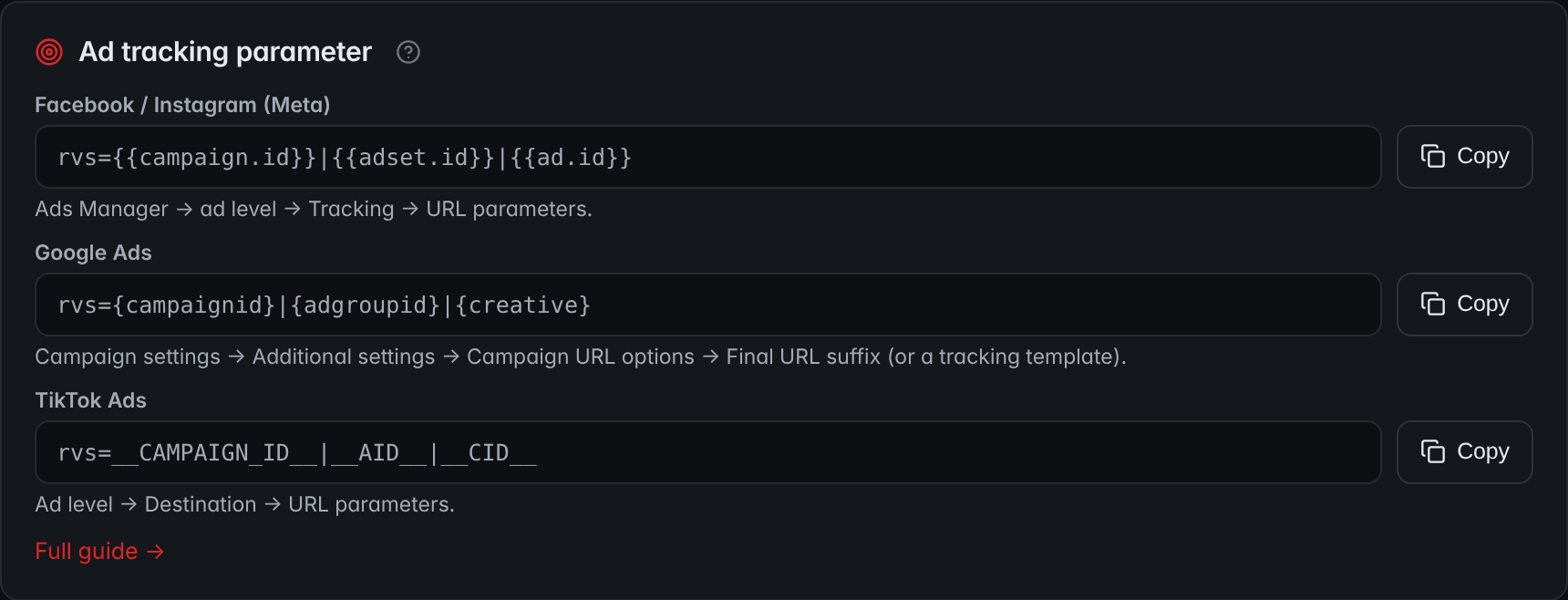
- MetaThe rvs line for Facebook and Instagram ads carries the campaign, ad set and ad IDs, added in Ads Manager at the ad level.
- Google AdsThe same key for Google Ads, added as a final URL suffix or a tracking template.
- TikTok AdsThe key for TikTok Ads, added in the ad's URL parameters.
Then judge ads the way Hopkins would: by money, not clicks. A worked example with two ads sending traffic to the same VSL:
Two ads, one VSL, judged by money
Worked example: two ads sending traffic to the same VSL
More left after ad spendAd A
- Visitors: 4,000
- Cost per click: $0.80
- Orders at $79: 52
- Revenue: $4,108
- Revenue per visitor: $1.03
- Revenue minus ad cost: $908
Higher revenue per visitorAd B
- Visitors: 2,500
- Cost per click: $1.10
- Orders at $79: 41
- Revenue: $3,239
- Revenue per visitor: $1.30
- Revenue minus ad cost: $489
Ad B looks better on revenue per visitor because its visitors buy more often. But its clicks cost more, so after ad spend, Ad A earned almost twice as much before product costs. No single metric tells the story; the comparison does. That's the point of keying everything. For the formulas behind RPV, EPC and break-even math, see revenue per visitor.
A Hopkins-style testing playbook for VSLs
Hopkins' method fits on an index card: guess, test cheaply, measure in money, scale what wins. As a procedure:
The playbook, step by step
Guess, test cheaply, measure in money, scale what wins
1Write the hypothesis in one sentence
What happens: For example: "A story lead will hold cold viewers longer than our promise lead, and more of them will reach the pitch."
2Test what changes belief first
What happens: Start with the offer, the lead and the big idea, because they change what the viewer believes or gets. Page details like button colors come later.
3Set a budget you can afford to lose
What happens: Hopkins tested in a few towns; you test with a small, fixed daily spend.
4Split traffic evenly and keep it sticky
What happens: Each new visitor gets one version and keeps seeing it, so a returning visitor doesn't see both.
5Run full weeks
Why it matters: Traffic quality often shifts by day of the week.
What goes wrong:
- A test that runs Tuesday to Thursday describes Tuesday to Thursday.
6Judge by revenue per visitor, with guardrails
What happens: Watch refund rate and cost per acquisition alongside it.
7Know how much traffic you need before you start
What happens: As a worked calculation: telling a 2.0% conversion rate from 2.4% with 95% confidence and 80% power takes roughly 21,000 visitors per version in a standard two-proportion test. Telling a 55% play rate from 60% takes about 1,500 per version.
Why it matters: That's why early-funnel tests finish fast and offer tests take patience.
8Scale the winner, then keep measuring
Why it matters: Results often soften at higher spend, as you reach colder audiences.
Size step 7 for your own test: put in your current conversion rate and the smallest lift worth finding.
Calculator
A/B test sample size calculator
How many visitors each version needs before a difference in conversion rate means something.
- Visitors in all
- Days at your traffic
- Orders per version at the current rate
95% confidence and 80% power, the usual defaults for comparing two conversion rates. Fix the sample before you start and read the result when it is reached: stopping the moment one version pulls ahead finds winners that aren’t there. With more than two versions, each is compared with the control and needs this many visitors.
On the Growth plan and up, RevvyScales can run headline, poster, offer and playback-speed variants inside one VSL. Each variant is shown by the weight you set, each viewer keeps seeing the same one, and analytics break results down per variant, so you can judge each one by revenue per visitor (split tests inside a VSL). For the statistics in more depth, see VSL A/B testing.
Specifics beat generalities: rewriting VSL claims
Hopkins' point about specifics is the easiest one to apply this week. Go through your script and find every adjective doing the work a fact should do.
One claim, rewritten
A fictional pool robot
GeneralitiesBefore
TideBot is the most powerful pool cleaner on the market, with amazing suction and incredible battery life.
SpecificsAfter
TideBot climbs the walls and scrubs the waterline, runs for 150 minutes on a charge, and floats a handle to the surface when it's done, so you never fish for it with a pole.
TideBot is fictional, and so are its specs. Three more rewrites, for a fictional bookkeeping app called Ledgerly:
- "Saves you hours" becomes "Sorts each bank transaction into a tax category as it arrives, so month-end means reviewing the handful it flagged."
- "Easy setup" becomes "Connect your bank, choose your business type, and the first categories appear while you watch."
- "Trusted by thousands" becomes a documented number, or it gets cut. A specific you can't prove is worse than a vague one.
That last rule isn't optional. The FTC's guidance for advertisers says ads must be truthful and non-deceptive and that you need proof for your claims before the ad runs (FTC Advertising FAQs). This isn't legal advice, but the practical rule is simple: every number on screen needs a document behind it.
Offer service: demos, samples and value-first VSLs
Hopkins' best ads opened by giving something. In a VSL, service looks like this:
Service before the sale: four checks for your VSL
0 of 4 done
Headlines that pick out the right viewer
Hopkins wanted headlines that select, not headlines that dazzle. Above a VSL, that means naming the person and the situation the offer is for, so the right viewer presses play knowing the video is for them. Three variants for TideBot, each picking a different reader:
- "For pool owners who spend Saturday mornings with a skimmer net"
- "Why the waterline ring keeps coming back, and how to stop scrubbing it by hand"
- "The pool robot that floats its own handle to the surface"
Run them against each other on the same traffic and judge by unmute or play rate first, then pitch reach and revenue. John Caples, who began writing mail-order ads a few years after the book appeared, built his career on the same kind of testing; see what John Caples' headlines teach.
What's outdated in Scientific Advertising
- The media. Coupons, dealers and town-by-town tests are gone. The method survives; the tools changed.
- His dislike of negative advertising. Many VSLs open on the problem, and for problem-aware viewers that can be the right call (see the levels of awareness). Treat his rule as a hypothesis to test, not a law. If you name a problem, keep it true and proportionate; fear-mongering invites complaints and ad-policy trouble.
- Long copy as a default. Mail order taught him that interested readers want the full story. For a VSL, the full story means everything the buyer needs to decide, not everything you know. Length should follow price, awareness and how warm the traffic is.
- His era's claims. He also worked for a patent medicine company. Take his habit of measuring, not his era's habits of claiming.
- Clean attribution. A coupon was unambiguous. Today, ad platforms model some conversions and use different attribution windows, so their numbers and yours rarely match exactly. Keep your own sales records by click ID as the source of truth and treat platform reports as a second opinion.
How to apply this to your VSL tomorrow
- Check that every sale can be traced to a campaign, an ad and a VSL version. If one link in the chain is missing, fix tracking before you test anything.
- Pull the last 14 days of revenue by ad and rank ads by revenue minus ad cost, not by click-through rate.
- Write one hypothesis for your biggest lever, usually the lead or the offer, and set a test budget you can afford to lose.
- Work out the traffic you'll need before launching, and commit to running full weeks.
- Replace the three vaguest claims in your script with specific, documented facts.
- Move your demonstration earlier, or add one if the product can be shown working.
- Read your headline and ask whether it picks out the right viewer or tries to please everyone.
- Log every test: hypothesis, dates, traffic, result and decision. Hopkins' real advantage was his records.
Frequently asked questions
Is Scientific Advertising still worth reading?
Yes, for the method more than the examples. Hopkins' core ideas, judging ads by sales, keying every ad so results can be traced, testing small before spending big and preferring specific claims to vague ones, map directly onto modern tracking and split testing. His media and some of his views have aged, so read it for how to think about advertising, not for tactics to copy word for word.
What is keyed advertising?
Keyed advertising means giving each ad a code, on a coupon, in an address or today in a link, so every response can be traced to the ad that produced it. Hopkins used keyed returns to compare ads and headlines by actual responses. The modern equivalent is URL parameters on each ad and a unique click ID for every click on the buy button, matched to the sale.
What is the main lesson of Scientific Advertising?
That advertising should be judged like salesmanship, by the sales it produces and what each sale costs, and that questions about what works should be settled by measured tests rather than opinion. Everything else in the book, from headlines to samples to specific claims, follows from that idea. For a VSL, it means deciding by revenue per visitor and tracked sales.
How is Scientific Advertising different from My Life in Advertising?
Scientific Advertising, published in 1923, is a book of principles: how to write, test and judge advertising. My Life in Advertising, published in 1927, is Hopkins' autobiography, covering his career and campaigns. If you only read one, start with Scientific Advertising for the method, then read the autobiography for the stories behind it.
What did David Ogilvy say about Scientific Advertising?
Ogilvy was one of the book's best-known admirers. He said that nobody should be allowed to have anything to do with advertising until they had read it seven times, and that it changed the course of his life. His praise is a big reason the book is still recommended to new copywriters a century after it was published.