
How to start a supplement company: 12 steps from idea to first sale
Starting a supplement company is twelve decisions in a fixed order: the customer, the channel, the formula, the ingredients, the numbers, the paperwork, the manufacturer, the label, testing, claims, payments and the launch. This is the path for a brand that will sell direct with video and paid traffic, with the primary sources linked at every step.
On this page
- What does it take to start a supplement company?
- Do you need FDA approval to start a supplement company?
- Step 1: Choose a customer and a problem you can honestly help with
- Step 2: Decide how you will sell before you formulate
- Step 3: Pick a formula route: stock, private label or custom
- Step 4: Check every ingredient before you commit
- Step 5: Work out the numbers before you ask for quotes
- Step 6: Set up the company, insurance and records
- Step 7: Choose a manufacturer that can prove its quality
- Step 8: Build a label that meets FDA rules
- Step 9: Test every lot and keep the paperwork
- Step 10: Write claims you can prove, then file the FDA notice
- Step 11: Set up payments once the site is finished
- Step 12: Launch small, then reorder on data
- What goes in a supplement business plan?
- A pre-launch checklist for a new supplement brand
- Frequently asked questions
To start a supplement company, choose one customer and one problem, pick a formula route (stock, private label or custom), check every ingredient is legal to sell and advertise, hire a cGMP manufacturer, build a compliant label, test each lot, price for paid traffic, write provable claims and set up payments. FDA approves neither the product nor, as a rule, its claims before sale: your company is responsible.
What does it take to start a supplement company?
Starting a supplement company, or any supplement business that sells under its own brand, means running three things at once: a product you usually don't make yourself, a label the law regulates, and a marketing operation that has to pay for its own traffic. If you hire a contract manufacturer, as this post assumes, the work that stays with you is choosing, checking and keeping records: the customer, the formula, the partner, the claims and the numbers.
The order matters because each decision narrows the next. The claim you can honestly make decides which ingredients make sense. The formula decides which manufacturers can make it. The label depends on the claims, and a payment processor reads the label, the site and the ads before it approves you. Here are the twelve steps in the order that avoids rework:
From idea to first sale in 12 steps
The order that avoids rework
- Customer and problemOne buyer, one problem, a benefit stated without naming a disease
- Sales channelYour own site with a VSL, a marketplace, or both
- Formula routeStock, private label or custom
- Ingredient checkLegal status, evidence at your dose, ad policies
- NumbersBundle prices, cost per customer, target landed cost
- Company and recordsEntity, insurance, trademark, the adverse event line
- ManufacturercGMP, an audit or certificate, a quality agreement
- LabelRequired statements, adverse event contact, disclaimer
- TestingA certificate of analysis for every lot
- ClaimsEvidence for each claim, then the FDA notice within 30 days of launch
- PaymentsPolicies live, processor terms, a dispute plan
- Launch and reorderA first run sized to learn
Each step below says what to decide, what to ask and where the rules are. This isn't legal advice: every rule links to its primary source, and a regulatory lawyer should review your label and claims before the first order ships.
Do you need FDA approval to start a supplement company?
No. Under the Dietary Supplement Health and Education Act of 1994 (DSHEA), FDA has no authority to approve supplements before they are marketed, and it generally doesn't approve claims or labels before use either (FDA, Questions and Answers on Dietary Supplements). That cuts both ways. Nobody signs off on your product before launch, and the firm that makes or distributes it is responsible for making sure it isn't adulterated or misbranded.
Four rules apply from the first order:
- Registered facilities. Facilities that manufacture, process, pack or hold supplements must register with FDA before they begin, according to the same FDA page. Ask your manufacturer and your fulfillment warehouse for their registration.
- New ingredients need a notice first. An ingredient that wasn't marketed in the US before October 15, 1994 is a "new dietary ingredient". A supplement that contains one needs a notification to FDA at least 75 days before it enters interstate commerce, unless every ingredient has been in the food supply in a form that hasn't been chemically altered (21 U.S.C. 350b).
- Adverse event reports come to you. The label must give a domestic address or phone number for reports of serious adverse events, the same FDA page says. The company named on the label must forward each serious report to FDA within 15 business days and keep records of every adverse event report for six years, and filing one is not an admission that the product caused the event (21 U.S.C. 379aa-1).
- Good manufacturing practice. The cGMP rule, 21 CFR Part 111, applies to anyone who manufactures, packages, labels or holds a dietary supplement (21 CFR Part 111). Step 7 covers what that means when someone else does the manufacturing.
Claims have their own rules, covered in step 10: a structure/function claim needs FDA's disclaimer and a notice within 30 days after the product is first marketed, and the FTC expects every health claim in an ad to rest on competent and reliable scientific evidence.
FDA's consumer video on supplements shows how the regulator explains their benefits and risks to the people you will sell to:

Step 1: Choose a customer and a problem you can honestly help with
Start with a person and a problem, not an ingredient. "Recreational runners who want to recover between training days" gives you an audience to reach with ads, a story for the video and a reason to reorder. "A turmeric product" gives you a commodity and a price war.
Five questions sort good ideas from expensive ones:
| Question | A good answer | Where to check |
|---|---|---|
| Who buys it, exactly? | One person you can describe and reach with ads | Reviews of rival products, customer interviews |
| Can you state the benefit without naming a disease? | "Supports muscle recovery after exercise" | Structure/function claims |
| Is there human evidence at a dose you can afford? | Studies on the same ingredient and form, at your dose | Supplement clinical studies |
| Will they reorder? | A daily serving that runs out on a schedule | Your serving size and pack count |
| Can you advertise it where you plan to sell? | No ingredient on the platform's restricted list | Step 4 |
The second question kills the most ideas, and it's cheapest to answer now. A supplement can describe its effect on the body's structure or function, but the disclaimer every such claim carries says the product is not intended to diagnose, treat, cure or prevent any disease. If the only honest way to describe what your product does is to name a disease, choose another problem: the label, the video and the ads will all hit the same wall.
The fourth question is about the business model. Consumables run out on a schedule, which is what makes bundles on the first order and repeat orders after it possible (supplement subscriptions).
Step 2: Decide how you will sell before you formulate
The channel shapes the product. A brand that sells on its own site with a video sales letter and paid traffic needs a product with a story worth telling, a price that leaves room for the cost of each customer, and bundles that raise the order value. A marketplace listing lives on reviews, search position and price, next to competitors one click away.
- Your own site with a VSL. You own the customer, the data and the message, and you pay for every visitor. The claims, the policies and the payments are all yours to get right. The nutra marketing guide shows how the ad, the VSL and the order page fit together.
- A marketplace. Demand already exists, but the marketplace sets its own rules for supplements on top of the law, and you reach buyers on its terms. Read the category's current policy in your seller account before you plan around it.
- Both. Possible, but start with one, so your first months of numbers mean something.
The VSL route asks more of the product than a listing does. The video has to explain why the problem persists and why this formula is different, so you need a mechanism you can support, proof you can show and an offer built in bundles. If you can't tell that story honestly about a product, no video will rescue it.
If you choose the VSL route, the page matters as much as the video. In RevvyScales the offer, the guarantee and the buy button stay hidden until the pitch second you set (player features), and a scientific references block lists the studies behind your claims (comments and references).
Step 3: Pick a formula route: stock, private label or custom
There are three ways to get a formula. Suppliers use the names loosely, so ask each one what it means by them.
- Stock, often called white label: the manufacturer's existing formula with your label. It's the fastest route, and other brands may sell the same product.
- Private label: a stock base that is adjusted for you or reserved for you. What "private" covers varies, so get any exclusivity in writing.
- Custom formula: developed to your specification. It's the slowest route and needs the most testing up front, and it's the only one where you choose every ingredient, form and dose.
Three ways to get a formula
Minimums, lead times and prices vary by supplier: get them in writing
FastestStock (white label)
- The manufacturer's existing formula, your label
- Specifications and tests already exist
- Other brands may sell the same formula
- Your story must fit what is in the bottle
Middle groundPrivate label
- A stock base, adjusted or reserved for you
- Exclusive only if the contract says so
- Limited changes: dose, flavor, capsule
- Ask who owns the changes
Most controlCustom formula
- Built to your spec: ingredients, forms, doses
- New specifications and more testing up front
- A new dietary ingredient needs an FDA notice at least 75 days before sale
- Who owns it depends on the contract
Minimum order quantities, lead times and prices vary widely by supplier and by route, so don't plan around a number you read online. Ask each supplier for its minimum per flavor or SKU, its lead time from approved label to delivered stock, and its price at two order sizes. Then read two clauses before the price: who owns the formula (the brand is yours; the formula belongs to whoever the contract says), and which documents you receive with each lot.
The route also decides what your VSL can honestly say. A mechanism has to be true of the formula in the bottle, at the dose in the bottle (unique mechanism), and a stock formula's story is available to every brand that buys it.
Step 4: Check every ingredient before you commit
Run each ingredient through four checks before you approve a formula:
- Legal status. Was it marketed in the US before October 15, 1994, or has it been in the food supply in an unaltered form? If neither, plan for the 75-day notice described above, and get the supplier's answer in writing.
- Evidence at your dose. The FTC expects the ingredient or combination that was studied to match the product you advertise (Health Products Compliance Guidance). Check form and dose against every study you plan to cite.
- Ad policies. Meta bans ads for supplements it considers unsafe, "as determined by Meta at its sole discretion", and its open-ended list includes anabolic steroids, chitosan, comfrey, dehydroepiandrosterone, ephedra and human growth hormones (Meta Advertising Standards). Check every platform you plan to buy traffic on; the Facebook ads for supplements post covers Meta's other rules.
- Origin and allergens. Know where each ingredient comes from and which major allergens the formula contains before the label goes to print. Both decide what the label may and must say.
Step 5: Work out the numbers before you ask for quotes
A brand that sells with paid traffic lives on contribution per order: what is left of the price after the product, shipping, payment fees and refunds, before advertising. Work it out before you talk to manufacturers, so you arrive with the landed cost per unit your offer can carry instead of accepting whatever is quoted.
Price in bundles from the start. One shipping cost spread over three or six bottles raises the order value, and the bundle pricing post shows how to set the ladder. Then work backward from what you can pay to acquire a customer.
An example with made-up numbers: you plan a three-bottle bundle at $147. Shipping costs you $10, payment fees run 4% ($5.88) and you hold back 8% for refunds ($11.76). If you expect to pay $70 in ads per buyer and want $20 of profit on the first order, the three bottles can cost you at most $147 − $10 − $5.88 − $11.76 − $70 − $20 = $29.36, or about $9.79 a bottle landed. That ceiling, not a price you saw online, is the number you take to manufacturers. The break-even ROAS post runs the same math with a calculator.
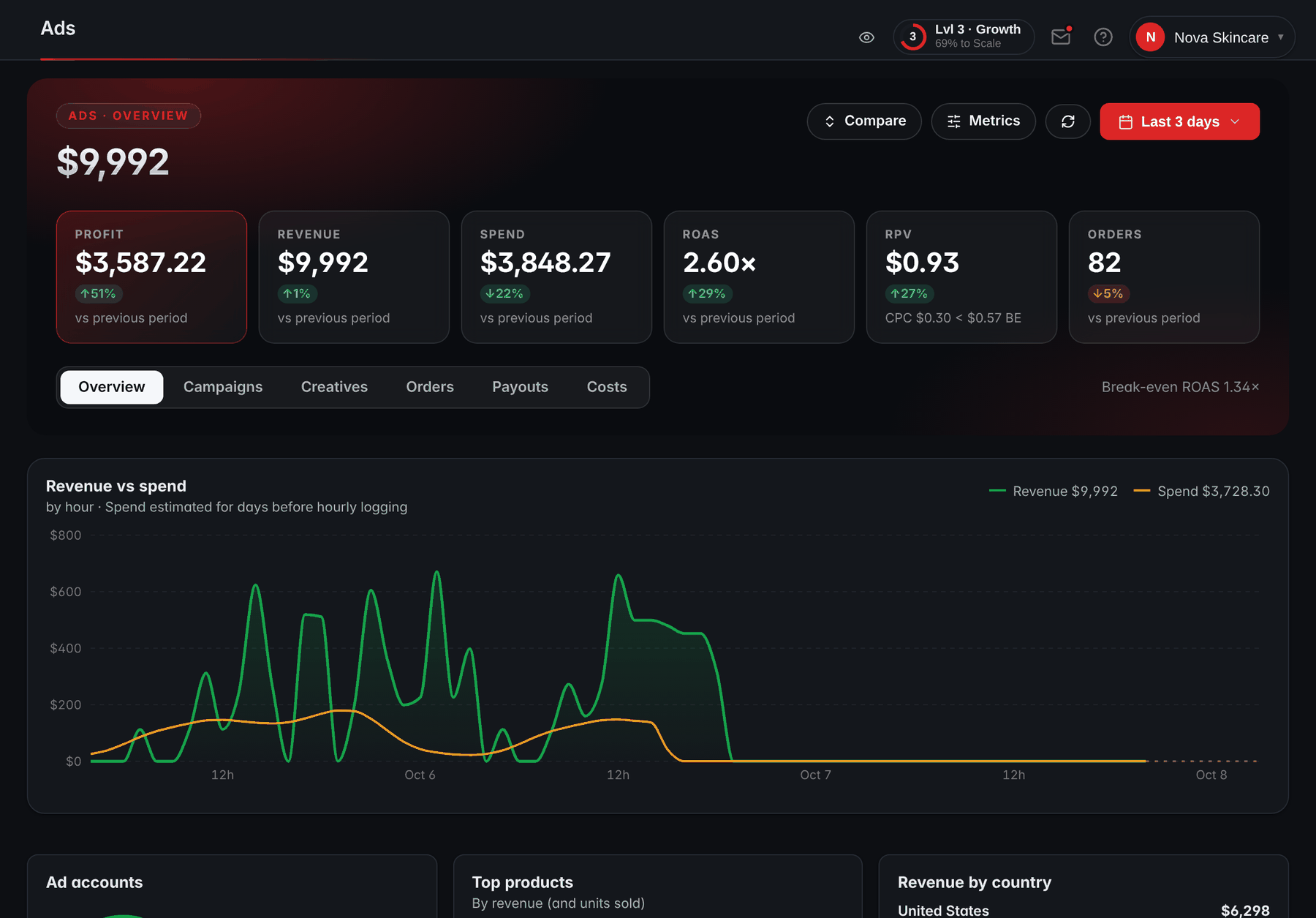
After launch, the same math has to run on real orders. RevvyScales profit tracking (Growth plan and up) subtracts Meta ad spend, product costs and gateway fees from revenue, and shows ROAS and margin by campaign (profit tracking).
Step 6: Set up the company, insurance and records
Do this before you sign anything with a manufacturer. It's paperwork, and it's easy to put off until a contract or a processor asks for it.
- Company. Form the legal entity and open its bank account first, so the manufacturing contract, the label and the merchant account all name the same business. Ask an accountant which structure fits.
- Insurance. Get a product liability quote from a broker who covers supplements, and ask your manufacturer and any retailer what coverage they require of you (what the policy covers).
- Brand name. Have the name cleared for trademark conflicts before you print a single label.
- The adverse event line. Decide who answers the address or phone number on the label, how a serious report reaches FDA within 15 business days, and where six years of records will live.
Step 7: Choose a manufacturer that can prove its quality
A contract manufacturer must follow Part 111. The rule requires written specifications, at least one test to confirm the identity of each dietary ingredient, a master manufacturing record for each formula and a batch record for each batch (21 CFR Part 111). Hiring someone doesn't move the responsibility, though. A firm is responsible for making sure the supplements it distributes aren't adulterated (FDA Q&A), so you need documents that show your product meets its specifications.
Before you sign, ask for:
Before you sign
0 of 4 done
The supplement manufacturer post has the full audit list, what each certification does and doesn't prove, and how to check FDA's records on a facility yourself.
Step 8: Build a label that meets FDA rules
FDA's labeling guide lists five required statements: the statement of identity, the net quantity of contents, the Supplement Facts panel, the ingredient list, and the name and place of business of the manufacturer, packer or distributor (Dietary Supplement Labeling Guide). On top of those come the domestic address or phone number for adverse event reports and, next to any structure/function claim, FDA's disclaimer.
The supplement label requirements post goes element by element, allergens included. Two decisions belong here because they're expensive to reverse after printing. The claims on the label must be the claims you'll make in the VSL and the ads, word for word or weaker. And any origin claim needs checking before it's printed (Made in USA claims). If you'll ship to California, read up on Proposition 65 warnings too.
Step 9: Test every lot and keep the paperwork
Part 111 requires product specifications for identity, purity, strength, composition and limits on contaminants, and finished batches must be verified against them, every batch or a subset chosen through a sound statistical sampling plan (21 CFR Part 111). Ask for a certificate of analysis (COA) for every lot, and read it before the stock ships: each result next to its specification, the test method, the lot number and the date.
Two habits protect you later. File every COA, specification and batch document you receive by lot, in one place. And send a retained sample to an independent lab from time to time, so the manufacturer's numbers aren't the only ones you have. The same rule requires reserve samples of each packaged lot to be kept for one year past the shelf life date, or two years from the last distribution if no date is used, so agree in writing who keeps yours and where. The certificate of analysis post shows how to read one line by line.
Step 10: Write claims you can prove, then file the FDA notice
A supplement may make structure/function claims, such as "supports muscle recovery after exercise". It may not claim, openly or by implication, to affect a disease or its characteristic symptoms, and FDA's rule counts implications made through the product name, the formulation, cited publications, pictures and symbols, among others (21 CFR 101.93). A picture that suggests a disease, or a disease study cited on the page, can turn a careful sentence into a disease claim.
Every structure/function claim needs this disclaimer next to it, or linked to it by a symbol such as an asterisk: "This statement has not been evaluated by the Food and Drug Administration. This product is not intended to diagnose, treat, cure, or prevent any disease." With more than one claim, it starts "These statements have not been evaluated". No later than 30 days after the product is first marketed, the manufacturer, packer or distributor must notify FDA of the claim's text.
Both FDA notices, on one timeline:
Two notices, in opposite directions
- At least 75 days before launchNew dietary ingredient noticeIf the formula contains one and no exception applies
- LaunchThe product is first marketed
- No later than 30 days afterStructure/function claim notice
The FTC judges the ads. Health claims need competent and reliable scientific evidence. For health benefits the FTC generally expects randomized, controlled human clinical trials, the evidence has to match your product, and testimonials are no substitute for research (Health Products Compliance Guidance). The supplement advertising rules post covers what that means for a sales video, and the VSL compliance guide covers testimonials and disclosures.
One list keeps all of it in order: every claim, the evidence behind it and every place it appears (label, VSL, page, ads, emails). Nothing ships with a claim that isn't on the list.
Step 11: Set up payments once the site is finished
Apply for payments when the site, the claims and the policies are final, so whoever reviews the application sees the business you'll actually run. Have these pages live first: a refund policy that matches your guarantee, shipping and delivery terms, a contact page with an email address and a phone number, a privacy policy and terms of sale.
Then ask each processor up front whether it accepts supplements and on what terms: reserves, volume limits, subscriptions. The high-risk merchant account post explains what to expect. Plan for disputes before the first one arrives: refund quickly, answer every email within a day, and check your chargeback ratio every week, not every month.
Step 12: Launch small, then reorder on data
Size the first production run to learn, not to get the lowest unit price. The first weeks tell you what no quote can: your real cost per customer, the bundle mix, refund requests by week and how many buyers come back.
Before the reorder, look at refunds and disputes by week of purchase, the share of buyers who order again, and how many days of stock you have left against the manufacturer's lead time. Reorder before you run out: a stockout stops ads that took weeks to tune.
What goes in a supplement business plan?
A supplement business plan doesn't need to be long. It needs to answer the questions a manufacturer, a processor and your own bank balance will ask, and each answer comes from a step above:
| Section | What to write | Steps |
|---|---|---|
| Customer and claim | Who buys, the problem, the benefit in structure/function words | 1 |
| Channel and offer | Where you sell, the bundles, the guarantee | 2, 5 |
| Product | Formula route, each ingredient's status, the evidence at your dose | 3, 4 |
| Unit economics | Price, landed cost, contribution per order, the most you can pay per customer | 5 |
| Operations | Company, manufacturer, testing, records, adverse event handling | 6, 7, 9 |
| Compliance | Label review, claims list, the date the FDA notice is due | 8, 10 |
| Cash | First production run, testing, insurance, the ad budget to learn, reorder timing | 5, 12 |
Write the cash section last. Plan the reorder from money you will actually have, not from forecast revenue, because the next production run has to be paid for while refunds from the first one are still coming in.
A pre-launch checklist for a new supplement brand
Tick these off before the first order ships, and run the list again before every new product:
Before the first order ships
0 of 12 done
Frequently asked questions
How much does it cost to start a supplement company?
There is no honest single number. The total depends on your formula route, each supplier's minimum order, testing, label design, insurance and the ad budget you need to find out what sells. Get written quotes from several manufacturers at two order sizes, add independent testing and an insurance quote, then size the ad budget from the most you can pay per customer. Treat any figure you read online as someone else's situation.
Do I need a license to sell supplements?
FDA does not license or approve supplements before they are sold. The facilities that make, pack or hold them must register with FDA, a new dietary ingredient needs a premarket notification, and a structure/function claim needs a notice within 30 days of first marketing. Your state and city may require a business license and sales tax registration, so check with them. This is not legal advice; a regulatory lawyer can confirm what applies to you.
How long does it take to launch a supplement brand?
It depends mostly on the formula route. A stock formula skips development; a custom formula adds formulation, samples, stability work and testing; a new dietary ingredient adds a notification that must reach FDA at least 75 days before sale. Label design, printing and payment approval can run in parallel. Ask each manufacturer for its timeline from approved label to delivered stock, in writing, and plan the launch around the slowest step.
Should my first supplement be private label or a custom formula?
A stock or private label formula is the faster way to test a customer and an offer, but you sell a formula other brands can buy too. A custom formula takes longer and needs more work up front, but it lets you choose doses that match the studies you cite and own a real difference. A sensible path is to test the offer on a stock formula and move to custom once it sells.
Who is responsible if a customer has a reaction to my supplement?
The company whose name is on the label is the responsible person for serious adverse event reports. It must send each serious report it receives to FDA within 15 business days and keep records of adverse event reports for six years, and filing a report is not an admission that the product caused the event. Product liability is a separate question for your insurer and your lawyer. This is not legal advice.
Sources
- Questions and Answers on Dietary Supplements — FDA
- 21 U.S.C. 350b: New dietary ingredients — Cornell LII
- 21 U.S.C. 379aa-1: Serious adverse event reporting for dietary supplements — Cornell LII
- 21 CFR Part 111: Current good manufacturing practice for dietary supplements — eCFR
- Dietary Supplement Labeling Guide: Chapter I, General Dietary Supplement Labeling — FDA
- 21 CFR 101.93: Certain types of statements for dietary supplements — eCFR
- Health Products Compliance Guidance (December 2022) — FTC
- Unsafe supplements — Meta Advertising Standards