
How to increase average order value: eight honest levers and how to judge them
Average order value is revenue divided by orders, and raising it lets you pay more to win each customer. This post covers eight ways to increase average order value for physical products sold with video, the honest version of each, what each can cost you in conversion, and how to judge every change by revenue per visitor.
On this page
To increase average order value, give buyers good reasons to put more in each order: multi-unit bundles, a relevant order bump, a one-click upsell after payment, a free-shipping threshold above your typical order, complementary products, a premium tier, a second-unit offer and, for repeat use, a clearly stated subscription. Then judge each change by revenue per visitor, because a lever that raises AOV can lower conversion.
What is average order value, and why does it set your ad budget?
Average order value (AOV) is revenue divided by orders. A store that takes $10,920 from 130 orders has an AOV of $84.
It matters because of what you can afford to pay for each order. An order's revenue first pays for the product, shipping and payment fees. What's left pays for the ad that brought the buyer, and then your profit. Say those costs take 40% of revenue: an $84 order leaves $50.40 for ads and profit. Raise AOV to $105 at the same cost share and the order leaves $63.00, which is $12.60 more you can spend to win each customer, or keep. That's why AOV sits behind your target CPA.
Two cautions before you chase it:
- AOV isn't profit. Revenue added at a thin margin, such as a deep discount or an add-on that costs you nearly what you charge, adds less than it seems. Check what each lever leaves after costs.
- Count upsells against the order they came from. If your checkout records a post-purchase upsell as a separate order, AOV per order drops even though each buyer spent more. Attach upsell revenue to the original order, or track revenue per buyer instead.
How to increase average order value: eight levers
Here are the eight, with the honest version of each. The sections below give the mechanism, the math and what each one can cost.
| Lever | How it adds to the order | Honest version |
|---|---|---|
| Bundles and quantity tiers | More units per order | Real per-unit savings |
| Order bump | A small add-on at checkout | Unticked box, price shown |
| One-click upsell | An offer right after payment | Plain price, easy "no" |
| Free-shipping threshold | Buyers add an item to qualify | Condition shown by the price |
| Complementary products | Items used with the main one | Pairings that make sense |
| Premium tier | A bigger or better version | A real offer, not a decoy |
| Second-unit offer | A discounted extra unit | Discount off your real price |
| Subscription | Repeat orders on a schedule | Terms before payment, easy cancel |
1. Bundles and quantity tiers
For a store built around one consumable, the bundle ladder is the first lever to get right, because it changes the size of every order rather than the share of buyers who accept an add-on. Offer one, three and six units with real per-unit savings, recommend the tier that matches how the product is used, and label it honestly.
The calculator turns bundle prices and the share of buyers who pick each one into an average order value. It starts with an example store: one bottle at $49, three at $129 and six at $222, with 45%, 40% and 15% of buyers choosing each.
Calculator
Average order value from your bundle mix
Prices and the share of buyers who pick each bundle.
- Bottles per order
- Versus selling only single bottles
- Shares add up to
The shares are scaled to 100% if they don’t add up exactly.
Against a page that sells only single bottles at $49, that mix more than doubles AOV, to $106.95. The bundle pricing post covers how to set the tiers, size the discount steps and label them.
2. Order bumps
An order bump is a small add-on offered on the checkout page and added with one tick: a travel pack, a second flavor, a companion product. It works because the buyer has already decided. A small, relevant addition next to the payment form is an easy yes.
The honest version starts unticked, shows its price next to the box, and adds nothing unless the buyer ticks it. FTC staff's 2022 report on dark patterns lists tricking shoppers into buying unwanted items with a pre-checked box, and sneaking products into online carts without the shopper's knowledge, among the practices it describes (Bringing Dark Patterns to Light). A bump the buyer didn't choose is also a refund request waiting to happen.
The math is simple: if 25% of buyers add a $14 bump, AOV rises by $3.50. The cost to watch is checkout completion. A cluttered checkout can lose orders, so compare the share of buy-button clicks that become orders before and after you add it.
3. One-click upsells
A one-click upsell is an offer shown right after payment, which the buyer can add without typing their card details again, if your checkout supports it. Because it appears after the sale, it can't lower front-end conversion. It can raise refunds and disputes if it feels like a trap.
The honest version says plainly what the product is and what it costs, makes "No thanks" as easy to find as "Yes", and offers something that follows from what the buyer just bought. If 15% of buyers take a $39 upsell, AOV rises by $5.85, provided you count it against the original order.
4. Free-shipping thresholds
For stores with several products, a free-shipping threshold above the typical order gives buyers a reason to add one more item (where exactly to set it depends on how your orders are spread). Say orders under $60 pay $6.95 shipping and a typical cart is $45. A buyer who adds a $19 item pays $64 and ships free: you gain $19 of revenue and give up $6.95 of shipping income on that order.
State the condition where the price is. The FTC's guide on "free" offers says the conditions of a free offer should be set out clearly and conspicuously at the outset, and that an asterisked footnote doesn't count as disclosure at the outset (16 CFR Part 251). In a single-product funnel, free shipping on bundles does the same job as a threshold. The opposite model, where the product is free and the buyer pays only shipping, has its own math in the free plus shipping post.
5. Complementary products
Products used with the main one raise the order without discounting it: a shaker with a powder, a refill with a dispenser, a case with a device. Offer one or two on the offer page or at checkout. More than that turns a simple decision into a shopping trip. The honest version pairs things people really use together; a random extra item is noise.
6. Premium tier
A premium tier is a bigger or better version at a higher price: a larger supply with a printed guide, faster shipping, a larger size. It raises AOV for the buyers who want more, and it gives the standard option a reference point. Build it as a real offer you're glad to sell. A tier that exists only to make another one look cheap tends to produce confused buyers and refund requests.
7. Second-unit and gift offers
Plenty of products get shared in a household or bought as gifts. An offer to add a second unit at a discount, such as "add one for your partner at $15 off", raises AOV with buyers who would otherwise order twice or not at all. Base the discount on the price you really charge, and don't invent urgency around it.
8. Subscriptions with clear terms
A subscription usually lowers the value of the first order, because subscribe-and-save comes with a discount, and then adds the orders that follow. It raises revenue per customer more than AOV, unless you sell prepaid multi-month plans.
The rules are strict. In the US, the Restore Online Shoppers' Confidence Act requires sellers of online subscriptions to disclose all material terms clearly before collecting billing information, get the buyer's express informed consent before charging, and provide a simple way to stop recurring charges (15 U.S.C. 8403). The supplement subscription post covers offer design and the state rules. This isn't legal advice.
What does each lever cost in conversion rate?
Nothing here is free. A lever that adds to the order can also take away buyers: a bigger default bundle can put off cold visitors, a busy checkout can lose orders, and a premium tier can slow the decision. The only way to know is to test, and the example below shows the trade-off with illustrative numbers.
The example store starts by selling single bottles at $49. It adds the bundle mix from the calculator, then a $14 bump taken by 25% of buyers, then a $39 upsell taken by 15%:
Average order value as each lever is added
Illustrative store
AOV more than doubles. But in this example the page with bundles, a bump and an upsell also converts fewer visitors, 2.6% instead of 3.0%:
| Single bottle only | Bundles, bump and upsell | |
|---|---|---|
| Conversion rate | 3.0% | 2.6% |
| Average order value | $49.00 | $116.30 |
| Revenue per visitor | $1.47 | $3.02 |
Here the trade is worth it: fewer buyers, each worth far more. Now the opposite case. Replace the $14 bump with a $29 one that 20% of buyers take, and AOV rises to $118.60. If the heavier checkout drops conversion to 2.4%, revenue per visitor falls to $2.85. AOV went up, and the page earns less from each visitor.
How to measure AOV changes with revenue per visitor
Revenue per visitor (RPV) is revenue divided by unique visitors, which is the same as conversion rate times AOV. It catches both sides of every lever at once. Profit per visitor goes one step further: RPV times your contribution margin, minus what each visitor cost in ads. The revenue per visitor guide covers both, plus the sample-size traps.
Look at every step between the visit and the last offer, not just the total. In this illustrative week, the buy button, the checkout and the upsell each have their own rate:
From visit to upsell
Illustrative week, 10,000 visitors
- Visitors10,000
- Clicked the buy button6.2% of the step before620
- Placed an order41.9% of the step before260
- Took the upsell15% of the step before39
If you add a bump and the share of buy clicks that become orders falls, the bump is costing you orders, whatever it adds to AOV. The upsell step tells you whether the post-purchase offer earns its place.
In RevvyScales, each VSL's analytics show revenue, unique visitors, CTA clicks, orders, conversion rate and RPV, with per-variant breakdowns when you test (reading your analytics):
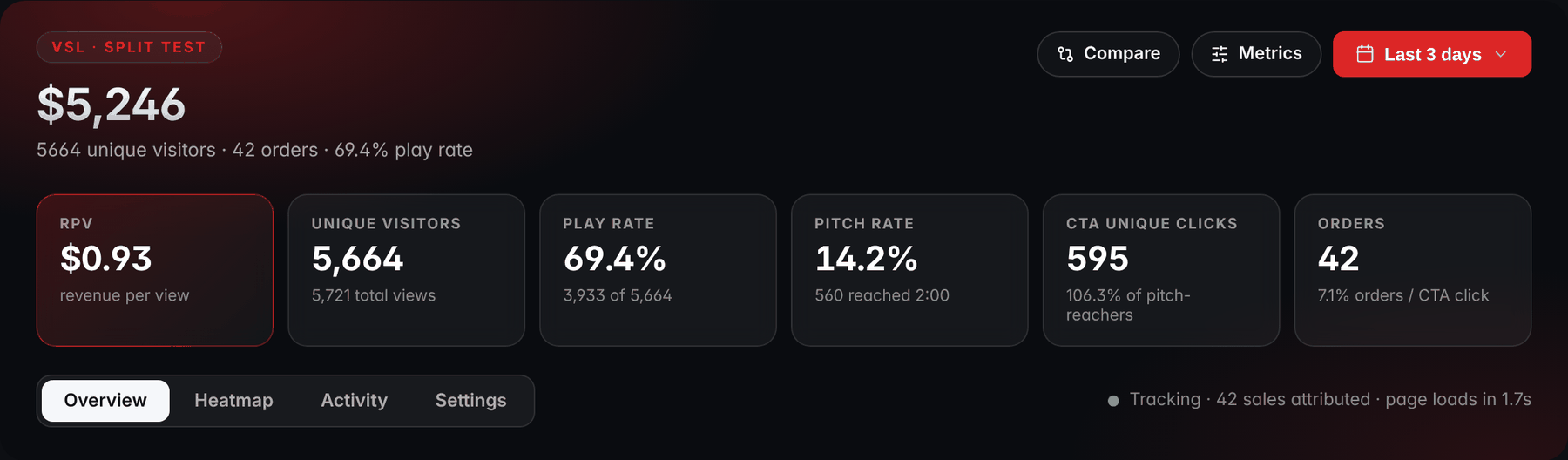
On the Growth plan and up, offer split tests show different bundles, prices or offer headlines inside one VSL by weight, and keep each viewer on the same version, so you compare per visitor from the start (offer split tests).
Whatever tool you use, the same discipline applies:
- Test one lever at a time, on the same traffic.
- Run tests over full weeks, so weekday and weekend buyers are both counted.
- Wait for enough orders that the difference isn't a handful of sales.
- Read the result again once refunds are in, after the guarantee window has closed.
Which lever should you test first?
A sensible order, from the least risk to front-end conversion to the most work:
- The bundle ladder, if you still sell single units only. It changes every order.
- A post-purchase upsell. It can't lower front-end conversion, because the order is already placed.
- An order bump. Small and quick to test, as long as you watch checkout completion.
- A free-shipping threshold, for stores with several products.
- Complementary products, a premium tier or a second-unit offer. Each adds a choice, so test them one at a time.
- A subscription. The biggest change, with the most setup and the strictest rules.
An AOV test checklist
Before you start the next test, tick these off:
Before each AOV test
0 of 7 done
Frequently asked questions
What is a good average order value?
There's no universal number. The right AOV is the one that pays for your traffic. Work backward: divide what you pay in ads per order by your contribution margin. If an order costs $50 in ads and 60% of revenue is left after product, shipping and fees, you need an AOV of about $83.33 just to break even on the first order. Anything above that is room for profit.
Does free shipping increase average order value?
Only when it asks for something. Free shipping on every order removes a cost for the buyer but gives no reason to add more. A threshold set a little above your typical order, or free shipping on bundles but not on a single unit, gives buyers a concrete reason to add an item. State the condition next to the price, not in a footnote.
Should an order bump be pre-checked?
No. Start it unticked, show the price next to the box, and add it only when the buyer ticks it. FTC staff's 2022 dark patterns report lists pre-checked boxes that trick shoppers into buying unwanted items among the practices it describes. A bump the buyer didn't choose can also come back as a refund request or a dispute, which costs more than the bump earned.
Do upsells count toward average order value?
It depends on how your checkout records them. Some add the upsell to the original order; others create a separate order, which makes AOV per order look lower even though each buyer spent more. Decide how you'll count it before you test, and keep the method the same for every arm. Revenue per buyer avoids the question altogether.
How long should an AOV test run?
Run it over full weeks so weekday and weekend buyers are both counted, and keep it going until each arm has enough orders that the difference isn't a handful of sales. Then wait for refunds, which means waiting out the guarantee window on the last orders. A test called early on revenue alone can pick the arm that refunds more.