
Payments, retention and operations
Selling supplements on Shopify: what Shopify Payments allows, what triggers a hold and when to add another gateway
Shopify's own rules don't ban supplements, but its payment service has limits of its own: a line on unverified health claims, and the Stripe list its US terms adopt. Here's what those pages say, what Shopify says leads to reserves and holds, what a third-party gateway costs you, and how the checkout connects to a VSL page.
On this page
- Where Shopify's supplement rules actually sit
- What "pseudo pharmaceuticals" means for a supplement brand
- What triggers a reserve or a hold on Shopify Payments
- Shopify Payments or another payment provider
- Subscriptions and trials: the version the list prohibits
- Connecting the checkout to your VSL page
- Before you sell supplements on Shopify
- Frequently asked questions
Yes, you can sell supplements on Shopify: its Acceptable Use Policy doesn't mention them. The limits come from Shopify Payments. Its eligibility page prohibits "pseudo pharmaceuticals", products making health claims no regulator has verified, and its US terms adopt Stripe's list, which bars nutraceuticals that are unsafe or make harmful claims. Without Shopify Payments you can add another payment provider, at an extra Shopify fee per order.
Four pages decide what a US supplement store can do on Shopify Payments, and only the last one names the product category:
Where the supplement rules sit for a US Shopify store
Checked on 21 October 2026, from the policy every store accepts to the list that names nutraceuticals
- Shopify Acceptable Use PolicyApplies to every store. No passage on supplements or health claims: you follow the law where you sell, and the terms of Shopify Payments and its processors apply too.
- Shopify Payments eligibilityProhibits "pseudo pharmaceuticals": products that make health claims not verified by a local or national regulatory body. Not exhaustive, and it varies by region.
- Shopify Payments Terms, United StatesNames Stripe, Bridge and PayPal as processors and adopts Stripe’s and PayPal’s lists. Restricted businesses need Shopify’s approval.
- Stripe’s prohibited and restricted listProhibits nutraceuticals that are unsafe or make harmful claims, trials with hidden pricing and deceptive testimonials. CBD with negligible THC needs approval.
Where Shopify's supplement rules actually sit
Shopify's Acceptable Use Policy is the rulebook every store accepts, and it has no passage on supplements, nutraceuticals or health claims. It asks you to follow the law wherever you do business, then points further down: Shopify Payments "involves an ecosystem of processors, card networks, and banks", and their terms apply to you too.
The first rule that touches supplements decides who may use Shopify Payments. Shopify's eligibility page lists six high-level categories of prohibited products. One of them, "Pseudo pharmaceuticals", covers pharmaceuticals and other products "that make health claims that are not verified by a local or national regulatory body". The page says the list isn't exhaustive and varies by region. It never uses the word supplement.
For US stores, the Shopify Payments terms name the processors behind the service, Stripe, its affiliate Bridge and PayPal, and adopt Stripe's and PayPal's lists of businesses. Some businesses are prohibited; others are restricted and "require additional review and approval" from Shopify. The lists are "meant to be representative but not exhaustive", and Shopify or the processors can add to them at any time without notice.
Stripe's US list, last updated on 22 September 2026, is where the category finally gets a name (Stripe). Here's what it says about the products and practices a supplement funnel touches:
What the list Shopify’s US terms adopt says
Stripe, Prohibited and Restricted Businesses, United States (updated 22 September 2026)
Not allowedProhibited
- "Pseudo-pharmaceuticals or nutraceuticals that are not safe or make harmful claims"
- Negative option marketing, and reduced-price trials with unclear or hidden pricing
- Businesses that make outrageous claims or use deceptive testimonials
- CBD above the legal THC limit
Needs approvalRestricted
- CBD with only negligible THC, within local limits
- Prescription-only products and pharmaceuticals sold card-not-present
- Online pharmacies and telemedicine
Not on the list by nameNot named
- Dietary supplements
- Peptides
- Hemp
Not named isn’t the same as approved: the lists aren’t exhaustive, and Shopify’s own pseudo-pharmaceuticals line still applies.
What the pages prohibit is unsafe products and harmful claims, plus two practices that have nothing to do with the bottle: trials with hidden prices and deceptive testimonials. Stripe's section on unfair and deceptive practices also carries a catch-all, "Any other businesses that Stripe considers unfair, deceptive, or predatory towards consumers", so treat the list as a floor, not a map of everything allowed.
Everything above is the US version. Shopify says its prohibited list varies by region, so a store based elsewhere should read its own country's eligibility page and terms.
What "pseudo pharmaceuticals" means for a supplement brand
Shopify's line turns on one phrase: health claims "not verified by a local or national regulatory body". In the US, FDA doesn't verify a supplement's claims before it goes on sale. It says it doesn't approve dietary supplements, and the structure/function claims they're allowed to make carry a disclaimer saying FDA hasn't evaluated them (FDA).
Put the two side by side and the question is plain: does a structure/function claim count as a health claim no regulator has verified? No Shopify page says. Merchants on Shopify's community forum report being refused Shopify Payments under this category, so put the question to Shopify before you build the funnel around Shopify Payments, not once the ads are running.
Disease claims aren't a gray area. In a July 2026 warning letter, FDA said a supplement seller's website claims made its products drugs, because they were "intended for use in the cure, mitigation, treatment, or prevention of disease", and unapproved new drugs at that (FDA). No payment provider fixes that.
What you control is the claims themselves. Keep each one within your evidence and within what a supplement may say, and keep it identical on the label, the store, the ads and the VSL. The structure/function claims post shows where the line sits.
What triggers a reserve or a hold on Shopify Payments
Approval isn't the last review. Shopify says accounts "are subject to standard reviews throughout the account's lifespan", and its help center describes two ways it can hold back your money (reserves, holds):
- A reserve holds back part of your sales, in some cases the full amount, for a set time, and you can generally keep accepting payments. It can be a fixed amount or a percentage held for a period (Shopify's example is a fixed reserve held for 120 days). Each has an expiry date, and Shopify reviews it to keep, reduce or raise it.
- A hold stops payouts. Customers can usually still check out, but "you won't be paid out for the orders until the hold is resolved", and in some cases the store can't take new orders. The reasons Shopify gives include details still to be verified, a business type or model that "might not be supported", product eligibility, sanctions, and creditor or legal action.
A hold is the one that hurts a paid-traffic brand most. Buyers keep checking out and the ad account keeps spending, but none of that revenue reaches your bank until the hold is lifted. Say a hold lasts two weeks while you spend an illustrative $1,000 a day on ads: $14,000 goes out before the sales it bought reach you.
So decide in advance who answers Shopify's emails, and send requested information the same day: the US terms say the processors may hold funds while they wait for information Shopify has requested.
None of the factors Shopify lists for a reserve mentions supplements. They describe how a business runs, and a VSL funnel can match all five at once:
Shopify’s five reserve factors, in a VSL funnel
Shopify’s factors, lightly paraphrased; the funnel examples are ours
Extended billing cycles
Shopify doesn’t define the term. The closest fit in a supplement funnel is a prepaid multi-month plan or a pre-order, where the buyer pays today for bottles that ship later.
Keep pre-order waits short, and say when each bottle ships.
Chargeback activity running high
Stripe says card networks typically give cardholders 120 days to dispute a payment (Stripe), so a launch month’s disputes keep arriving long after its sales.
Make the charge easy to recognize and refunds easy to get.
Increased refund rate
A money-back guarantee invites refunds by design. A rate that climbs after a new angle or a new VSL version is the signal to watch.
Count refunds against the month the orders were placed, not the month they were paid.
Industries with extended delivery timelines
Backorders, a slow warehouse or shipping from abroad stretch the time between the charge and the delivery.
State realistic ship times before checkout, and send tracking when the parcel leaves.
Significant volume surges
A winning ad can multiply orders in days, while the account’s history still describes a smaller business.
Scale in steps, and keep cash aside in case a reserve follows.
Matching one isn't a verdict on your product, but each can tie up cash you'd planned for ads. How reserves hold money back month by month, and what to ask a provider before you sign, is in the high-risk merchant account guide.
Shopify Payments or another payment provider
If Shopify Payments refuses you, Shopify's answer is one line: "If you aren't eligible for Shopify Payments, then you can add a third-party payment provider." Before you do, count what changes (third-party providers):
- A Shopify fee on every order. Third-party transaction fees apply to every transaction through a third-party or alternate gateway, on top of the provider's own processing fees. The rate depends on your Shopify plan (pricing), and refunds don't return it. PayPal escapes the fee when Shopify Payments is the store's main provider, so a store without Shopify Payments can't count on that exemption either (fees).
- No Shop Pay. "Shop Pay is included as part of Shopify Payments" (Shop Pay), so a store without Shopify Payments doesn't get it.
- A second review. Expect the new provider to look at your business at least as closely as Shopify did.
Which way to go depends on your product and on where your application stands:
Shopify Payments or another provider?
Three questions about your product and your application
Does the product, its name or its marketing claim to treat, cure or prevent a disease?
Does the product contain CBD?
Where does your Shopify Payments application stand?
Best fit
Fix the claims before you pick a provider
The product, its name or its marketing claims to treat, cure or prevent a disease. No provider fixes that: FDA treats such a supplement as an unapproved new drug, Shopify Payments prohibits products with health claims no regulator has verified, and Stripe’s list prohibits nutraceuticals that make harmful claims.
Read more: Structure/Function Claims: Rules, Examples, Disclaimer
Best fit
Ask Shopify before you build: CBD needs approval at best
The product makes no disease claims but contains CBD. On the Stripe list that Shopify’s US terms adopt, CBD with only negligible THC within local limits is restricted and needs approval, and CBD above the legal THC limit is prohibited. Get the answer in writing, and plan as if you’ll need another provider.
Best fit
Stay on Shopify Payments, and plan for reviews
The product makes no disease claims and contains no CBD, and Shopify Payments approved the account. Keep it: Shop Pay comes with it and no third-party fee applies. Reviews continue for the life of the account, so keep the claims, ship times and subscription terms you applied with, and keep cash aside for a reserve.
Best fit
Add a third-party provider
The product makes no disease claims and contains no CBD, but Shopify Payments refused the account. Shopify lets you add a third-party provider: budget for its fees plus Shopify’s third-party transaction fee on each order, expect its own review, and plan the checkout without Shop Pay.
Read more: High-Risk Merchant Accounts for Supplement Brands
Best fit
Apply when the store is finished
The product makes no disease claims and contains no CBD, and you haven’t applied yet. Apply once the store and the VSL page are finished, with the claims, ship times, refund policy and subscription terms you’ll actually use, so the review sees the business you’ll run.
Subscriptions and trials: the version the list prohibits
Stripe's list doesn't mention subscriptions by name. Its prohibited section names negative option marketing, negative option membership clubs and "reduced price trials with unclear or hidden pricing", without saying whether the pricing condition covers all three or only the trials. Read either way, it rules out the offer whose buyer can't see what they're agreeing to. If your offer renews on its own, ask your provider how it reads that line before you launch.
The honest version is also the legal one. ROSCA, the federal law on negative-option offers sold online, requires you to disclose all material terms before taking billing details, get express informed consent before charging, and give a simple way to stop the charges (15 U.S.C. 8403). Visa's rules for free trials that turn into subscriptions, effective April 2020, add a reminder with a cancellation link at least seven days before the first recurring charge, and let issuers use a misrepresentation dispute when the cardholder wasn't clearly told about further billing (Visa). This is a summary, not legal advice; the state laws on top are in auto-renewal laws.
How to build a subscription offer people keep, and the churn math behind it, is in the supplement subscription post.
Connecting the checkout to your VSL page
Whichever provider takes the money, the VSL page works the same way: the buyer watches, picks a bundle and lands in your checkout. RevvyScales integrates with Shopify, Whop and CartPanda, and works with any checkout that can report the click_id back from its thank-you page, so each sale is credited to the VSL that made it (connect Shopify). The connections sit on one settings page:
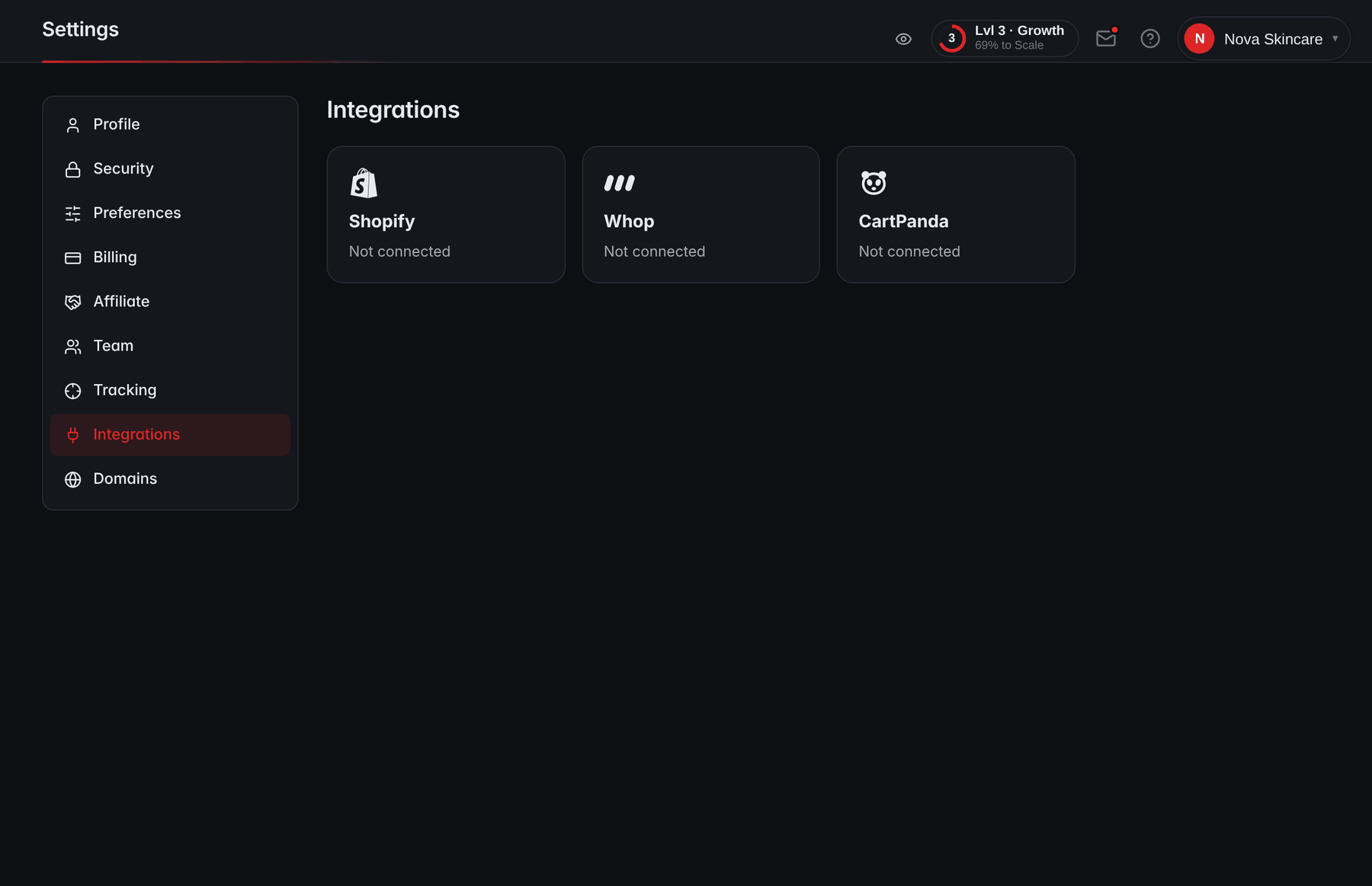
- ShopifyConnect the store here, and its sales are reported back to the VSL that made them.
- Whop and CartPandaThe other two checkouts RevvyScales connects to, for brands whose checkout runs there.
A VSL makes its claims out loud and at length, so the claims section above applies to every line of the script, not just the product page. How to send each bundle straight to Shopify checkout, track every sale and keep Meta from counting a purchase twice is in the VSL for Shopify guide.
Before you sell supplements on Shopify
Run through this with the store, the VSL and your subscription terms open:
Before you sell supplements on Shopify
0 of 9 done
Frequently asked questions
Can I use Shop Pay without Shopify Payments?
No. Shopify says Shop Pay is included as part of Shopify Payments and processed at Shopify Payments rates, so a store that takes payments through a third-party provider doesn't get it. Adding Shop Pay to a store on another platform also requires the business to be eligible for Shopify Payments. If Shop Pay matters to your checkout, settle your eligibility first.
How much is the third-party transaction fee on Shopify?
It depends on your Shopify plan, and the rates are on Shopify's pricing page. The fee applies to every transaction through a third-party or alternate gateway, on top of the provider's own processing fees, and refunds don't return it. Orders paid with Shopify Payments, Shop Pay, Shop Pay Installments or manual methods don't pay it, and PayPal is exempt when Shopify Payments is the store's main provider.
Can I sell supplements on the Shop app?
The Shop sales channel has its own merchant guidelines and product eligibility criteria, on top of Shopify's Acceptable Use Policy. Its prohibited-products page lists drugs and drug-related products, cannabis products, and medication, medical devices and accessories, but doesn't name supplements. Check your product, and the way you describe it, against the channel's criteria before you list it there.
Will Shopify Payments approve a supplement store?
No Shopify page promises it either way. Eligibility depends on your country, your business type and products, and compliance with the law and Shopify's terms, and Shopify says its list of prohibited products isn't exhaustive and varies by region. Merchants on Shopify's community forum report refusals under the pseudo-pharmaceuticals category, so apply with the store finished and have a second provider in mind.
How long does a Shopify Payments reserve last?
Each reserve has an expiry date, and Shopify reviews it to decide whether to keep, reduce or raise it. A reserve can be a fixed amount or a percentage of sales held for a period; Shopify's own example is a fixed reserve held for 120 days. You can generally keep accepting payments while it runs, so plan ad budgets around the payouts you'll actually receive.
Do I need FDA approval to sell supplements on Shopify?
No. FDA doesn't approve dietary supplements before they're marketed, and the company is responsible for the product's safety and its claims. Facilities that make, pack or hold supplements for US consumers must register with FDA, but FDA says a registration number doesn't mean it approves the facility or its products. So never call a supplement FDA approved, on Shopify or anywhere else.
Sources
- Shopify Acceptable Use Policy — Shopify
- Prohibited products on Shop — Shopify Help Center
- Shopify Payments eligibility — Shopify Help Center
- Shopify Payments Terms of Service, United States — Shopify
- Prohibited and Restricted Businesses (United States, updated 22 September 2026) — Stripe
- Overview of reserves in Shopify Payments — Shopify Help Center
- Shopify Payments account holds — Shopify Help Center
- Third-party payment providers — Shopify Help Center
- Third-party transaction fees on your Shopify bills — Shopify Help Center
- Shop Pay — Shopify Help Center
- Shop Pay on any platform — Shopify Help Center
- How disputes work — Stripe Docs
- Questions and Answers on Dietary Supplements — FDA
- Registration of Food Facilities: Small Entity Compliance Guide — FDA
- Warning letter, CMS 732724 (9 July 2026) — FDA
- 15 U.S.C. 8403 (Restore Online Shoppers’ Confidence Act) — Cornell LII
- Updated Policy for Subscription Merchants Offering Free Trials or Introductory Promotions — Visa