
AI VSL script: how to write a video sales letter with ChatGPT and other AI tools
AI can draft a VSL script in minutes; the hard part is making it true, specific and yours. This guide gives you a workflow that uses AI where it is strong, prompt skeletons written as briefs, a human review checklist, the rules on AI voices and avatars, and a way to test AI leads.
On this page
An AI VSL script is a video sales letter drafted with a language model such as ChatGPT, Claude or Gemini, then edited by a person. AI is fast at research synthesis, hook variations, outlines, tightening and translation. It is weak at original insight, a believable voice, compliance judgment and facts, which it can invent. Brief it like a junior copywriter and check everything it gives you.
Can AI write a VSL script?
It can write a draft, and a fast one. Whether the draft is any good depends almost entirely on what you feed it. A language model predicts plausible text from patterns, so without your research its default output is the average of every sales letter it has seen: familiar hooks, vague promises, generic proof. Your customer research is what makes it specific. Here is how the work splits, task by task:
What AI does well, and what you still own
Task by task
What AI does well
- Research synthesis: Grouping reviews, surveys and tickets into pains, desires and objections
- Hooks and headlines: Dozens of variations from one brief
- Outlining: Turning a brief into a timed beat sheet
- Drafting: Fast first passes at transitions, offer explanations and FAQs
- Editing: Shorter sentences, plainer words, consistent tense
- Translation and captions: First-pass localization and caption files
- Compliance: Flagging risky phrases for review
- Facts: Nothing reliable: it can invent studies, numbers and quotes
What you still own
- Research synthesis: Deciding which insight matters
- Hooks and headlines: Choosing, sharpening, testing
- Outlining: The big idea and the order of the argument
- Drafting: Voice, story, specifics
- Editing: Rhythm and emphasis
- Translation and captions: Native review and cultural fit
- Compliance: Every decision about claims
- Facts: Verifying every one
The same applies to tools sold as an "AI VSL generator." They wrap this process in a form, and their output is a first draft that needs the same review.
Why your prompt should be a brief
"Write me a VSL for my supplement" gets you the average VSL for a supplement. A brief gets you a draft built on your market. Write one document with these fields and start every prompt from it:
- Product and offer: what it is, what's included, bundles, guarantee, subscription terms.
- Customer: who buys and why, in their words. Paste real quotes from reviews, surveys, sales calls and refund reasons.
- Awareness and traffic: how much the viewer knows when they press play, and where they come from.
- Big idea and mechanism: written by you, one sentence each. See big idea copywriting and unique mechanism.
- Proof inventory: only what you actually have: studies with links, real testimonials used with permission, demonstrations, credentials.
- Constraints: claims you can't make (disease, income, guaranteed results), reading level, banned words, tone.
- Format and length: presenter, slides or UGC, and the runtime converted to words at about 150 per minute, the average US speaking rate according to the National Center for Voice and Speech.
The proof inventory does double duty. It tells the model what it may use, and it becomes the checklist for your fact review later.
A step-by-step AI VSL workflow
Eleven steps, from raw research to a live test:
The AI VSL workflow
- Gather raw research yourselfReviews, survey answers, support tickets, sales-call notes, refund reasons. AI can't interview your customers.
- Synthesize with AIAsk for pains, desires, failed solutions and objections, each with verbatim quotes. Spot-check the quotes against the source, because models sometimes paraphrase and present it as quotation.
- Choose the big idea and mechanism yourself, using the synthesis
- Write the brief
- Outline with AIA beat sheet with a word budget per beat for your target runtime. The beats are explained in the VSL script guide.
- Generate leadsTen to twenty openings across hook types. Pick the best three and write one of your own.
- Draft the body one section at a timeNot the whole script in one prompt. Short sections are easier to steer and to check.
- Edit for the earRead it aloud, have AI shorten sentences and mark stress, then hold a table read with the presenter.
- Run the claims audit, then a human compliance readAI flags; a person decides.
- Localize and captionTranslate with AI, then have a native speaker review it. RevvyScales takes a .vtt or .srt file per language and can turn one track on by default (subtitles and captions).
- Produce the cheapest decent version and test it
Prompt skeletons you can adapt
These are written as briefs, not magic words. Replace the capitalized placeholders in square brackets and keep the constraints; they do most of the work.
Five prompt skeletons
Replace the capitalized placeholders; keep the constraints
Prompt 1: research synthesis
Role: You are a direct-response researcher. Use only the material below. Do not add facts.
Material: [PASTE 50 TO 200 REVIEWS, SURVEY ANSWERS OR SUPPORT TICKETS]
Task: Group the material into pains, desired outcomes, failed solutions and objections. For each group, list the five most common themes with two verbatim quotes each.
Output: A table. Mark any theme backed by fewer than three quotes as weak.
Prompt 2: leads
Role: You are a direct-response copywriter writing a video sales letter. Follow the brief exactly.
Brief: [PASTE THE BRIEF]
Task: Write 12 openings of 60 to 90 spoken words: two each of story, contrarian, demonstration, question, warning and discovery hooks. Reuse customer phrases where they fit.
Constraints: No claim that isn't in the proof inventory. No numbers that aren't in the brief. Short sentences.
Output: A numbered list. After each opening, one line naming the objection it pre-empts.
Prompt 3: beat sheet
Brief: [PASTE THE BRIEF]
Task: Build a beat sheet for a [RUNTIME]-minute VSL at about 150 spoken words per minute. For each beat, give its job, its word budget and the open loop that carries the viewer into the next beat.
Constraints: The offer is first stated at [MINUTE]. Use only proof from the inventory.
Prompt 4: edit for the ear
Text: [PASTE ONE SECTION]
Task: Rewrite for spoken delivery: one idea per sentence, everyday words, contractions, sentences mostly under 15 words. Keep every claim exactly as strong as the original, never stronger. Put the words to stress in capitals.
Prompt 5: claims audit
Script: [PASTE THE SCRIPT]
Proof inventory: [PASTE THE INVENTORY]
Task: List every claim, stated or implied, in a table with the line, the claim, and the matching proof from the inventory or the words NO PROOF. Flag health, income, results, comparison, urgency and testimonial language.
Note: You are flagging, not approving. A person will decide.
The human review checklist
Run this on every AI-assisted script before anyone records it:
Nine checks before recording
0 of 9 done
AI voices and avatars: what to disclose
The script is only half of an AI-produced VSL. If an AI voice or avatar delivers it, another set of rules applies. The short version, as of this writing:
- AI testimonials are out. The FTC's Consumer Reviews and Testimonials Rule, in effect since October 21, 2024, bans fake testimonials, including AI-generated ones that claim to come from someone who doesn't exist or who had no actual experience with the product, and lets the FTC seek civil penalties against knowing violators (FTC announcement).
- AI presenters aren't banned. The FTC's Q&A on the rule says it has no blanket prohibition on AI-generated avatars in marketing, while warning that avatar use can still be deceptive under the FTC Act.
- Don't mislead people about what they're seeing. An FTC business blog post on chatbots, deepfakes and voice clones puts the test plainly: "Are you misleading people about what they're seeing, hearing, or reading?"
- Disclosure laws are arriving. New York now requires a conspicuous disclosure when an ad includes a synthetic performer, a digitally created human-looking performer (S8420A), and the EU's AI Act transparency rules, in effect since August 2026, call for deep fakes to be clearly labelled (European Commission).
If you clone a real person's voice or face, founder included, get their written consent first. The VSL presenter guide covers these rules in more detail and compares AI avatars with founders, actors and UGC creators.
How to test AI-written leads against human ones
Don't decide in a meeting whether the AI lead or the human lead is better. Let viewers decide.
- Hold the body constant. Swap only the first 60 to 90 seconds, and keep the pitch at the same second in both versions.
- Split traffic evenly, from the same sources in the same period, with each visitor kept on one version.
- Judge the lead by its job: retention at 30 and 60 seconds and pitch reach (visitors who reach the pitch ÷ all unique visitors). Then let revenue per visitor decide.
A worked example with illustrative numbers, 2,500 visitors per version; both percentages are shares of all visitors:
Human lead vs AI-assisted lead
Illustrative test: 2,500 visitors per version
Sold moreHuman lead
- Still watching at 60 seconds: 48%
- Reached the pitch: 20%
- Orders at $60: 50
- Revenue per visitor: $1.20
Hooked moreAI-assisted lead
- Still watching at 60 seconds: 55%
- Reached the pitch: 19%
- Orders at $60: 41
- Revenue per visitor: $0.98
The AI-assisted lead hooked more people, then lost them before the pitch and sold less. One likely cause is an opening that promises more than the body delivers. The next test writes itself: keep the AI lead's first 15 seconds and the human lead's transition into the body. And judge the lead, not where it came from.
In RevvyScales, upload each lead as its own VSL and put both in a folder, which splits new visitors and keeps each one on the same version (folders and A/B splits). For hook formulas to feed your prompts, see VSL hook examples.
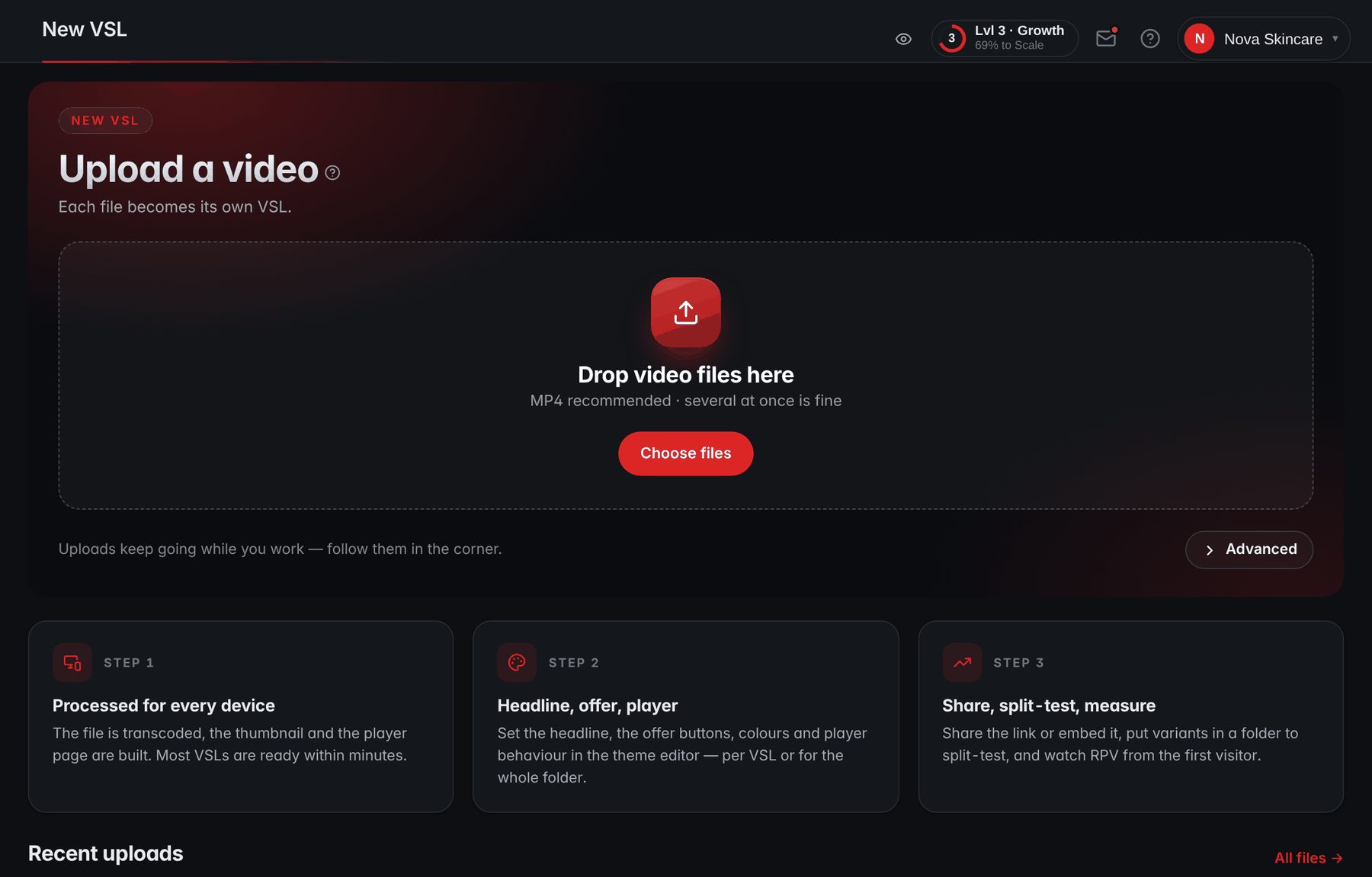
- One file, one VSLEach file you upload becomes its own VSL, so each lead gets its own version.
- Split-testPut the versions in a folder to split new visitors between them and compare revenue per visitor.
Mistakes to avoid
- One-line prompts. No research in, generic copy out.
- Letting AI supply proof. Invented studies, numbers and testimonials are the fastest route to legal and refund trouble.
- Shipping the first draft's voice. If it sounds like every other VSL, viewers will treat it like every other VSL.
- Asking the model whether a claim is legal and treating the answer as advice.
- Feeding it competitor scripts to rewrite. Reworded copying is still copying.
- Translating without a native speaker. Literal translations miss idioms, tone and local rules.
What to do next
- This week, collect at least 100 real customer quotes from reviews, surveys and support tickets.
- Write a one-page brief with a proof inventory.
- Run the synthesis, beat-sheet and lead prompts. Choose three leads and write one yourself.
- Draft section by section, edit for the ear, and run the claims audit followed by a human compliance read.
- Record the cheapest decent version and test two leads on the same body.
Frequently asked questions
Can ChatGPT write a VSL script?
Yes. ChatGPT and similar models can write a complete first draft in minutes, but the quality depends on the brief. Give it real customer quotes, the awareness level, your big idea, mechanism, offer and the proof you actually have. Then edit for voice, check every fact and claim, and test the result. Treat it as a fast junior writer, not a finished copywriter.
Is it legal to use AI-generated testimonials in a VSL?
Not if they present invented customer experiences. The FTC's Consumer Reviews and Testimonials Rule, effective October 21, 2024, bans fake testimonials, including AI-generated ones that claim to come from someone who doesn't exist or who had no real experience with the product, and the FTC can seek civil penalties against knowing violators. Use real customers' words with permission. This is not legal advice.
Do I need to disclose that AI wrote my VSL script?
The FTC rules covered in this guide focus on whether claims and endorsements are true, whoever drafted them. Disclosure questions mostly arise when AI appears on screen or in the voice: New York requires a conspicuous disclosure for synthetic performers in ads, and the EU calls for deep fakes to be clearly labelled. Check the rules in every market where your VSL runs.
What is the best AI tool for writing a VSL?
Any capable general-purpose model can draft a VSL; the brief matters far more than the brand. Choose one that handles long inputs well, since you will paste research and full scripts, and keep a library of your briefs and prompts so your results are repeatable. Tools marketed as VSL generators run the same process with a form in front of it.
Do AI-written VSLs convert as well as human-written ones?
There is no general answer, and anyone quoting one is guessing. Results depend on the research, the brief and the editing more than on who typed the first draft. The reliable way to find out for your offer is to test an AI-assisted lead against a human one on the same body and compare retention, pitch reach and revenue per visitor.
Sources
- Federal Trade Commission Announces Final Rule Banning Fake Reviews and Testimonials (August 2024)
- The Consumer Reviews and Testimonials Rule: Questions and Answers — Federal Trade Commission
- Chatbots, deepfakes and voice clones — FTC Business Blog (March 2023)
- Health Products Compliance Guidance — Federal Trade Commission
- New York Senate Bill S8420A: Requiring advertisements to disclose the use of a synthetic performer
- AI Act: regulatory framework for AI — European Commission
- Voice production tutorial — National Center for Voice and Speech